

A handheld thickness gauge and a thermal camera can both run on rechargeable lithium-ion batteries, but they handle a long day in the field differently. One instrument may accept an AA battery holder as a backup. Another may let the technician swap in a charged pack and get back to work. The battery type tells you how the device stores energy. The instrument’s design tells you what you can do when that energy runs low. For field inspections, both matter.
What Is a Handheld Inspection Instrument, and How Does It Work?
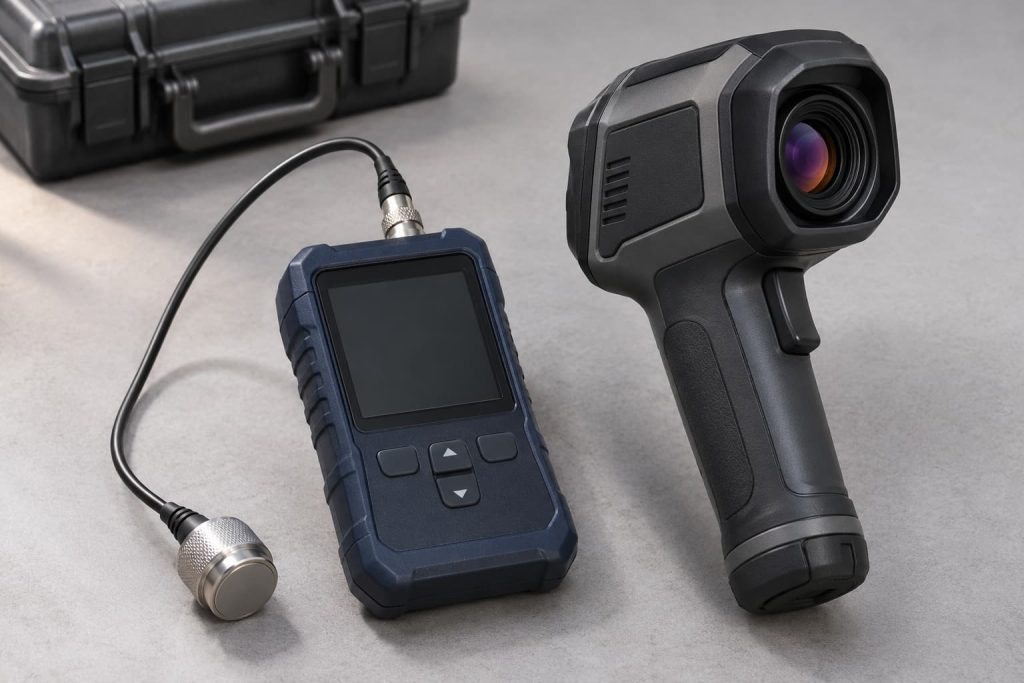
A handheld inspection instrument lets a technician take measurements at the equipment being checked. An ultrasonic thickness gauge sends a pulse into a material through a probe and uses the returning echo to determine thickness. A thermal camera shows temperature patterns on its display so the operator can inspect equipment and save images during a walk-through.
Think of a technician checking a series of pipes. At each point, they take a reading, check the result, and move on. A technician using a thermal camera might keep the display active while scanning several panels before saving an image. Those routines place different demands on the battery, even if both instruments spend the same amount of time away from an outlet.
Which Instrument Features Affect Battery Life?
Some functions run throughout an inspection. Others draw power when the operator takes a reading or transfers a file. To understand battery life, look at how often the technician uses each function and what the instrument does in between.
| Feature | What to account for during an inspection |
|---|---|
| Display | Brightness, time spent reviewing readings, and how long the screen stays on between measurements |
| Measurement system | Continuous scanning or individual readings, including how often the probe or sensor is active |
| Image or data capture | Saving occasional readings or recording for extended periods |
| Wireless transfer | Sending results after each measurement or storing them for export at the end |
| Sleep mode | How long the device stays active while the technician moves to the next inspection point |
For a new instrument, use the expected field routine to set the test conditions. If technicians need a bright screen outdoors, include that setting in the runtime test. If they export data before returning to the workshop, include that task too.
How Long Can a Handheld Instrument Run on One Charge?
Published runtime figures help when the test conditions resemble the job. Fluke lists two to three hours per battery for its Ti480 PRO thermal camera and says actual battery life varies with settings and usage. Use the figure as a reference for that model and check the specifications for any other instrument you are evaluating.
When comparing battery packs, watt-hours show each pack’s rated energy. To find out how much work that energy supports, run the instrument through a realistic inspection route. Count how many planned inspection points the technician can complete, then check whether the instrument can still save or export the last set of readings.
Can You Keep Working When the Main Battery Runs Low?
That depends on the instrument. Some models let you swap a rechargeable pack in the field. Others support a separate battery holder that takes an approved type of AA cell. Check the model’s manual for the supported power options and how to install them.
Also check how you will recharge the backup. For example, the Evident 38DL PLUS can run on rechargeable NiMH AA batteries in its designated holder. Those cells require a separate charger, so technicians planning to use that backup can charge them before leaving for the job.
Two Real Instruments, Two Power Options
| Instrument | Manufacturer-documented power options | What this means in the field |
|---|---|---|
| Evident 38DL PLUS ultrasonic thickness gauge | Rechargeable lithium-ion battery and a separate holder for supported AA alkaline or NiMH batteries | The AA holder provides a backup when recharging the main pack is inconvenient. Rechargeable AA cells need a separate charger. |
| Fluke Ti480 PRO infrared camera | Field-replaceable lithium-ion battery packs, with in-camera charging or a two-bay charger | A technician can carry a charged spare and recharge a depleted pack separately from the camera. |
What Battery Pack Makes Sense for a New Handheld Instrument?
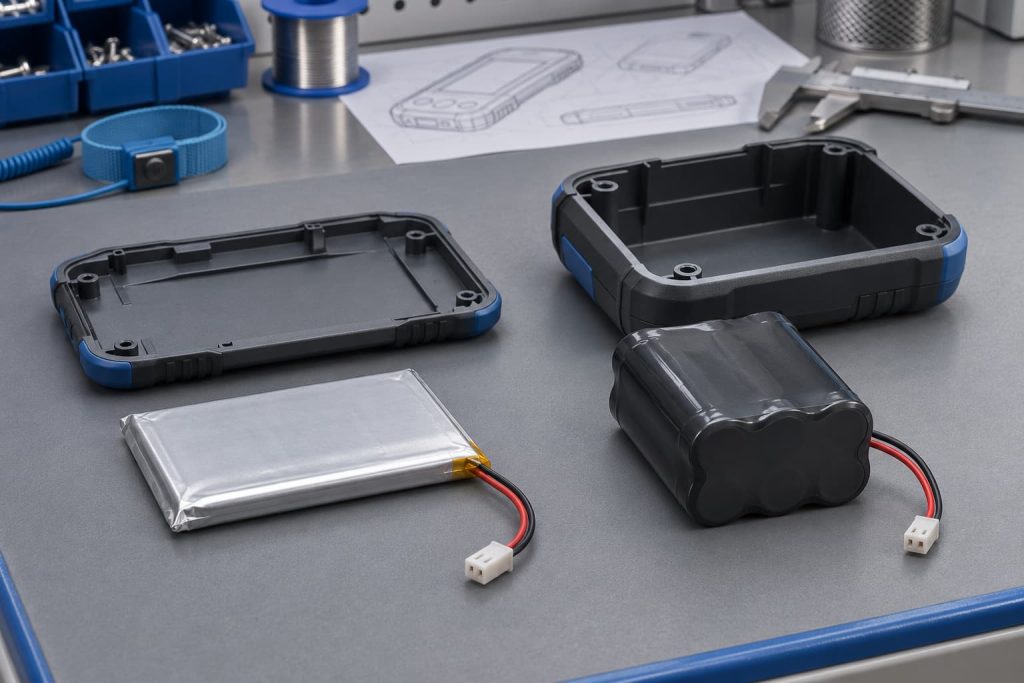
Start with the housing. A broad, shallow space behind the display may suit a flat polymer battery pack. Check the available thickness, the connector position, and how the wires will exit the pack. The battery and its wiring both need clearance when the cover is closed.
A deeper bay may have room for a cylindrical 18650 battery pack. Zenilove’s published 3.6 V, 10,400 mAh example measures 37.5 × 37.5 × 66 mm. That gives the enclosure designer a concrete layout to check against the available space, mounting points, and plug clearance.
Once you have a shortlist, compare the device input-voltage range, the current it draws during measurement, and the charging requirements. The cylindrical battery pack selection guide explains how those requirements affect the pack configuration.
If a standard layout leaves too little room for the plug or wiring, review which dimensions and connection details can change. Zenilove’s custom battery solutions cover options such as pack structure and connector integration. A battery-bay drawing, the device’s input-voltage range, and a target runtime give the engineering team a starting point for evaluating fit.
Frequently Asked Questions
Do all handheld inspection instruments use lithium-ion batteries?
Power options vary by model. Some instruments use a rechargeable lithium-ion pack and also support an approved AA holder. Check the instrument manual for the battery types and accessories it supports.
Will a higher-capacity battery always give longer runtime?
Compare the rated energy in watt-hours, then test the candidate packs using the same instrument settings and inspection sequence. Display brightness, measurement time, and wireless functions can change the result.
Can I use a replacement pack if the connector fits?
For an existing instrument, confirm the manufacturer’s approved replacement part number. For a new design, review the voltage range, connector pinout, charging requirements, and physical fit together.