
Cart Total Items (0)

Cart

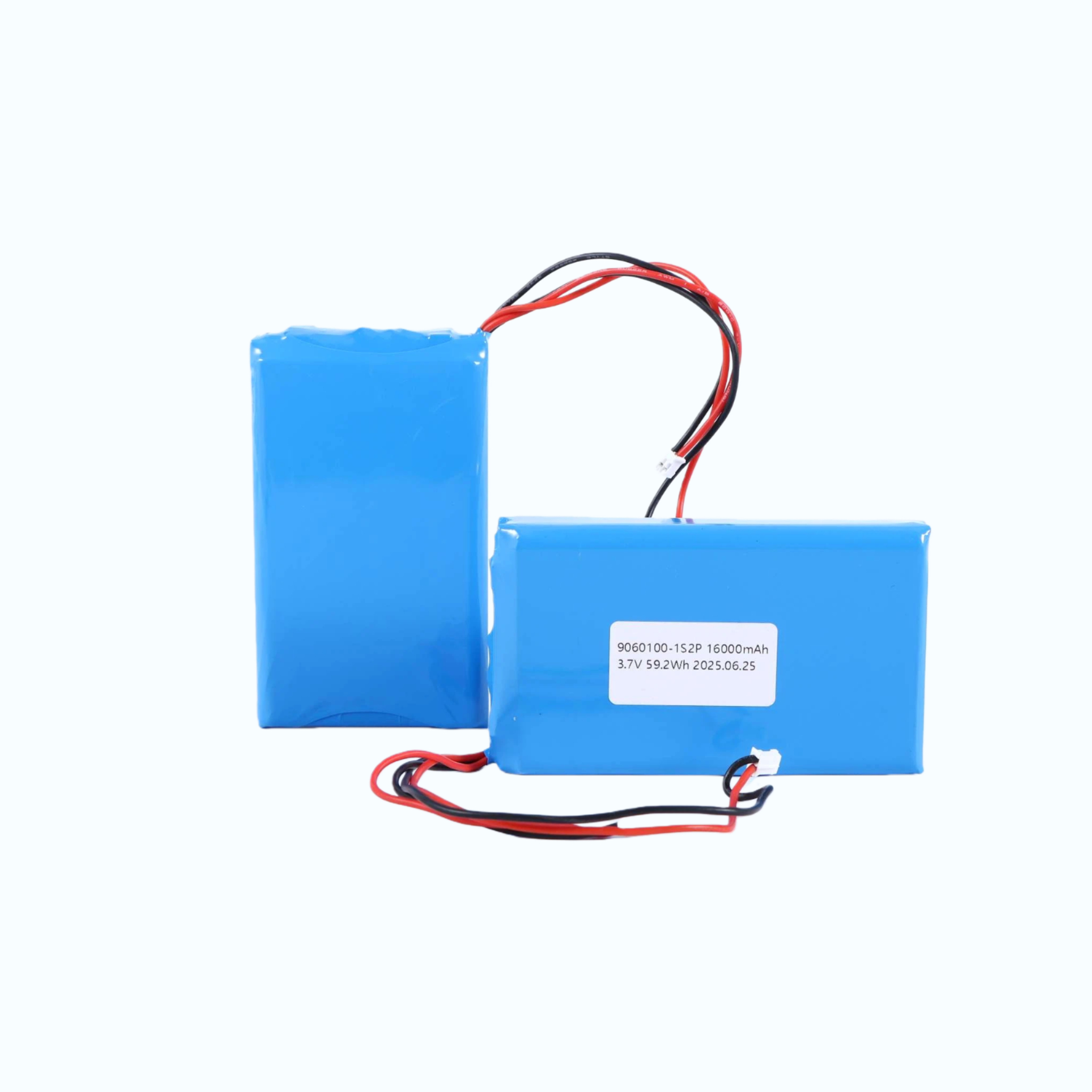
16000mAh 3.7V Polymer Battery Pack – 9060100 1S2P

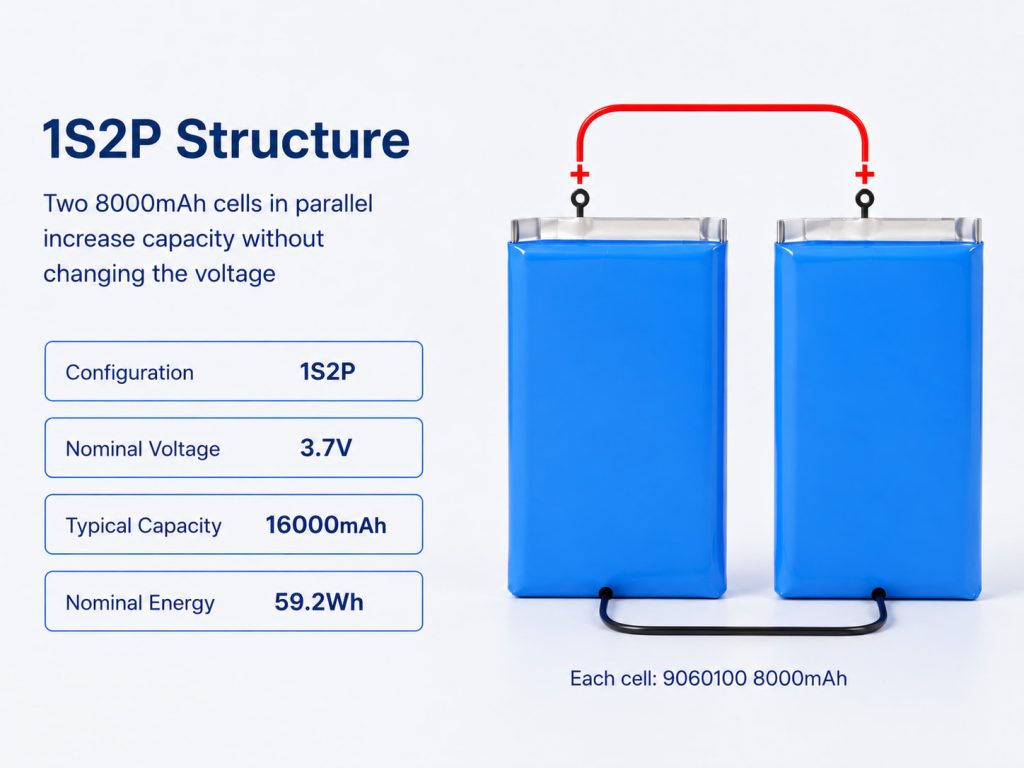
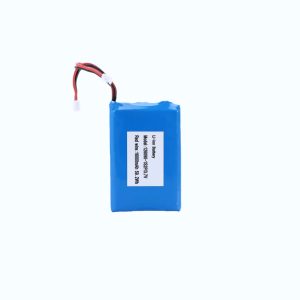
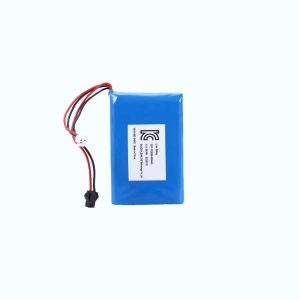
Built with two 8000mAh 9060100 pouch cells connected in parallel, the 16000mAh 3.7V Polymer Battery Pack provides 16000mAh capacity and 59.2Wh of nominal energy. Its 1S2P configuration keeps the nominal voltage at 3.7V while extending operating time for low-voltage portable equipment. Designed as a rechargeable 3.7V LiPo battery, this pack includes a PCM, silicone wires and a customizable connector. Portable monitoring equipment, inspection instruments, handheld terminals and similar devices can use this battery when longer runtime and a flat battery structure are required.

Item Specification
Model 9060100-1S2P/16000mAh
Size L/W/H (mm) 60.5*19*105
Energy (Wh) 59.2
Nominal Voltage (V) 3.7
Capacity (mAh) 16000mAh
Configuration 1S2P
Chemical Composition Manganese
Weight (g) 250
Cell Model 9060100
Category Polyme

16000mAh 3.7V Polymer Battery Pack for Portable Equipment

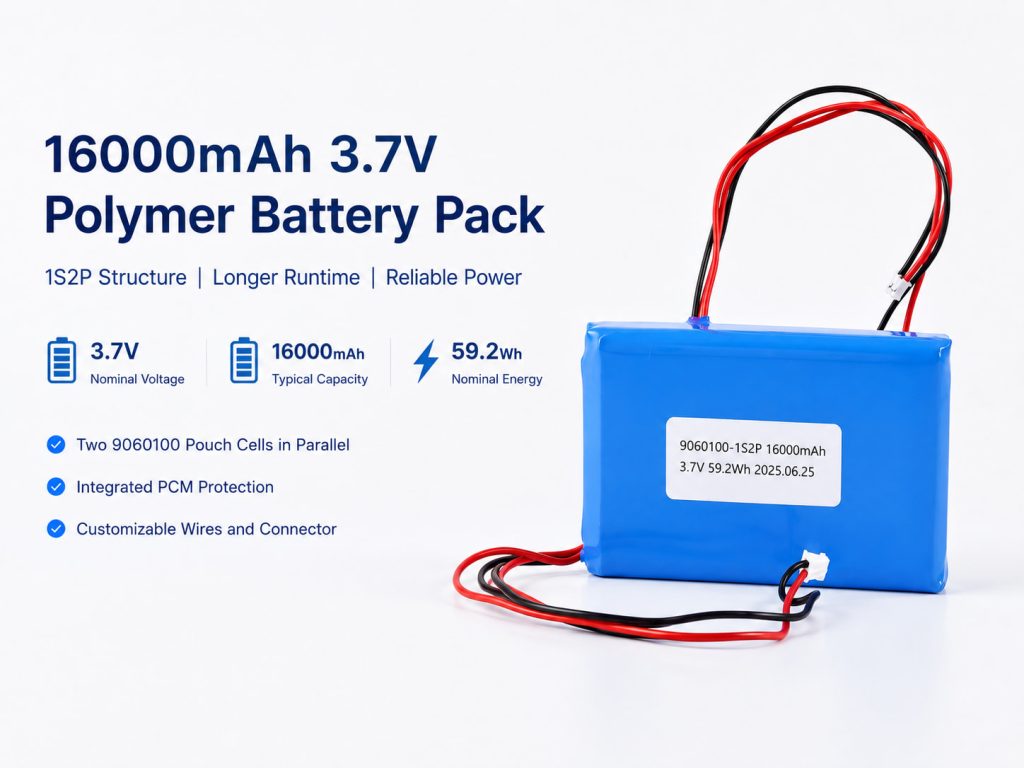
Portable devices often need more runtime without changing their existing voltage system. The 16000mAh 3.7V Polymer Battery Pack addresses this requirement by combining two 9060100 lithium-ion polymer cells in parallel. Each pouch cell provides 8000mAh capacity. Connecting both cells in parallel keeps the nominal voltage at 3.7V while increasing the total capacity to 16000mAh and the nominal energy to 59.2Wh. Such a structure works well for devices that already operate from a single-cell lithium battery voltage but need longer operating time than one pouch cell can provide.

1S2P Structure and Battery Performance

A 9060100 1S2P Battery Pack contains one series group and two parallel cells. Parallel connection increases capacity without raising the pack voltage.

Main pack characteristics include:

  • 3.7V nominal voltage
  • 16000mAh typical capacity
  • 59.2Wh nominal energy
  • Two matched 9060100 pouch cells
  • Integrated PCM protection
  • Customizable wires and connector

Before assembly, both cells should be matched by voltage, capacity and internal resistance. Proper matching helps distribute current more evenly during charging and discharging. Longer runtime is the main purpose of this pack. Continuous current and peak current must still match the selected PCM, wire gauge, connector and actual equipment load.
16000mAh 3.7V Polymer Battery Pack – 9060100 1S2P2

Flat Polymer Pouch Battery Design

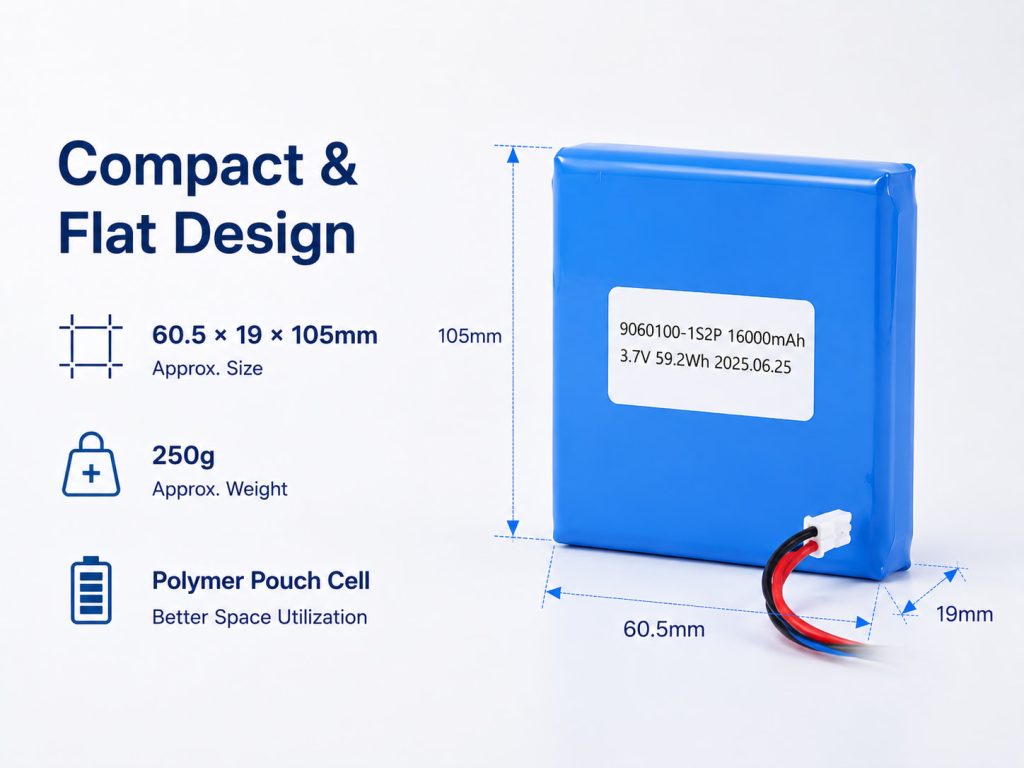
Flat pouch cells give this 3.7V LiPo battery a rectangular structure that suits elongated or relatively thin battery compartments. Compared with cylindrical cells, the pouch format can make better use of available internal space in certain device designs. Approximate finished dimensions are 60.5 × 19 × 105mm, while the estimated weight is 250g. Installation planning should also allow space for the PCM, connector, wire outlet and insulation materials.

Before approving the enclosure, confirm:

  • Available battery length
  • Available width and thickness
  • Wire outlet direction
  • Connector position
  • Fixing and insulation requirements
  • Space for normal cell expansion

As part of the wider 3.7 volt lithium ion battery category, this product still needs to be clearly identified as a polymer pouch battery. That distinction helps buyers separate it from 18650 or 21700 cylindrical battery packs with the same nominal voltage.

Charging and Discharging Requirements

Charging requires a 1S lithium-ion or lithium-polymer charger with a 4.2V charge limit. Constant-current and constant-voltage charging should be used throughout the charging process. Based on the complete 16000mAh capacity, a 0.2C standard charge rate equals 3.2A. Full charging normally takes approximately five to six hours, including the constant-voltage stage.

Recommended charging parameters include:

  • Charge limit voltage: 4.2V
  • Standard charging current: 3.2A
  • Standard charging rate: 0.2C
  • Charging method: CC/CV
  • Estimated charging time: Approximately 5–6 hours

At 0.4C, the calculated current reaches 6.4A. Using this higher current requires confirmation that the cells, PCM, wires, connector and charger can all support it safely. Discharge current should also be selected according to the complete device load. Motors, pumps, transmitters and other components with startup surges require separate peak-current testing.
16000mAh 3.7V Polymer Battery Pack – 9060100 1S2P1

Suitable Applications

A 16000mAh LiPo Battery Pack can support low-voltage products that need extended runtime and have enough installation space for a two-cell pouch structure.

Suitable applications may include:

  • Portable monitoring equipment
  • Handheld industrial terminals
  • Inspection and testing instruments
  • Portable diagnostic equipment
  • Rehabilitation devices
  • Mobile data collection equipment
  • Portable communication devices
  • IoT gateways
  • Remote monitoring equipment
  • Low-voltage backup modules
  • Portable lighting and control systems

Capacity alone does not determine whether a battery fits a project. Voltage, continuous current, peak current, charging method, available dimensions and working temperature must also match the device. Medical and other regulated equipment may require additional battery-level and device-level testing before commercial use.

Battery Pack Customization Options

Standard construction includes two pouch cells, a PCM, silicone wires, a connector and insulation materials. Each component can be adjusted according to the device’s electrical and mechanical requirements.

Available customization options include:

  • PCM protection current
  • Overcharge and over-discharge settings
  • Continuous and peak current requirements
  • Wire gauge
  • Wire length
  • Connector model
  • Connector pin definition
  • NTC temperature sensor
  • ID resistor
  • Insulation material
  • Protective wrapping
  • Battery label
  • Wire outlet direction
  • Cell arrangement
  • Packaging requirements

Providing a connector drawing, battery compartment drawing or physical device sample can make structural confirmation easier before sample production.
16000mAh 3.7V Polymer Battery Pack 0

Information Required Before Sampling

Accurate project information helps determine whether the existing battery structure can be used directly or needs adjustment.

Please provide:

  • Device operating voltage
  • Normal operating current
  • Maximum continuous current
  • Startup or peak current
  • Required operating time
  • Maximum battery dimensions
  • Connector model
  • Connector pin definition
  • Wire length
  • Charging voltage and current
  • Operating temperature
  • Required protection functions
  • Estimated order quantity

Engineering review can then confirm whether the current 1S2P structure fits the equipment or whether another pouch cell size, PCM or connection method would be more suitable.

Testing the Battery Before Production

Device testing should be completed before mass production. Installing the battery sample in the actual equipment helps identify electrical, thermal and structural problems early.

Recommended tests include:

  • Charging performance
  • Device runtime
  • Continuous operating current
  • Startup and peak current
  • Voltage drop
  • Battery temperature
  • Low-voltage shutdown
  • Connector fit
  • Wire direction
  • Installation clearance

Once the sample passes testing, the final drawing, bill of materials, protection settings, label, packaging and inspection requirements can be approved for production.
Specification

Item Specification
Product Name 16000mAh 3.7V Polymer Battery Pack
Battery Pack Model 9060100-1S2P
Battery Type Rechargeable Lithium-ion Polymer Battery Pack
Cell Type Polymer Pouch Cell
Cell Model 9060100
Cell Quantity 2 Cells
Single Cell Capacity 8000mAh
Configuration 1S2P
Nominal Voltage 3.7V
Typical Capacity 16000mAh
Minimum Capacity 15900mAh
Nominal Energy 59.2Wh
Charge Limit Voltage 4.2V
Charging Method Constant Current / Constant Voltage
Standard Charge Rate 0.2C
Calculated Standard Charge Current 3.2A
Maximum Specified Charge Rate 0.4C
Calculated 0.4C Charge Current 6.4A, subject to PCM and component confirmation
Standard Charging Time Approximately 5–6 Hours
Faster Charging Time Approximately 2.5–3.5 Hours, subject to final charging current
Standard Discharge Rate 0.2C
Calculated Standard Discharge Current 3.2A
Maximum Specified Discharge Rate 0.4C
Calculated 0.4C Discharge Current 6.4A, subject to PCM confirmation
Normal Discharge Cut-off Voltage 3.0V ± 0.10V
PCM Over-discharge Detection Voltage 2.40V ± 0.10V, subject to final PCM
Overcurrent Protection Customized according to the approved PCM and device load
Short-circuit Protection Included
Protection Functions Overcharge, Over-discharge, Overcurrent and Short Circuit
Operating Consumption Current ≤6μA, subject to PCM confirmation
Charge Temperature 10°C to 45°C
Discharge Temperature -20°C to 60°C
Storage Temperature Recommended at 25°C ± 5°C
Recommended Storage Capacity 40%–50% State of Charge
Cycle Life At least 300 Cycles under Specified Test Conditions
Internal Impedance ≤150mΩ, subject to the specified test method
Approximate Pack Size 60.5 × 19 × 105mm
Approximate Weight 250g
PCM Model 43A73 or Customized Equivalent
Wire Type 3239 22AWG Silicone Wire
Standard Connector 2.0mm 2-Pin Connector
NTC Temperature Sensor Optional
ID Resistor Optional
ESD Test ±3kV, subject to the final test standard
Wire Length Customizable
Connector Type Customizable
Label and Packaging Customizable

Customization Process

Step 1: Submit the Device Requirements

Provide the main electrical and mechanical requirements of the equipment, including:

  • Operating voltage
  • Normal operating current
  • Maximum continuous current
  • Startup or peak current
  • Required operating time
  • Maximum battery dimensions
  • Charging voltage and current
  • Operating temperature
  • Estimated order quantity

Step 2: Review the Battery Structure

Engineering review determines whether the standard 9060100-1S2P structure fits the available battery compartment and device power requirements.

When the standard size or output does not match, another pouch cell size, battery structure or capacity may be recommended.

Step 3: Confirm the PCM and Connections

Protection and connection components are selected according to the device load and installation design.

Customizable items include:

  • PCM continuous current
  • Overcurrent protection settings
  • Overcharge and over-discharge settings
  • Wire gauge and length
  • Connector model
  • Connector pin definition
  • NTC temperature sensor
  • ID resistor
  • Wire outlet direction
  • Insulation materials

Step 4: Confirm the Drawing and Quotation

A battery drawing is prepared to show:

  • Pack dimensions
  • Wire length
  • Connector position
  • Connector pin definition
  • Label information
  • Electrical specifications
  • Protection requirements

Quotation, sample cost, production quantity and estimated lead time are confirmed after the design review.

Step 5: Produce the Battery Sample

A sample is assembled using the approved cells, PCM, wires, connector, insulation and outer structure.

Initial inspection checks the battery voltage, capacity, dimensions, wiring, connector polarity and protection functions.

Step 6: Test the Battery in the Device

Install the sample in the actual equipment and test:

  • Charging performance
  • Operating runtime
  • Continuous current
  • Startup and peak current
  • Voltage drop
  • Temperature rise
  • Low-voltage shutdown
  • Connector fit
  • Wire direction
  • Installation clearance

Any required changes should be completed before mass production approval.

Step 7: Approve the Production Specification

After sample testing, confirm the final:

  • Product drawing
  • Bill of materials
  • PCM settings
  • Cell specifications
  • Wire and connector
  • Label
  • Testing requirements
  • Packaging method
  • Quality acceptance standard

Step 8: Begin Mass Production

Production begins according to the approved specification. Finished battery packs are inspected for voltage, internal resistance, protection performance, dimensions, appearance, connector polarity and packaging before shipment.

FAQ

1. How does the 9060100 1S2P battery structure work?

Two 8000mAh 9060100 pouch cells are connected in parallel. This arrangement keeps the nominal voltage at 3.7V while increasing the total typical capacity to 16000mAh and the nominal energy to 59.2Wh.

2. What charger should be used with this battery pack?

Use a charger designed for a 1S lithium-ion or lithium-polymer battery. Charging should follow the constant-current and constant-voltage method with a charge limit voltage of 4.2V.

3. How long does the 16000mAh battery pack take to charge?

Charging at the calculated 0.2C standard current of 3.2A normally takes approximately five to six hours, including the constant-voltage stage. Actual charging time depends on the charger, termination current, PCM and operating temperature.

4. Can this battery pack discharge at 6.4A?

A 0.4C discharge rate equals 6.4A based on the 16000mAh capacity. However, 6.4A should only be used after confirming the continuous current rating of the cells, PCM, wires and connector. Device testing must also check voltage drop and temperature rise.

5. Can the connector, wire and protection board be customized?

Yes. Available options include connector model, pin definition, wire length, wire gauge, PCM protection current, NTC sensor, ID resistor, insulation, label and outer packaging.

6. What equipment can use this 3.7V LiPo battery?

Suitable applications may include portable monitoring equipment, handheld terminals, inspection instruments, data collection devices, IoT equipment and other low-voltage products that need extended runtime. Final selection should be based on voltage, current, installation space, operating temperature and charging requirements.

Reviews

There are no reviews yet.

Be the first to review “16000mAh 3.7V Polymer Battery Pack – 9060100 1S2P”

Your email address will not be published. Required fields are marked *

Related Products