
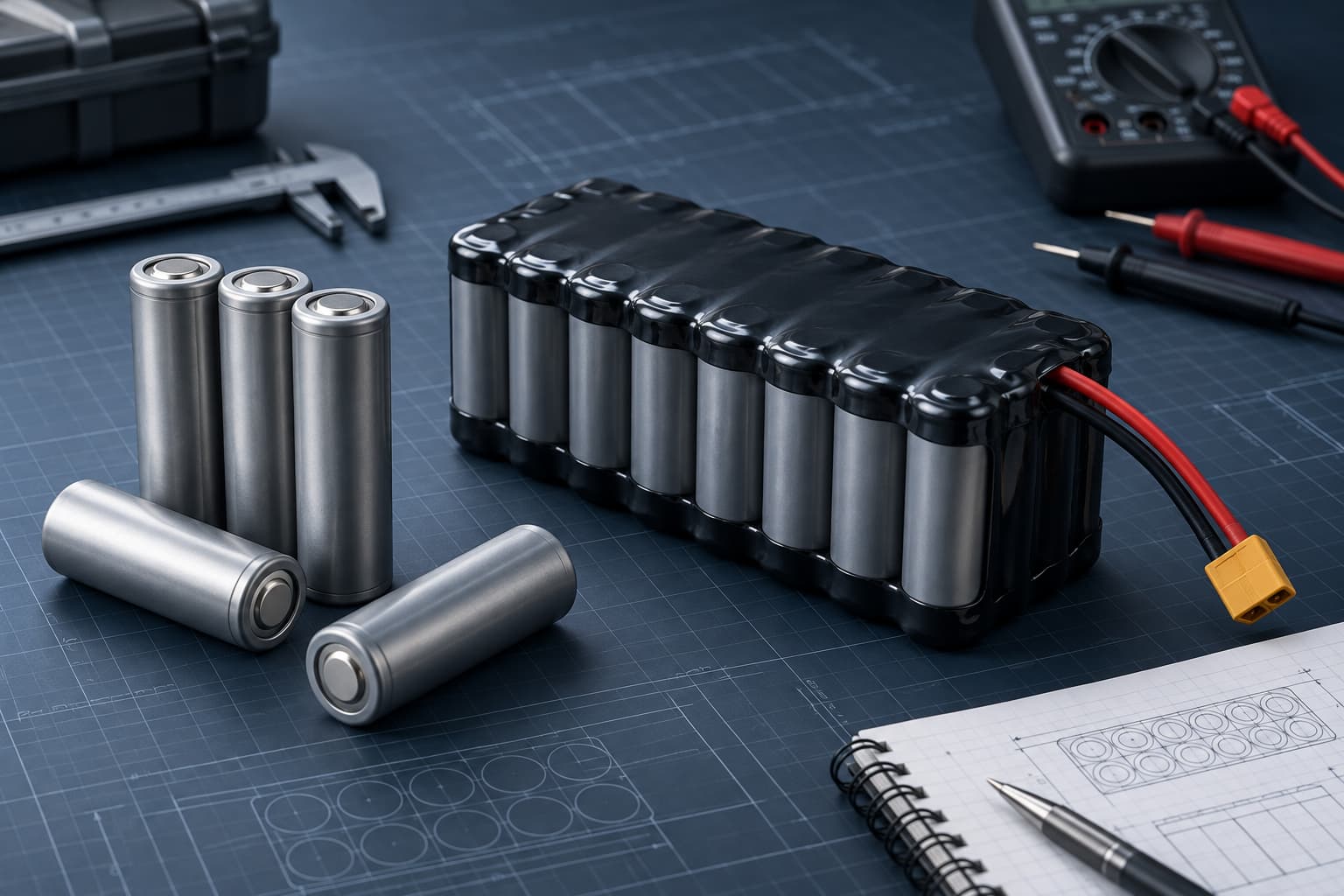
To calculate a 21700 battery pack’s voltage and capacity, start with the approved cell specifications and the series-parallel configuration. Series cells increase voltage. Parallel cells increase amp-hour capacity. Energy in watt-hours combines both values and gives a better basis for comparing packs with different voltage platforms. The calculation is useful for early planning, but it does not approve a battery for a device. Cell resistance, current limits, protection settings, temperature, cutoff voltage, enclosure design, and test results determine how much of the calculated performance is available in practice.
Confirm the 21700 Cell Specification
Record the exact cell model rather than assuming that every 21700 cell has the same ratings. The 21700 designation mainly describes the cylindrical format. Nominal voltage, maximum charge voltage, capacity, continuous current, pulse capability, temperature range, and cycle life depend on the selected cell. For the examples below, assume one cell is rated at 3.6V nominal and 4900mAh. Convert 4900mAh to 4.9Ah when calculating watt-hours.
The specification should identify:
- Nominal cell voltage
- Maximum charge voltage
- Minimum approved discharge voltage
- Typical and minimum capacity
- Continuous and peak current limits
- Charging current limits
- Operating temperature range
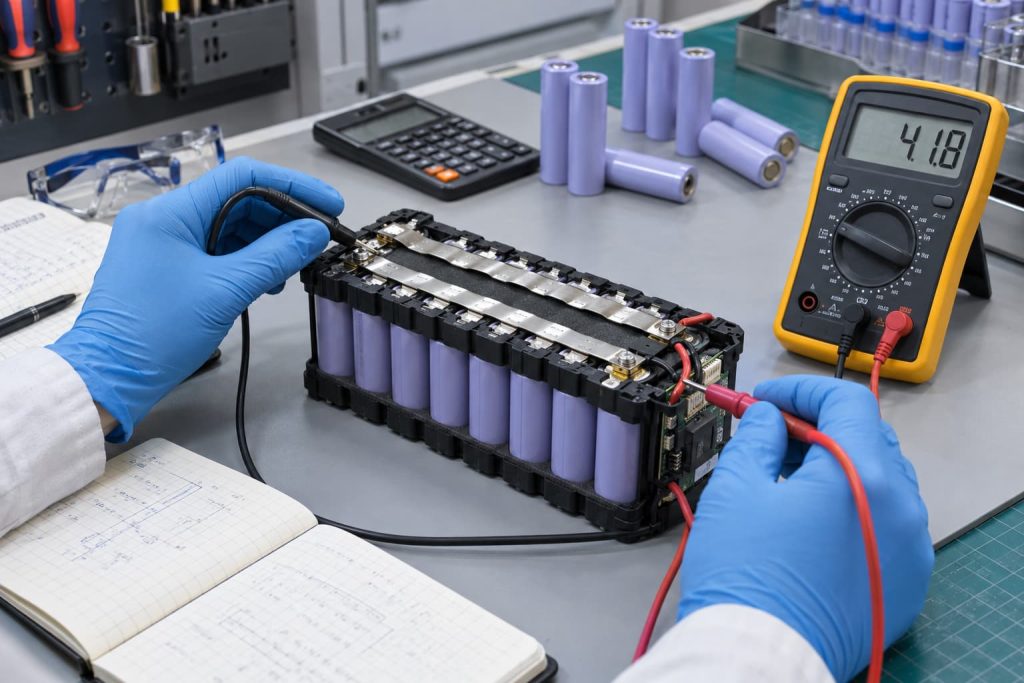
Calculate Nominal Pack Voltage
Nominal pack voltage equals nominal cell voltage multiplied by the series count.
For three 3.6V cells in series:
3.6V × 3 = 10.8V nominal
A 3S1P pack and a 3S2P pack therefore both provide approximately 10.8V nominal when they use the same 3.6V cell chemistry. Adding cells in parallel does not increase voltage. Calculate maximum pack voltage from the maximum cell charge voltage. If each cell charges to 4.2V, a 3S pack has a 12.6V charge limit. The charger and BMS must match the actual cell specification.
Calculate Pack Capacity
Pack capacity in amp-hours equals the cell capacity multiplied by the parallel count. Series count does not add amp-hour capacity.
For 4900mAh cells:
- 3S1P: 4900mAh × 1 = 4900mAh
- 3S2P: 4900mAh × 2 = 9800mAh
- 3S3P: 4900mAh × 3 = 14700mAh
The 21700 3S1P battery pack uses three series-connected cells and remains approximately 4900mAh. The 21700 3S2P battery pack uses two cells in each parallel group and provides approximately 9800mAh.
Calculate Nominal Energy in Watt-Hours
Nominal energy equals nominal pack voltage multiplied by capacity in amp-hours.
For a 3S1P pack:
10.8V × 4.9Ah = 52.92Wh
For a 3S2P pack:
10.8V × 9.8Ah = 105.84Wh
Watt-hours make it easier to compare battery packs with different voltage and capacity ratings. A higher amp-hour number does not automatically mean more energy when the compared packs operate at different voltages. Use nominal watt-hours for comparison and planning, not as a guaranteed delivered-energy value. The device stops operating at a defined cutoff voltage, and losses occur in the battery, connector, wiring, BMS, and voltage-conversion circuit.
Estimate Device Runtime
A simple first estimate divides usable watt-hours by average device power (watts). If a 52.92Wh battery has an assumed usable-energy factor of 85 percent, the usable energy is about 44.98Wh. A device averaging 10W would have a preliminary estimate of about 4.5 hours.
This estimate can differ from real operation because device power is rarely constant. Startup loads, wireless transmission, motors, heaters, displays, standby modes, temperature, firmware, and conversion efficiency affect runtime. Measure the actual duty cycle and confirm runtime using production-intent packs. Do not hide the usable-energy factor in the final specification. State the discharge rate, ambient temperature, starting state of charge, device mode, cutoff condition, and pass requirement.

Estimate Charging Current and Time
You can express charging current as a C-rate. A 0.2C rate for a 4.9Ah 3S1P pack is approximately 0.98A. The same 0.2C rate for a 9.8Ah 3S2P pack is approximately 1.96A. An ideal capacity-divided-by-current calculation does not include the constant-voltage phase, charger losses, balancing time, or device consumption while charging. Measure actual charging time with the approved charger, cable, pack, and device power-path design.
Check Current Capability and Voltage Drop
Capacity calculations do not determine whether the pack can support the load. Review continuous current, startup current, peak duration, cell resistance, BMS rating, nickel connections, wire gauge, connector resistance, and enclosure temperature. Parallel cells may share current, but the sharing depends on cell matching and connection resistance. Record voltage at the pack and at the device during maximum load. A device may reset before it reaches nominal capacity if the voltage drops to its shutdown threshold. The cylindrical battery range includes different 18650 and 21700 configurations for applications with different voltage, energy, and size requirements.
Validate the Calculation in the Finished Device
Test capacity, energy, runtime, voltage drop, charging, temperature rise, protection response, and low-state-of-charge operation. Use representative samples and retain the cell lot, BMS revision, drawing revision, firmware, enclosure, charger, and test conditions with each result. The IEC 62133-2 standard covers safety requirements and tests for portable sealed secondary lithium cells and batteries. Application-specific and transport requirements may also apply.
21700 Battery Calculation Questions
Does Series Connection Increase Capacity
Series connection increases voltage but does not increase amp-hour capacity. Parallel connection is required to add capacity.
Is Nominal Energy the Same as Usable Energy
No. Usable energy depends on discharge rate, cutoff voltage, temperature, efficiency, cell variation, pack losses, and ageing.
Can Runtime Be Calculated from Milliamp Hours Alone
Only if you also know voltage and load behavior. Watt-hours and measured device power provide a more useful starting point.