
-1.png)
21700 Battery Pack for Custom Rechargeable Equipment
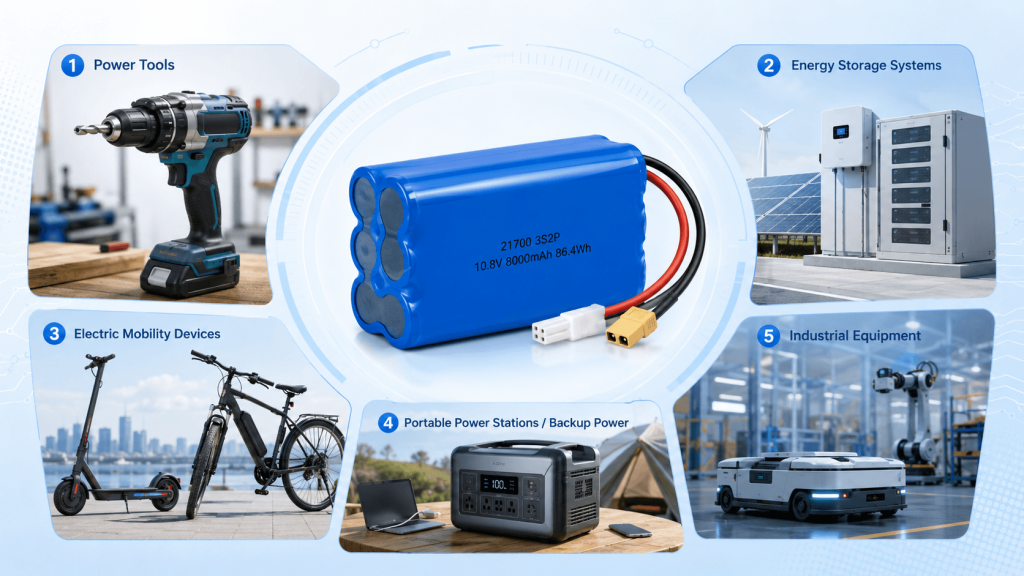
This 21700 3S2P Battery Pack is designed for equipment that needs stable rechargeable power and longer operating time. Its six-cell arrangement combines series and parallel connections, helping the battery pack balance operating voltage, capacity, and installation size.
The compact rectangular structure makes it easier to integrate into industrial devices, inspection tools, monitoring equipment, portable instruments, and other custom electronic products.
Integrated Protection and Durable Construction
The battery pack includes a protection board, nickel connections, insulation materials, silicone wires, and an outer PVC sleeve.
Its protection system helps manage:
- Overcharging
- Over-discharging
- Overcurrent
- Short circuits
The insulation and connection structure also help protect the 21700 batteries during assembly, transportation, and normal device operation.
Choosing Between a 21700 Battery vs 18650 Battery
When comparing a 21700 battery vs 18650 battery, the decision should not be based only on capacity.
21700 cells usually provide more energy per cell, making them suitable for products that need longer runtime. However, they also require more installation space than 18650 cells.
The final battery choice should consider:
- Available installation space
- Device power consumption
- Continuous and peak current
- Required operating time
- Battery weight
- Charging method
The battery pack should be tested with the actual device before mass production.
Suitable Applications
This 21700 Battery Pack can be considered for:
- Portable inspection devices
- Industrial monitoring equipment
- Measuring instruments
- Security equipment
- Rechargeable control systems
- Custom electronic products
Applications with motors, pumps, heating elements, or high startup current require additional confirmation of the discharge current and protection board settings.
Custom 21700 Battery Pack Options
The battery can be adjusted to meet the device’s electrical and structural requirements.
Customization options include:
- Cell brand and model
- Battery dimensions
- Cell arrangement
- Connector type
- Wire length and direction
- Terminal polarity
- Protection board
- Insulation materials
- Outer sleeve
- Labels and packaging
Providing the device voltage, working current, peak current, available space, connector drawing, charging method, and order quantity helps shorten the battery evaluation process.

Reviews
There are no reviews yet.