
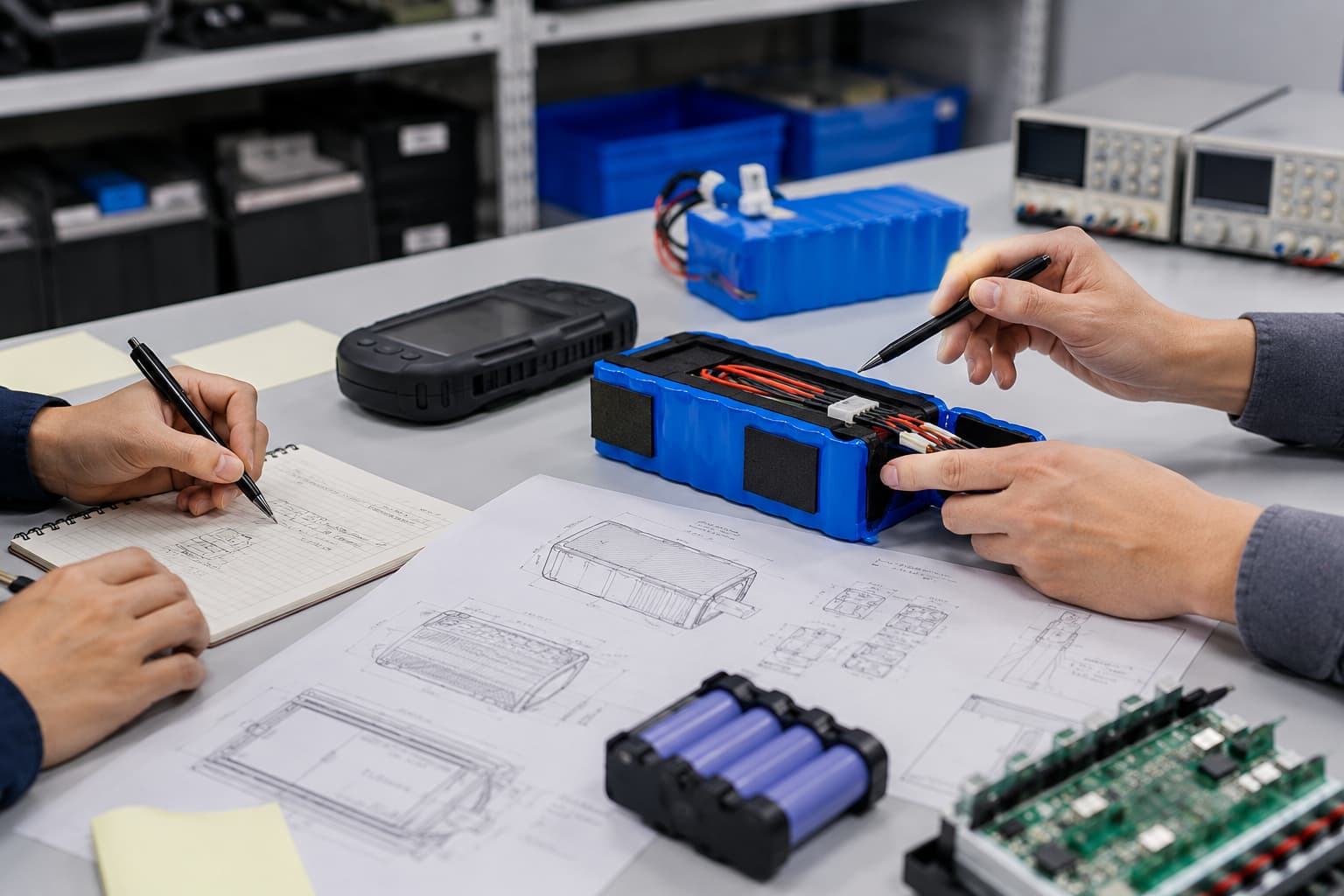
A product team can lose months by sending a battery supplier only three requirements: voltage, capacity, and maximum dimensions. These values describe the basic battery pack, but they do not explain how the device operates, how the battery will be charged, where it will be installed, or which markets the finished product must enter. An ODM Lithium Battery Manufacturer needs a controlled technical brief before selecting cells, protection components, wires, connectors, insulation materials, and pack construction. Before requesting a quotation, confirm whether the supplier offers a complete ODM battery design service or only produces battery packs according to finished drawings.
A useful brief should clearly separate confirmed requirements, preferred targets, and unresolved questions. Confirmed requirements become acceptance criteria. Targets give the engineering team room to compare different solutions. Unresolved questions should have an owner and a decision date so assumptions do not quietly become approved specifications.

Give the ODM Lithium Battery Manufacturer a Real Duty Cycle
Average current alone cannot describe the actual battery demand. The supplier needs to understand how current changes during startup, normal operation, peak loading, standby, charging, and shutdown. Provide operating data for startup pulses, motors, heaters, wireless transmission, display brightness, processor load, sleep current, and any accessory powered by the same pack. Also state the lowest input voltage at which the device can operate correctly.
A device may have a low average current but still generate short high-current pulses. These pulses affect cell selection, voltage drop, connector rating, wire size, nickel thickness, and overcurrent protection settings. When a working device is available, record representative current and voltage traces under both normal and demanding conditions. Runtime requirements also need clear test conditions. A statement such as “the battery must run for eight hours” is incomplete unless the team defines temperature, screen brightness, wireless activity, operating sequence, accessory use, and shutdown voltage. The battery supplier should calculate runtime against the same operating cycle used during device validation.
The brief should also cover abnormal conditions. Explain how the product behaves during a stalled motor, shorted output, charger fault, blocked cooling path, or extended storage period. This helps the supplier divide protection responsibilities between the battery pack, charger, and host device.
Control the Mechanical Envelope and Assembly Process
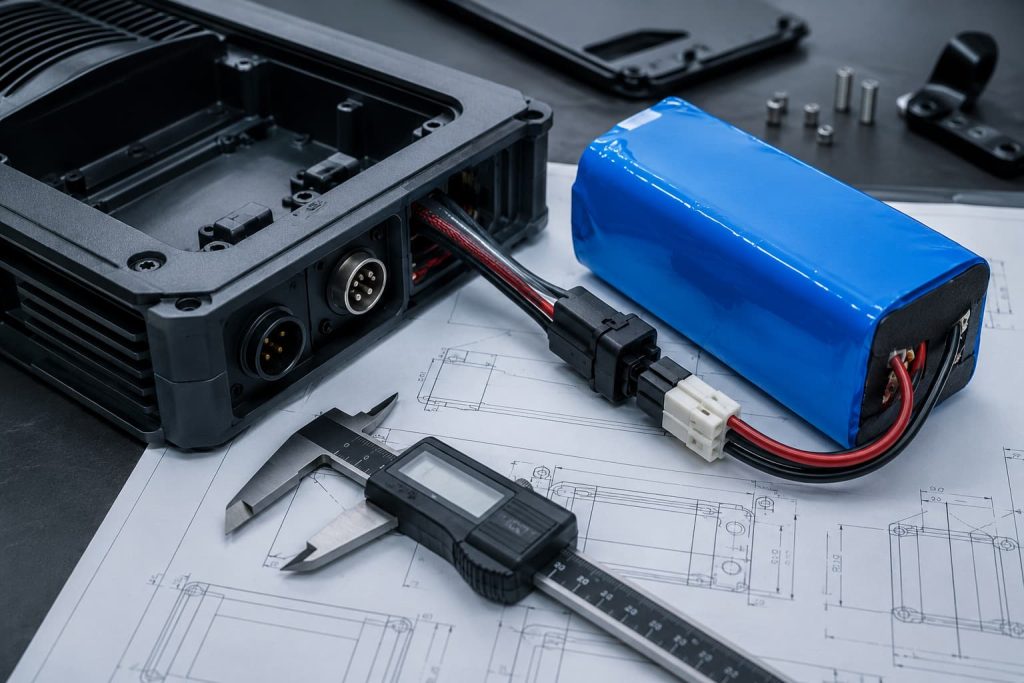
A maximum length, width, and height rarely provide enough information for a custom battery design. Send a drawing or 3D model showing the battery cavity, mounting points, keep-out areas, cable direction, connector position, nearby parts, insulation boundaries, service access, and allowable swelling space. The supplier also needs to know which dimensions are fixed and which can be adjusted. Small changes to cell arrangement, protection board position, connector direction, or wire exit can affect the complete battery structure.
Explain how the battery enters the device during assembly. A pack may fit inside the finished cavity but still be impossible to install after another component has been mounted. Include wire routing, bend radius, tool access, strain relief, adhesive areas, and removal method. Cell format should match both the electrical requirements and the available space. A custom lithium battery pack may use cylindrical, polymer, or button cells depending on the required shape, current, capacity, thickness, and installation method.
Mechanical loads should also be defined according to the real product. State the expected drop, vibration, shock, compression, transportation, and user-handling conditions. Do not copy test values from an unrelated device because the mounting structure and product risks may be different.
Define Charging Control With the ODM Lithium Battery Manufacturer
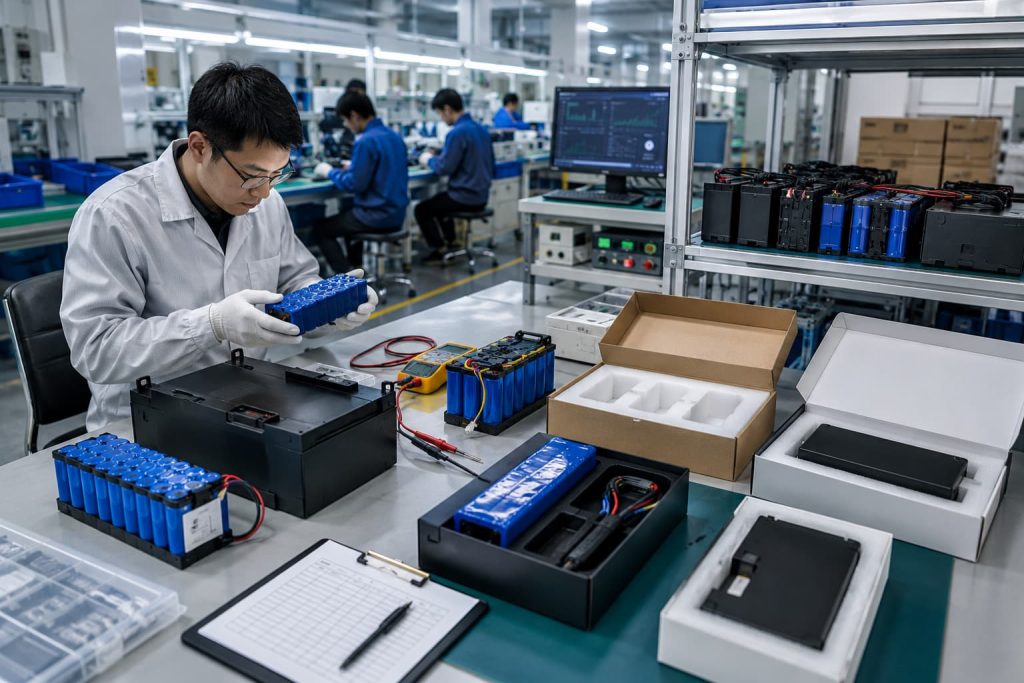
The supplier should understand the complete charging architecture before designing the protection system. State the charging input, charger type, required charge time, maximum charging current, permitted use during charging, connector pinout, temperature sensing method, and communication interface. The brief must also identify which controller owns each charging decision. Explain whether the charger, battery pack, or host device sets the charging current and voltage. State which controller can interrupt charging and how the device reacts when protection is activated.
Thermal conditions may limit the desired charging rate. Provide the ambient temperature range, enclosure material, nearby heat sources, airflow, and available sensor positions. Charging tests should take place inside the completed device because an open-air battery test cannot represent a sealed housing beside a processor, motor driver, or power module. User indicators also need attention. The battery pack, charger, host firmware, and user interface should show consistent behavior when charging pauses, temperature protection activates, or the battery reaches a low state of charge. Poorly coordinated indicators often create product returns even when the protection system works correctly.
Set Market, Transport, and Compliance Boundaries Early
List every intended sales market, device category, transportation method, and customer-specific requirement at the beginning of the project. These decisions can affect cell selection, battery construction, protection design, labels, packaging, technical documents, and change-control procedures. Ask the supplier to identify the standards included in its proposal and explain why they apply. The final compliance plan should still be confirmed with qualified laboratories or compliance professionals because requirements can vary by product category and destination market.
Transport planning should begin before prototype approval. Provide the pack configuration, watt-hour rating, packaging method, shipment quantity, and expected shipment state. The UN Manual of Tests and Criteria contains test methods and classification criteria relevant to lithium cell and battery transport, but the exact shipping procedure depends on the battery configuration, destination, transport mode, and current regulations. Prototype batteries, certification samples, and production goods may need different documents and packaging. A functional battery pack can still delay a launch when the project team has not prepared the required transport evidence.
Ask the ODM Lithium Battery Manufacturer for Design Evidence
The supplier should explain why the proposed cell, protection system, and construction method fit the device requirements. Request the proposed cell model or cell family, approved alternatives, and the conditions behind capacity, resistance, discharge rate, cycle life, and temperature claims. Do not transfer performance data from one cell model to another without supporting evidence. Each important claim should connect to the exact cell, component, and test condition used in the design.
Protection thresholds should be reviewed against the real host behavior. Overcurrent protection must tolerate legitimate startup pulses while still responding to faults. Low-voltage protection should coordinate with device shutdown. Temperature protection needs defined sensor placement, activation limits, and recovery conditions. Ask for a block diagram showing the cells, sensing circuits, protection IC, switching devices, fuse, balancing system, communication interface, and connector protection. This makes it easier to identify missing functions and control conflicts before prototypes are built.
The proposal should also disclose long-lead components, single-source parts, minimum order requirements, and substitution rules. A low-cost prototype design may become difficult to produce if the selected cell or protection component cannot support the expected order volume.
Use Staged Builds Instead of One Prototype Round
The first engineering build should confirm battery fit, electrical interfaces, basic charging, protection behavior, and device operation. A later design-validation build should use production-intent cells, components, materials, and construction. The pilot build should confirm tooling, assembly instructions, inspection, traceability, process control, and production yield. Define what each stage must prove before approving the next build. This prevents the team from mixing mechanical, electrical, thermal, compliance, and production questions into one sample round.
A validation matrix should connect each requirement to a test method, sample condition, acceptance limit, responsible owner, and required record. It should cover fit, runtime, peak load, charging, thermal behavior, protection, communication, storage, environmental exposure, transportation preparation, and interaction with the completed device. When a test fails, record the exact sample configuration, symptom, measured data, suspected cause, corrective action, and retest result. A note stating that the sample passed after adjustment is not enough. The released design must show which adjustment worked and how production will control it.
A Complete Brief Helps an ODM Lithium Battery Manufacturer Build the Right Pack
Before approving prototypes, confirm the requirement revision, sample quantity, test cases, deliverables, review dates, quotation exclusions, and the person responsible for technical trade-offs.
Projects that require a new cell arrangement, connector, protection board, wire configuration, or mechanical structure should also review the supplier’s Custom Battery Pack capabilities before the design direction is frozen. Before production, release a controlled design package containing the battery drawings, bill of materials, cell specifications, electrical diagrams, labels, packaging requirements, inspection standards, test procedures, approved samples, and documented deviations.
Every controlled document should have a revision number. Purchase orders should reference the released design package instead of relying on an email attachment with an uncertain date. The agreement must also define which changes require written approval, new samples, partial retesting, or full requalification. Changes to cells, protection ICs, MOSFETs, thermistors, connectors, wires, adhesives, insulation materials, firmware, or production processes can affect previously validated performance.
A complete brief gives the ODM team one clear design boundary. It allows the supplier to compare technical options, identify risks, prepare realistic quotations, and build a lithium battery pack that supports device performance, compliance planning, and future production.