
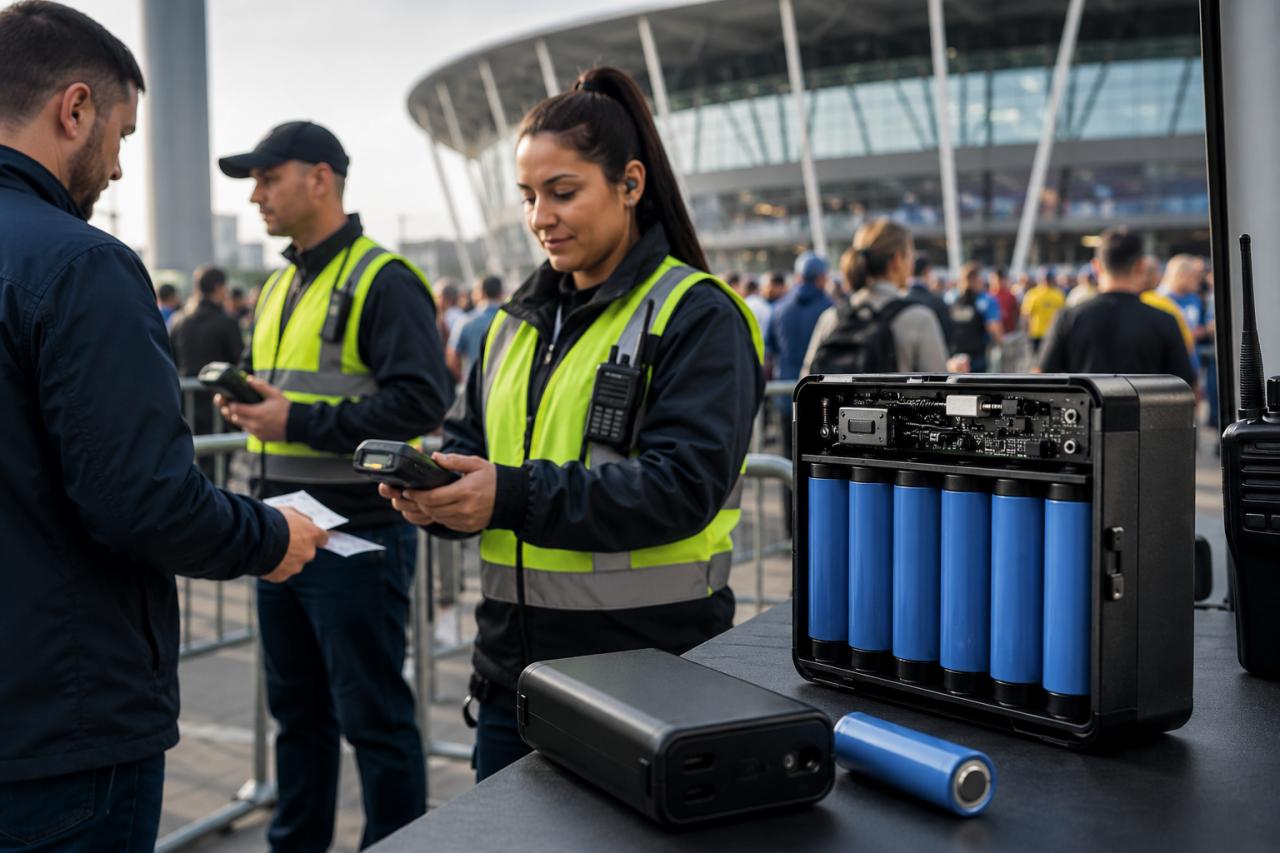
Major football events create demanding working conditions for portable electronic equipment. Security teams, ticketing contractors, medical service providers, broadcasters, maintenance crews, and venue operators may need devices that work across long shifts with limited charging time.
Manufacturers preparing equipment for stadiums, fan zones, transportation hubs, temporary facilities, and supporting service areas must match the battery to the device’s actual load. The operating environment connected with the FIFA World Cup 26 also involves multiple host cities, changing weather conditions, high visitor traffic, and temporary technical deployments.
A cylindrical battery can support many portable device designs because manufacturers can select different cell formats, pack structures, capacities, connectors, and protection systems. The final battery specification must follow the equipment voltage, peak current, runtime target, available space, charging method, and operating environment.
The event examples below describe possible equipment applications. They do not indicate that Zenilove batteries are officially used, approved, or endorsed by FIFA.
Why World Cup Equipment Needs a Reliable Cylindrical Battery
Portable equipment used around a large football event may operate for several hours without returning to a fixed charging point. Some devices remain active throughout an entire shift, while others experience short periods of higher power demand. A ticket scanner may process visitors continuously before kickoff. A radio may remain in standby for long periods and draw more power during communication. A handheld security device may experience frequent start-and-stop operation. Portable medical equipment may require a stable voltage throughout use.
These different load patterns affect battery selection. Capacity alone cannot confirm whether a battery will support the device. Procurement teams also need to check:
- Nominal and maximum operating voltage
- Average working current
- Peak discharge current
- Required operating time
- Charging time between shifts
- Available battery compartment dimensions
- Connector and wire specifications
- Indoor or outdoor operating temperature
A properly specified cylindrical lithium battery can be built around these requirements, rather than forcing the equipment design to accept a standard consumer battery.
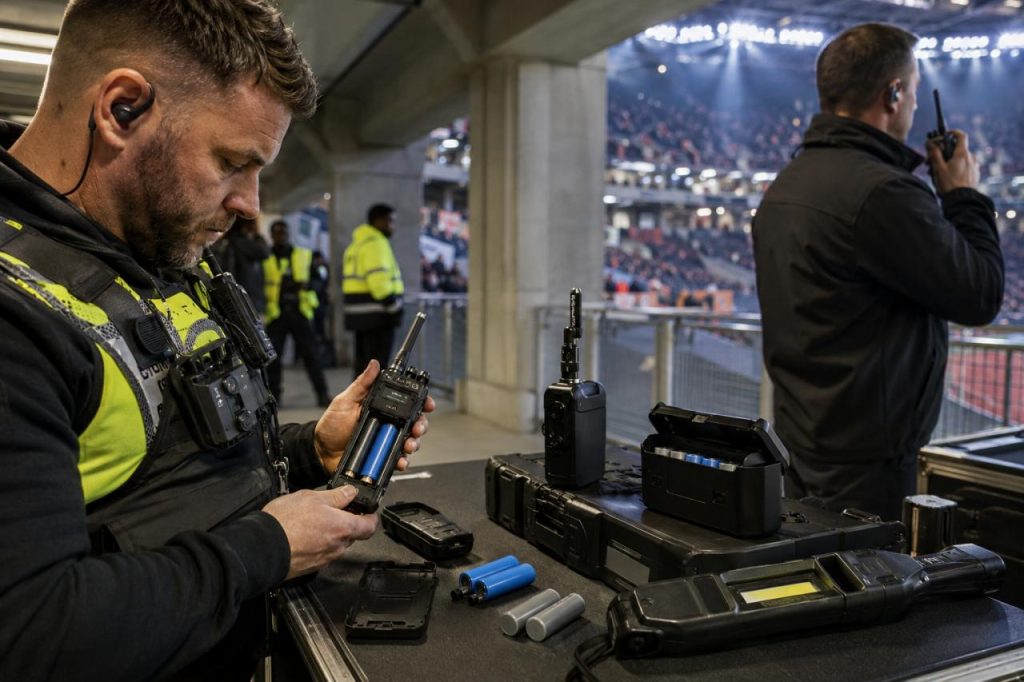
Which Event Devices May Use a Cylindrical Battery?
Several types of portable equipment may use cylindrical cells or custom battery packs. The correct cell and pack structure depends on the device design.
Ticketing and Accreditation Terminals
Handheld barcode scanners, identity verification terminals, mobile point-of-sale devices, and accreditation equipment require compact power sources that support repeated scanning and wireless communication. These devices usually impose strict limits on battery size and weight. The engineering team should calculate the runtime from the actual scan frequency, screen use, network connection, and standby consumption.
Communication Equipment
Two-way radios, wireless dispatch terminals, body-worn communication devices, and portable network equipment may remain active throughout a work shift. A communication device can also create short current peaks during transmission. Battery selection should therefore consider both continuous and peak current rather than relying solely on the stated capacity.
Security and Inspection Devices
Portable detection equipment, handheld inspection tools, body cameras, and mobile monitoring devices may operate at entrances, fan zones, vehicle checkpoints, and temporary access points. The battery pack may need protection against overcurrent, short circuits, excessive discharge, and charging faults. Outdoor deployment can also affect the required temperature range and housing design.
Medical and Emergency Equipment
Portable monitoring devices, diagnostic tools, emergency lighting, and communication terminals may support temporary medical areas and mobile response teams. These devices need stable output, reliable connectors, clear battery status information, and documented testing. The equipment manufacturer should define the applicable certification and validation requirements before requesting samples.
How to Compare 18650 and 21700 Cylindrical Battery Formats
The 18650 and 21700 formats can support different equipment layouts. Neither format should be selected from capacity figures alone. An 18650 lithium battery may suit compact terminals, measuring instruments, scanners, communication products, and devices with limited internal space. The established cell format also gives engineers several options when arranging cells into custom packs.
A 21700 battery pack may suit equipment that requires greater capacity, longer runtime, or a higher-voltage pack configuration. The larger cell format needs more installation space, so engineers should confirm the enclosure dimensions during the early design stage.
| Selection Factor | 18650 Direction | 21700 Direction |
|---|---|---|
| Equipment space | Better suited to compact layouts | Requires more cell space |
| Runtime target | Suitable for moderate energy needs | Useful when longer runtime is required |
| Pack flexibility | Supports many compact arrangements | Can reduce the number of cells in some designs |
| Typical project focus | Scanners, radios, instruments and small terminals | Maintenance tools, industrial devices and longer-runtime equipment |
| Main checks | Dimensions, current, connector and capacity | Space, heat, discharge current and pack structure |
The final comparison should use verified cell data, pack drawings, current requirements, and sample test results.

Match Cylindrical Battery Voltage and Capacity to Runtime
Battery capacity does not directly equal device runtime. Engineers need to calculate the equipment’s actual energy consumption.
A basic evaluation should include:
- Measure the average current during normal use.
- Record peak current during scanning, transmission, motor startup, lighting, or wireless connection.
- Define the minimum required operating time.
- Add a practical reserve for battery aging and environmental conditions.
- Confirm whether the device can enter a low-power or standby mode.
- Check whether staff can replace or recharge the battery during a shift.
Series and parallel configurations also change the pack performance. Series connections raise the pack voltage, while parallel connections increase available capacity. The protection board, charger, wiring, and device electronics must match the selected configuration. Using a larger capacity without reviewing the charging system can result in longer charging times. Buyers should evaluate runtime and charging together, especially when equipment must return to service between matches or operating shifts.
Review Protection, Charging, and Operating Conditions
A custom battery pack may need overcharge, over-discharge, overcurrent, and short-circuit protection. Some projects may also require temperature monitoring, cell balancing, communication functions, or a battery status indicator. The required protection design depends on the pack voltage, number of cells, load current, charger, and equipment environment.
Manufacturers should also review:
- Charging voltage and current
- Connector polarity
- Wire length and wire gauge
- Battery placement inside the enclosure
- Heat generated during discharge and charging
- Ventilation around the battery compartment
- Exposure to vibration, impact, moisture, or dust
- Storage conditions before and after the event
Sample validation should reproduce the real operating cycle. A short bench test at room temperature may not reveal runtime loss, connector movement, heat buildup, or voltage drops during peak load.
Prepare a Complete OEM Battery Requirement
Buyers can reduce repeated revisions by sending a structured requirement before pack development starts.
The request should contain:
- Device name and application
- Required nominal voltage
- Continuous and peak current
- Minimum runtime
- Maximum battery dimensions
- Preferred cell format
- Charging method
- Connector model and wire requirements
- Protection functions
- Operating and storage temperature
- Required certifications
- Expected sample and production quantities
- Target production schedule
An OEM Lithium Battery Manufacturer can then review cell selection, pack configuration, protection design, connector layout, sample production, testing, and mass-production requirements in relation to the equipment specification. Buyers should also provide enclosure drawings when space is limited. A two-dimensional size limit may overlook connector orientation, wire-bending clearance, insulation, protection board placement and assembly tolerances.
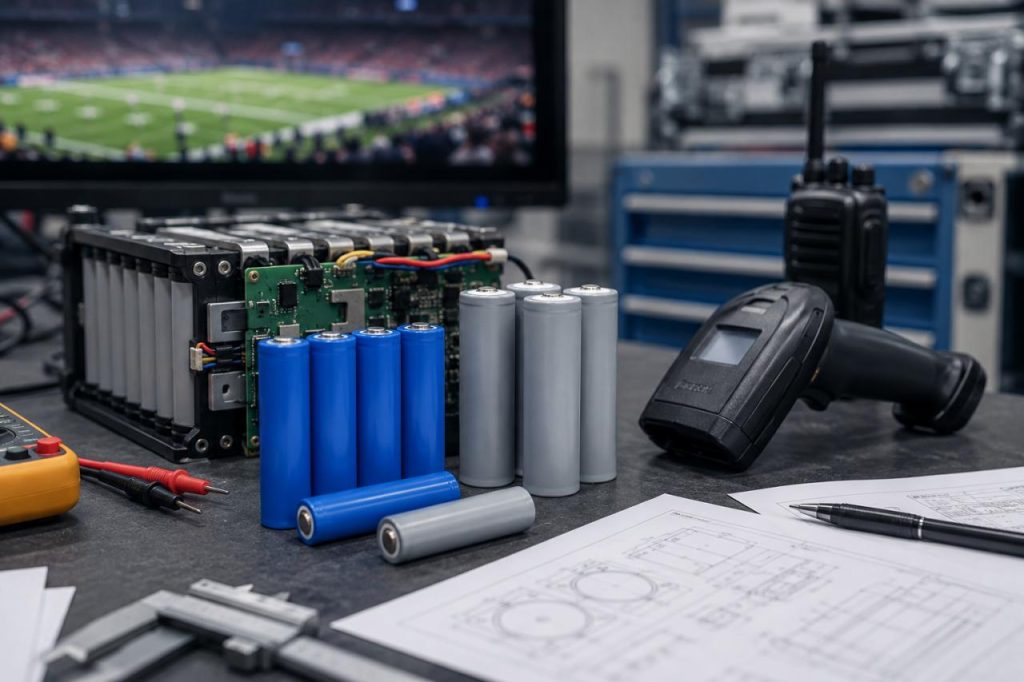
A Cylindrical Battery Can Support Portable World Cup Equipment
A cylindrical battery can provide a practical power source for ticketing terminals, communication devices, security equipment, portable medical products, inspection tools, and maintenance devices used around large football events. The 18650 format can support compact equipment and flexible pack layouts. The 21700 format can support projects that place greater emphasis on capacity, runtime, or higher-energy pack structures.
Buyers should select the battery based on verified device data rather than on its capacity label. Voltage, continuous current, peak load, runtime, internal space, charging, protection, connector design, environmental conditions, and validation requirements must work together. A complete technical requirement helps the battery supplier recommend an appropriate cell and pack structure, prepare a usable sample, and reduce changes before production.