

A custom electronic device needs a battery that matches its voltage, current, runtime, installation space, charging system, and operating environment. Capacity alone cannot show whether a battery will work reliably inside the final product. A 5,000mAh battery may run a low-power sensor for several days. The same battery may struggle to support a motor, heating element, wireless transmitter, or another component with high startup current. A reliable Lithium Battery selection process should begin with the complete device requirements.
Check the Device Power Requirements
Start by confirming the device’s rated voltage, operating voltage range, average current, peak current, and required runtime. These values determine how many cells the battery needs and how the cells should be connected. Cells connected in series increase voltage. Cells connected in parallel increase capacity and available current. Equipment that needs a higher operating voltage may require several cells in series, while equipment that needs a longer runtime may need additional cells in parallel. Peak current should be measured separately from average current. Motors, pumps, heating elements, displays, and wireless communication modules may draw much more current during startup or short operating periods. The cells, wiring, connector, and protection board must support this load without excessive voltage drop, overheating, or an unexpected shutdown.
Battery energy can be estimated with a simple formula:
Battery energy (Wh) = Nominal voltage × Capacity (Ah)
The final calculation should also consider power conversion losses, operating temperature, battery aging, and the device’s actual working cycle. This gives a more realistic capacity target than comparing mAh values alone.
Choose the Right Battery Type
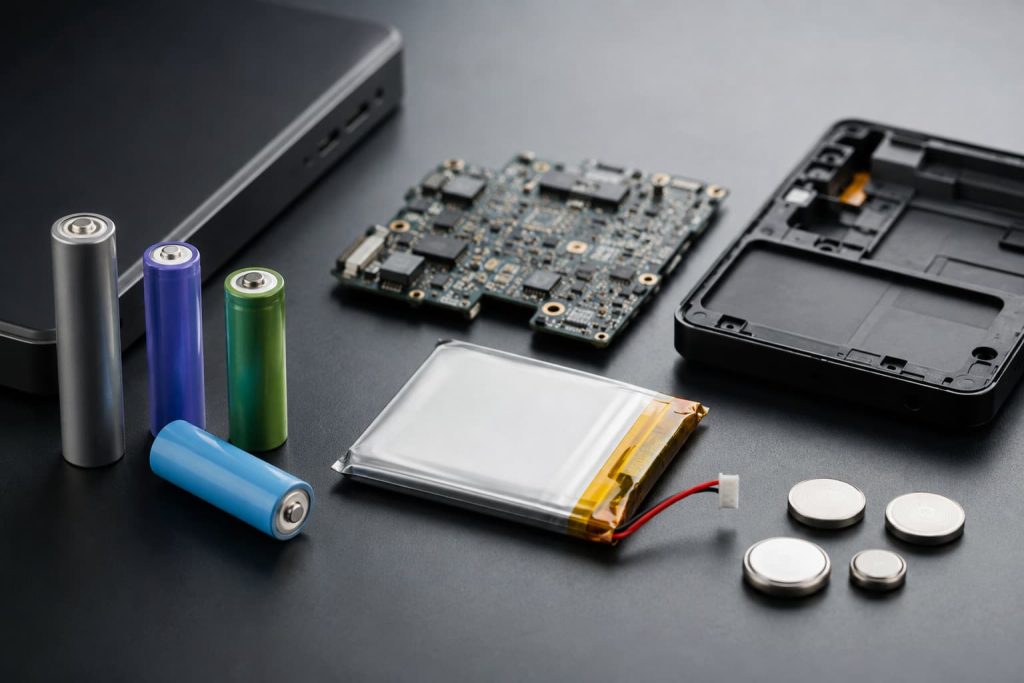
The device structure and power demand usually determine whether the project needs cylindrical cells, polymer batteries, or button batteries. Cylindrical lithium-ion cells, including 18650 and 21700 cells, work well in equipment that needs stable discharge, durable construction, and repeatable pack assembly. They are commonly used in industrial instruments, portable equipment, monitoring devices, security products, and electronics with moderate or high current requirements.
Buyers can review different cell formats and pack structures through the available Battery Pack product range before deciding whether an existing configuration can support the project. Polymer batteries are more suitable for thin products, lightweight electronics, and equipment with irregular installation spaces. They are often used in wearable products, medical electronics, IoT devices, handheld terminals, and tracking equipment.
The enclosure must protect a pouch cell from pressure, bending, sharp edges, and puncture risks. The design should also allow for normal production tolerances and possible cell expansion. Button batteries such as CR2032 and CR2025 suit low-power devices, including remote controls, meters, real-time clocks, memory backup circuits, and compact sensors. These primary lithium batteries are disposable and require a different device design from rechargeable lithium-ion packs.
Confirm the Battery Size
Measure the available installation space before developing the battery. Confirm the maximum length, width, height, and weight that the device can accept. The battery compartment must leave room for the protection board, insulation, wires, connector, mounting materials, and assembly tolerances. Cable length, wire gauge, connector model, polarity, and wire exit direction should appear clearly on the battery drawing. A battery may fit the enclosure according to its basic dimensions and still create assembly problems. The connector may lack bending space, the cable may exit in the wrong direction, or the protection board may interfere with another component.
Providing a three-dimensional enclosure drawing or a physical housing sample allows the supplier to identify these problems before prototype production. Portable products also need a balance between capacity, weight, and size. Increasing capacity normally increases battery volume, weight, or both. The final pack should provide the required runtime without making the product too heavy or difficult to operate. Projects with restricted dimensions, unusual layouts, or special connectors may require a Custom Battery Pack designed around the equipment structure.
Check Capacity and Discharge Current
Capacity shows how much charge the battery stores, while watt-hours show its nominal energy. Discharge current describes how quickly the battery can supply that energy to the device. A high-capacity cell may still perform poorly in high-power equipment. If the selected cell cannot support the required current, the voltage may drop quickly under load, and the battery temperature may rise.
When the voltage falls below the device cutoff point, the product may restart or shut down even though the battery still contains usable energy. Before sample development, provide the supplier with the continuous working current, maximum peak current, peak duration, peak frequency, cutoff voltage, expected runtime, and operating temperature.
Cold conditions can reduce the available capacity and output power of lithium batteries. High temperatures can accelerate battery aging and increase operating risks. Equipment used outdoors, inside vehicles, near motors, or in sealed housings should be tested under realistic temperatures and working loads.

Match the Protection and Charger
Rechargeable lithium-ion packs normally need protection against overcharging, over-discharging, overcurrent, and short circuits. Multi-cell packs may also require cell balancing, voltage monitoring, and a battery management system. Temperature monitoring can stop charging or discharging when the battery becomes too hot or too cold. Smart equipment may also need battery level reporting, state-of-charge calculations, cycle records, fault reporting, or communication through UART, I²C, SMBus, or CAN.
The charger must match the battery chemistry and series configuration. Confirm the charging voltage, charging current, termination method, connector, and whether the charging circuit is installed inside the device or supplied as an external charger. A charger developed for one pack may be unsuitable for another pack with a different voltage, chemistry, or cell configuration. The battery supplier should review the charging circuit before confirming the final design. When comparing custom battery pack manufacturers, buyers should check whether the supplier can review the cells, protection board, charger, connector, and device controller as one complete system.
Confirm Testing and Shipping
A prototype should be tested beyond basic power-on performance. The project team should check runtime, peak-current performance, voltage drop, temperature rise, charging behavior, connector stability, and installation inside the final enclosure. The required tests depend on the product and its operating environment. Common evaluations include charge and discharge cycling, high- and low-temperature performance, drop resistance, vibration resistance, short-circuit protection, peak-current output, and connector retention.
International transport also requires suitable testing and documents. The United Nations publishes the UN Manual of Tests and Criteria, which includes subsection 38.3 for lithium cells and batteries. Before mass production, confirm the approved cell model, protection settings, connector, wiring, insulation materials, label, packaging, and sample revision. Any proposed material change should be reviewed before production. Changing the cell, connector, protection component, wire, or insulation material may affect performance, assembly, certification, and reliability.
Work With the Right Battery Supplier
A suitable Lithium Battery must match the complete electronic device. Voltage, current, runtime, dimensions, weight, charging, protection, temperature, transportation, and production requirements all influence the final design. Send the supplier a complete requirement document instead of requesting a battery based only on capacity. Include the device voltage, average current, peak current, required runtime, available space, maximum weight, charging method, connector requirements, operating temperature, target market, expected quantity, and certification needs.
A capable Lithium battery manufacturer should review these details before recommending a standard product or developing a customized configuration. Complete project information reduces repeated sample changes and helps the supplier prepare a pack that supports stable operation, predictable runtime, safe charging, and future mass production.

FAQ
How do I calculate the required Lithium Battery capacity?
Calculate the device’s energy consumption in watt-hours and add a suitable margin for conversion losses, operating temperature, battery aging, and peak loads. Verify the result by testing the pack inside the complete device.
Which battery type is suitable for compact electronics?
Polymer batteries fit thin or irregular spaces. Cylindrical cells support equipment that needs stronger construction and stable discharge. Button batteries suit compact, low-power devices that use disposable power.
What is the difference between mAh and Wh?
mAh measures battery charge capacity, while Wh measures nominal energy and includes voltage. Two batteries with the same mAh rating may provide different amounts of energy when their nominal voltages are different.
Does every rechargeable battery need a BMS?
A single-cell battery may use a basic protection circuit. A multi-cell battery may require balancing, voltage monitoring, temperature detection, and communication. The final design depends on the pack structure and device requirements.
What information should I send to a battery supplier?
Provide the required voltage, continuous current, peak current, runtime, maximum dimensions, weight limit, connector, cable length, charging method, operating temperature, target market, expected quantity, and enclosure drawing.