
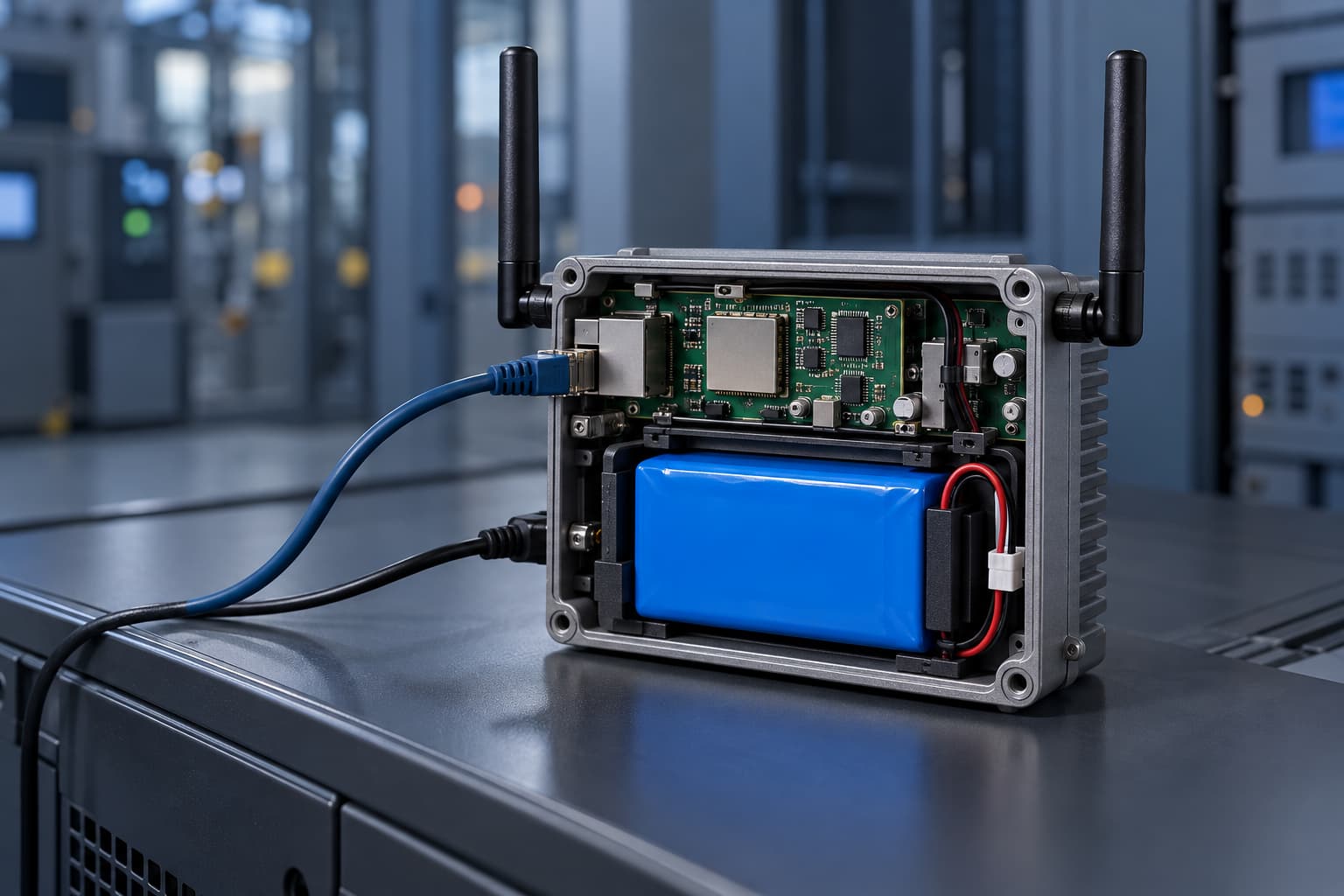
An IoT gateway backup battery can help keep equipment operating when its main power supply fails. Continued data uploads, however, depend on more than stored energy. The gateway must change power sources successfully, retain access to a working network and handle any records waiting for delivery.
Consider a gateway collecting readings from equipment in a commercial building. During an outage, its battery may keep the processor running while the network router loses power. The gateway remains active, but the remote dashboard stops receiving updates.
For an OEM buyer, the useful question is specific: which data tasks must continue during the outage, and what must the complete system support to make that happen?
Define the IoT gateway backup task first
“Keep the gateway running” leaves several possible requirements unresolved. A customer may need continuous uploads, local recording until the network returns, one outage notification or enough time for an orderly shutdown.
Each target creates a different operating plan. A gateway that records locally can have a different backup requirement from one that must maintain a live cellular connection.
Write the required outcome in plain language. For example: “Continue collecting readings during the agreed outage period, retain undelivered records and upload them after the connection returns.”
Identify the source of those readings too. If external sensors lose their own power, keeping the gateway active cannot preserve measurements they no longer produce. Define which parts of the installation remain powered.
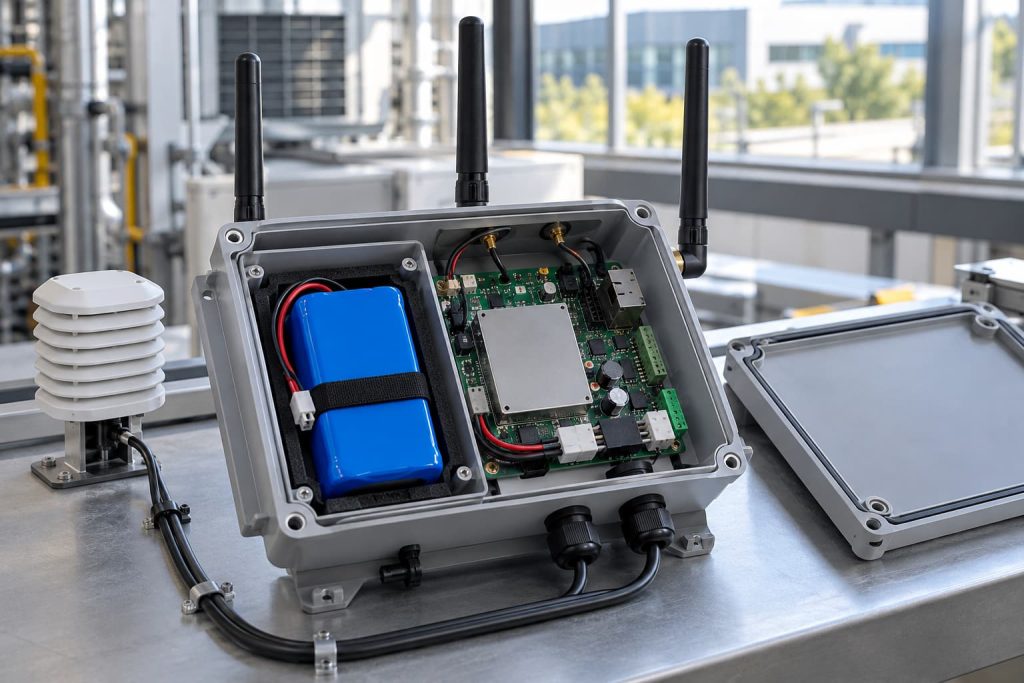
Battery backup must cover the power-source transition
A charged battery can contain enough energy for the intended task while the gateway still restarts when main power disappears. The transition depends on the device’s power-management design.
Ask the equipment team to demonstrate the change from normal supply to battery operation. Check the gateway’s behaviour while it is collecting data or transmitting, rather than testing only an idle device.
Texas Instruments’ reference design for backup power switchover illustrates why the transition between supplies needs its own design and verification. It supports the switching principle; it does not establish the performance of a particular gateway or battery pack.
Keep responsibilities clear. The battery supplies energy within its approved limits. The gateway’s charging, voltage-conversion and source-selection circuitry must work with that battery. A battery protection board alone does not provide a complete gateway backup system.
A powered gateway still needs a working communication path
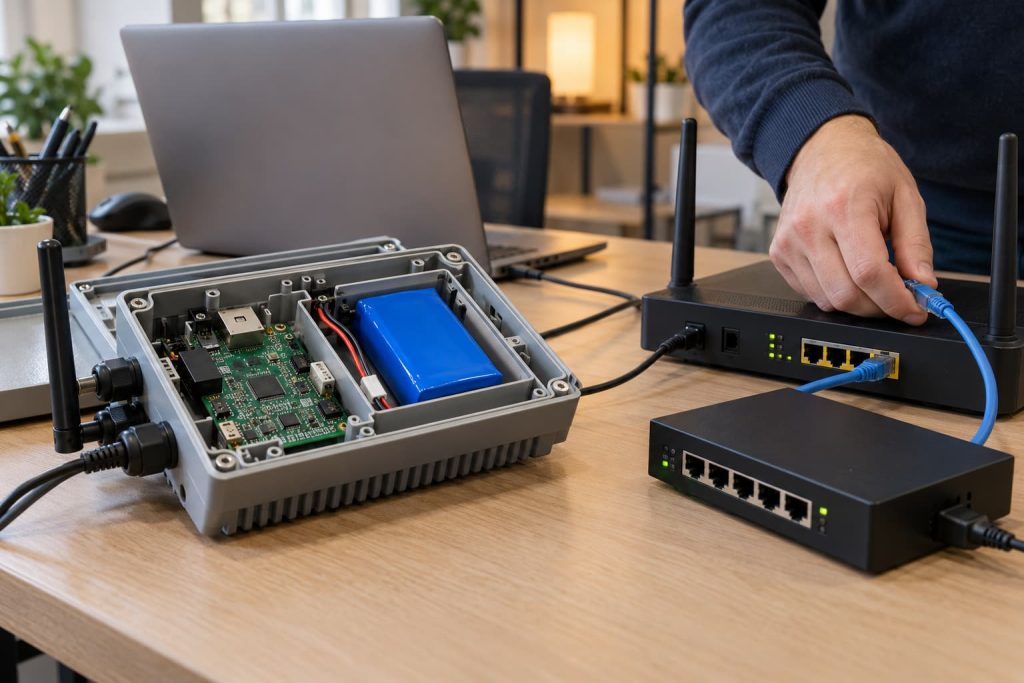
Follow the data from the gateway to its destination. Identify any router, Ethernet switch, modem or other equipment that the connection requires.
If the gateway relies on a local router, confirm how that router receives backup power. If it uses cellular communication, test the intended modem, network conditions and reconnect behaviour. A cellular connection does not guarantee that service will remain available during every outage.
Separate gateway power loss from network loss during testing. Otherwise, a missing upload may be blamed on the battery when the communication path failed elsewhere.
The buyer should receive a clear statement of the supported outcome. “The gateway stays powered” and “the server continues receiving readings” describe different results and need different evidence.
Plan what happens to undelivered IoT data
When the network becomes unavailable, the gateway needs a defined approach to records it cannot send.
Ask the firmware team how much information the device can retain, how records receive timestamps and what happens when storage approaches its limit. Define the expected outage period and recording frequency together.
Recovery deserves attention as well. When the connection returns, the system should have an agreed method for identifying records that reached the server and handling retries. Depending on the application, missing or duplicate records may both require review.
These are system and software questions. Increasing battery capacity does not resolve them. The battery assessment should support the agreed recording and recovery behaviour rather than assume that continuous power guarantees complete data.
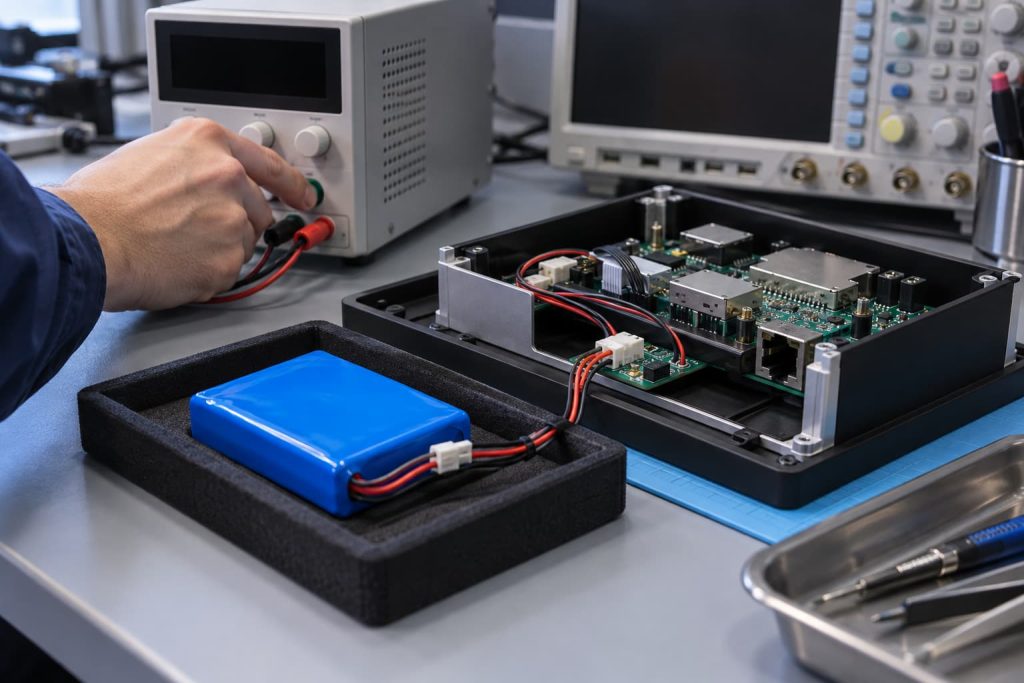
Evaluate a gateway battery against the power architecture
A battery proposal needs to match the gateway’s electrical design, installation space and operating conditions.
The 16000mAh 3.7V Polymer Battery Pack offers a specific reference for that discussion: a 1S2P assembly with 3.7V nominal voltage, 16000mAh typical capacity and 59.2Wh rated energy. Those values describe the battery, not a promised gateway backup duration.
A gateway requiring a regulated 5V, 12V or another supply needs a compatible power arrangement. The pack should not be presented as a direct replacement for an external adapter or a complete UPS.
Review current demand during communication and recovery, as well as ordinary recording. Also consider whether the enclosure provides an appropriate location for the battery. Other Polymer Battery options may deserve evaluation when space or construction requirements differ.
Test the backup system through complete outage events
A battery discharge result provides only part of the evidence. The gateway also needs testing through power loss, communication interruption and recovery.
Agree on the expected result before running the checks. Record the gateway version, firmware, battery configuration, starting charge condition, connected equipment and operating settings.
| Test event | What the buyer should establish |
|---|---|
| Main power fails during recording | Gateway behaviour and whether the current record is retained |
| Main power fails during transmission | Connection behaviour and the server’s received-data record |
| Network fails while the gateway remains powered | Local storage, retry behaviour and status reporting |
| Outage continues for the agreed period | Completion of the required recording or communication task |
| Main power returns | Return to normal supply and charging behaviour |
| Network returns | Delivery of retained records and handling of retries |
| Another outage occurs before full recharge | Performance with a partially recharged battery |
Use timestamps from both the device and the receiving system where available. A photograph showing a powered indicator cannot demonstrate that the server received every required record.
Treat this table as a proposed validation plan. Project-specific test results should state which events were actually tested and under what conditions.
Include recharge readiness in the backup requirement
An installation may experience several interruptions close together. The battery may therefore begin a later outage before it has recovered from the previous one.
Ask how charging proceeds while the gateway performs its normal work. Confirm the intended charger, available input power and the conditions used to assess recharge time.
When discussing custom battery solutions, provide the expected outage pattern alongside the required backup task. Include any limits on installation space and the measurements available from the gateway team.
That information helps define a candidate assembly and the remaining tests without turning a nominal capacity figure into an unsupported availability promise.
IoT gateway backup works when power and data recovery work together
An IoT gateway backup battery can support continued uploads when the gateway changes supplies successfully and the communication path remains available. If the network fails, the system needs an agreed method for retaining and delivering records later.
Approve the solution against that complete task. Keep the battery specification, gateway configuration and outage-test evidence together.
The purchasing decision can then follow demonstrated behaviour: what remains powered, which records reach their destination and how the equipment recovers after the interruption.