

A portable instrument runs low halfway through a job. The user connects its charger and wants to continue working. Another device stays in a powered dock throughout the day, ready for the next task.
Can these products operate while their batteries recharge?
You can use a lithium polymer battery while charging when the finished device supports that operating mode. Its charging and power-management system must handle the device load, control battery charging, and stay within the specified electrical and temperature limits. The battery type alone does not confirm that capability.
For equipment manufacturers, the useful question is what customers can do after connecting power: continue their work, recover battery charge, or both.
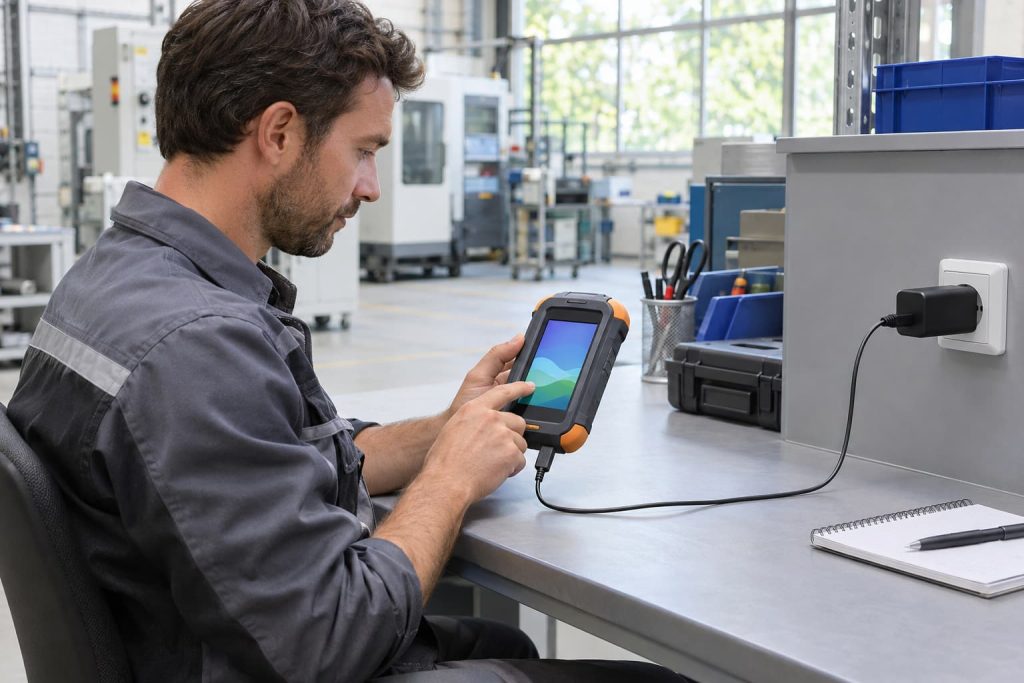
What Allows a Lithium Polymer Battery to Charge During Use?
A device needs a way to distribute incoming power between its operating circuits and its battery.
With a suitable power-path design, the external supply can power the system while the charger controls battery current separately. This helps the device respond when its load changes—for example, when a display brightens, a wireless transmitter starts, or a motor operates.
Other designs connect the system load across the battery charging output. That arrangement needs careful evaluation because the load can affect the current the charger measures and its ability to recognize charge completion.
Texas Instruments describes these differences in its application report on power-path management. The appropriate arrangement depends on the product’s load and charging requirements.
When comparing polymer battery products, manufacturers should provide the intended operating and charging behavior, along with the required capacity and dimensions. A battery specification cannot establish how the finished device routes power.
Why Can the Battery Level Fall While the Charger Is Connected?
A connected charger does not guarantee that the battery receives enough power to recharge during operation.
Some power-management systems reduce battery charging current as the device load increases. If the system supports battery supplementation, the battery may supply additional power when the input cannot meet demand. The device can therefore remain operational while gaining little charge—or temporarily losing charge. This behavior depends on the controller and its configuration.
A simplified power budget illustrates the problem. Suppose a device receives 8W of usable power after input losses:
- At a 5W operating load, some power remains available for charging.
- At an 8W load, little or no power remains for charging.
- At a 10W load, the system needs another energy source, must limit operation, or may shut down.
These figures are illustrative. Actual charging power also depends on battery voltage, charge settings, temperature, and conversion efficiency.
For a field technician, the difference matters. “Works while plugged in” and “recharges while working” describe two different product capabilities. Manufacturers should test and explain both.
A Protection Board Does Not Establish Charging Compatibility
A battery pack may include protection electronics, but those components do not replace the device’s charging and power-distribution design.
Protection functions address specified abnormal conditions. The charging circuit still needs to regulate the battery correctly, while the system design determines how the equipment operates from external power.
For example, Zenilove’s 16000mAh 3.7V Polymer Battery Pack lists CC/CV charging at 4.2V and a PCM protection circuit. Those specifications describe the pack’s charging requirements and protection arrangement. They do not establish that a device using it supports simultaneous operation and charging.
Before approving a pack, confirm its permitted charging current, discharge requirements, temperature limits, connector pinout, and any temperature-sensing connection. Review these together with the selected charger and system schematic.
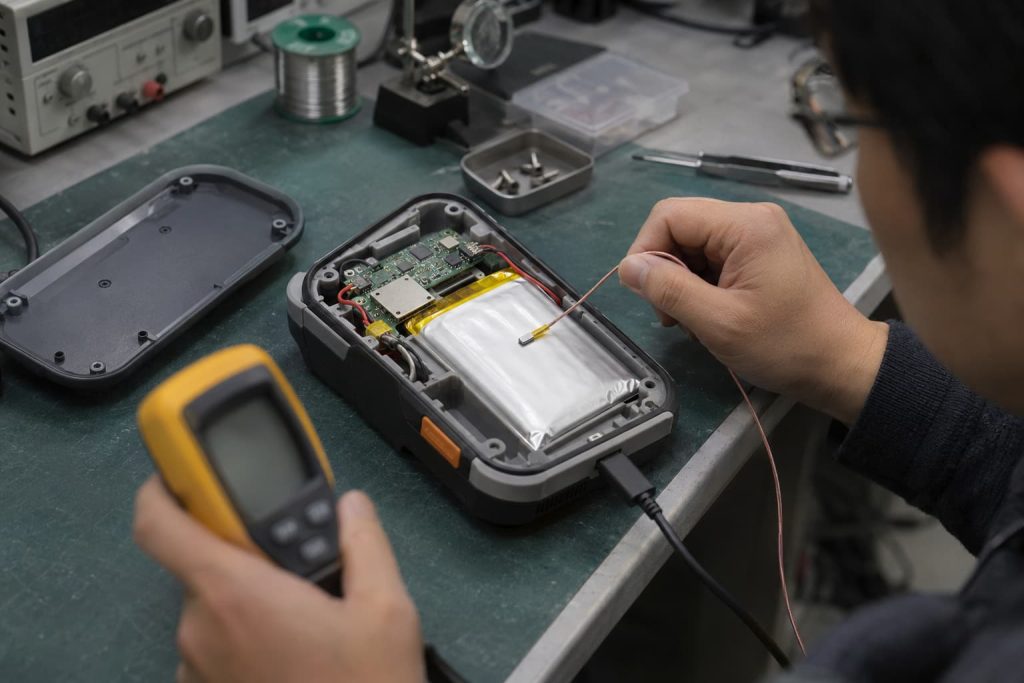
Heat Needs Checking Inside the Finished Device
Charging and active operation can create heat in several places. The charging electronics, processor, display, wireless circuits, and battery may sit close together inside a compact enclosure.
An open-board test may therefore differ from the assembled product.
Some charging controllers provide thermal regulation and battery-temperature monitoring. Their behaviour depends on the specific component, settings, and implementation; the controller’s operating-temperature rating must not be mistaken for the battery’s permitted charging range.
Manufacturers should measure the battery temperature under representative conditions, including demanding device functions. Check the applicable cell specification rather than using enclosure surface temperature as the sole acceptance measure.
A product that operates comfortably during a light demonstration may need reduced charging current during sustained use. Validation should reveal that behaviour before customers encounter it.
Test the Charging Experience Customers Will Actually Have
Start with a clear product requirement. For example:
“The instrument must continue its normal measurement task when connected to the supplied adapter, and its battery must recover charge during ordinary use.”
That requirement gives the development team more to verify than a general instruction to support charging during operation.
| Test condition | What to check | Customer experience being verified |
|---|---|---|
| Normal operation while connected | System stability and net battery current | The user can continue working and understand if the battery is recharging |
| Highest supported operating load | Input limits, battery contribution, and resets | Demanding functions remain available as specified |
| Low battery at connection | Startup behaviour and available charging power | Connecting the charger produces predictable recovery |
| Near-full battery with an active load | Charge termination, restart behaviour, and battery current | The system manages charge completion correctly |
| Repeated connection and removal | Power transitions and task continuity | Moving between a dock and handheld use does not interrupt normal work |
| Operation inside the enclosure | Battery and circuit temperatures | The assembled product meets its specified limits |
Separate battery-current measurement can help engineers distinguish charging from system consumption. Suitable power-path controllers support independent battery-current monitoring and charge termination, but the finished implementation still needs verification.
Record the adapter, cable, firmware, battery condition, ambient conditions, and operating task for each test. Those details make results repeatable and help investigate later complaints.
Give Users Clear Instructions About Charging During Use
Customers should be able to find a direct answer in the product instructions.
If operation during charging is supported, explain which functions remain available, which power accessories are approved, and if active use extends charging time. If the device restricts certain functions while connected, describe that behaviour clearly.
Avoid promising a fixed charging time based only on a powered-off test when customers are likely to keep using the equipment.
For a Custom Battery Pack project, include the expected charging routine in the initial requirements. Useful details include dock time, functions used while connected, typical charging opportunities, and the runtime needed after disconnection.
These inputs help the battery supplier and device team agree on the pack requirements and the tests needed to support the intended experience.

FAQ
These questions address common concerns about using portable equipment while it charges.
Will a Lithium Polymer Battery Charge More Slowly During Use?
It can. The operating device consumes part of the available input power, and the charging controller may reduce battery current as demand increases. Compare charging time under the same workload, adapter, and starting battery condition.
Does Using a Device While Charging Damage Its Battery?
Simultaneous operation does not, by itself, cause damage. The product must support the mode and keep the battery within its specified limits. Pay particular attention to temperature and charging conditions; follow the finished-device manufacturer’s instructions.
Can the Device Stay Connected to Power All Day?
Confirm that the manufacturer supports prolonged connected operation. A short charging test does not establish suitability for continuous dock use. The design needs appropriate charge completion, restart, power-sharing, and temperature behavior over the intended operating period.
A Lithium Polymer Battery Can Support Charging During Use When the Device Is Designed for It
The finished product determines if users can continue working while connected to power. Its power supply, charging controller, battery, and thermal design must work together under the intended load.
Before approving that feature, verify three outcomes: the device operates reliably, the battery charges as expected, and measured conditions remain within the specified limits. Those results give manufacturers a defensible basis for telling customers what to expect.