
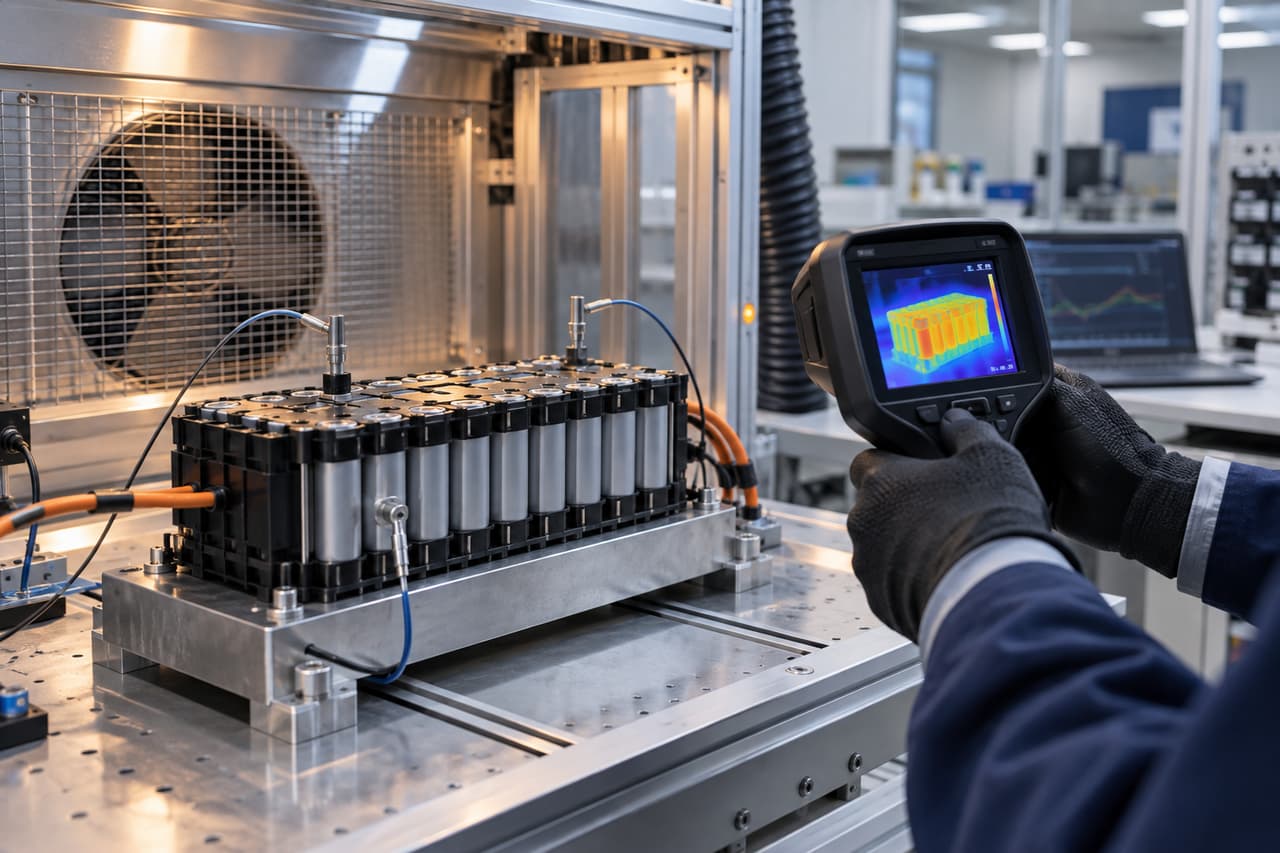
Temperature affects how much energy a 21700 battery pack can deliver, how quickly its voltage drops under load, whether it can be charged safely, and how fast it ages. Cold conditions usually reduce available runtime and power. High temperatures may improve short-term power delivery but accelerate degradation and increase safety risk. A 21700 battery pack temperature specification should therefore define separate limits for charging, discharging, and storage. These limits must come from the selected cell datasheet and finished-pack design, not the 21700 format alone.
Why 21700 Battery Pack Temperature Changes Performance
Lithium-ion cells rely on electrochemical reactions and ion movement. When temperature falls, internal resistance rises and the reactions slow. The pack then shows greater voltage sag during startup or high-current operation. A device may reach its low-voltage cutoff even though energy remains in the cells.
At elevated temperature, internal resistance may temporarily decrease, but that does not mean heat is beneficial. Prolonged exposure accelerates side reactions, capacity loss, and impedance growth. Heat produced by the pack adds to ambient temperature, so enclosed equipment can run significantly warmer than the surrounding air.
The Zenilove cylindrical battery range includes different configurations, but every finished design still requires temperature limits matched to its cell, load, enclosure, and charging system.
How Cold Conditions Reduce 21700 Battery Pack Runtime?
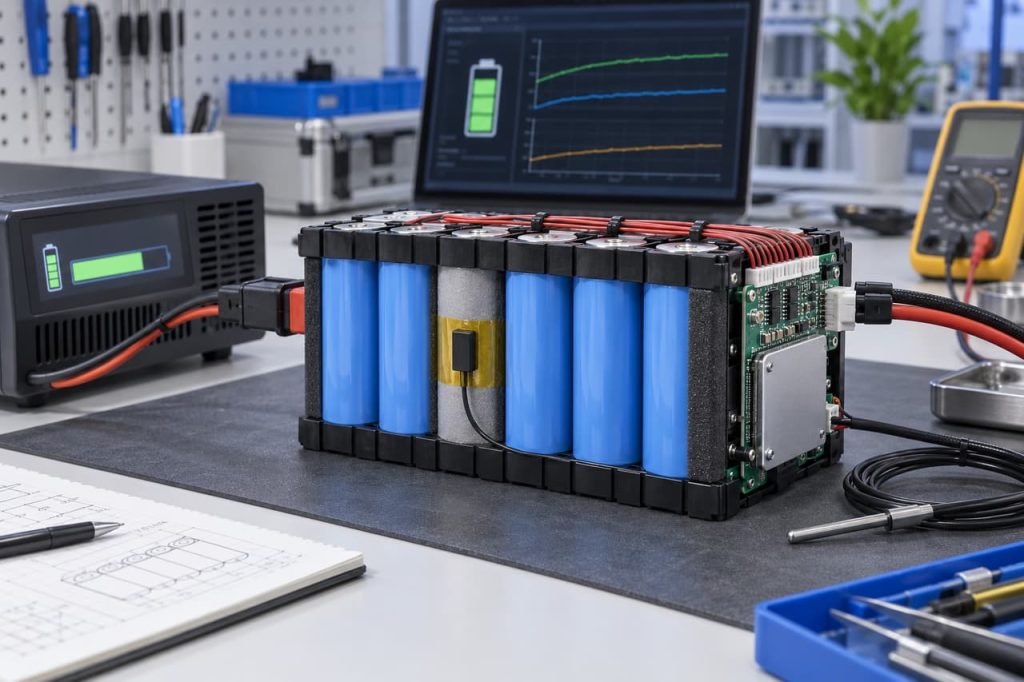
Cold weather reduces usable energy mainly through increased resistance and earlier voltage cutoff. The effect becomes more noticeable at high discharge current because voltage drop increases with load. Motors, pumps, radios, and wireless devices may reset during a current peak even when the same pack works normally at room temperature.
Runtime calculations should therefore use measured device power and a temperature-specific usable-energy factor. A nominal watt-hour value is useful for comparison, but it does not guarantee delivered energy at every temperature.
For example, a 10.8V 3S1P 21700 battery pack may meet a device’s room-temperature runtime target yet require additional capacity or load reduction in a cold environment. The exact result depends on the approved cell, discharge current, cutoff voltage, insulation, and thermal conditions.
Can a Cold 21700 Battery Pack Be Charged
Charging at low temperature requires more caution than discharging. If the cell temperature is below its approved charging range, lithium plating may occur. This can reduce capacity and create a safety risk that may not be visible immediately.
The charger should not start merely because the equipment has entered a warm room. A cold pack may need time to equalize before the temperature is measured; start charging only after the cells are within the approved range.
A BMS with a temperature sensor can block charging outside specified limits, but you must verify the complete system. Sensor placement, sensor tolerance, thermal delay, charger behavior, recovery threshold, and firmware logic all affect the result.
How High Temperature Affects Battery Life and Safety?
High ambient temperature, direct sunlight, nearby electronics, and internal current heating can raise cell temperature. Continuous high temperature accelerates aging, so the pack may lose capacity faster and develop more voltage drop over its service life.
Heat can also trigger BMS temperature protection or force the device to reduce power. If the enclosure traps heat, a pack that passes a short bench test may still overheat during an extended duty cycle.
Higher-capacity configurations can sometimes reduce current per parallel cell. A 10.8V 3S2P 21700 battery pack may therefore experience less cell-level electrical stress than a 3S1P pack under the same total load, but it also occupies more space and changes heat distribution. Measure thermal performance rather than assume it.
Design Battery Pack Temperature Management
Begin with the actual operating environment. Record minimum and maximum ambient temperature, sunlight exposure, installation orientation, enclosure material, airflow, nearby heat sources, duty cycle, and charging location.
Then evaluate the complete thermal path:
- Cell temperature during continuous and peak loads
- Temperature difference between interior and exterior cells
- BMS and connector temperature
- Cooling time before charging
- Warm-up time after cold storage
- Enclosure ventilation and insulation
- Sensor position and attachment method
Do not place a temperature sensor where it mainly measures circuit-board or ambient temperature if the safety decision depends on cell temperature. The drawing should define the sensor, location, attachment, wiring, cutoff limits, and recovery behavior.
Test the Finished Pack at Relevant Temperatures
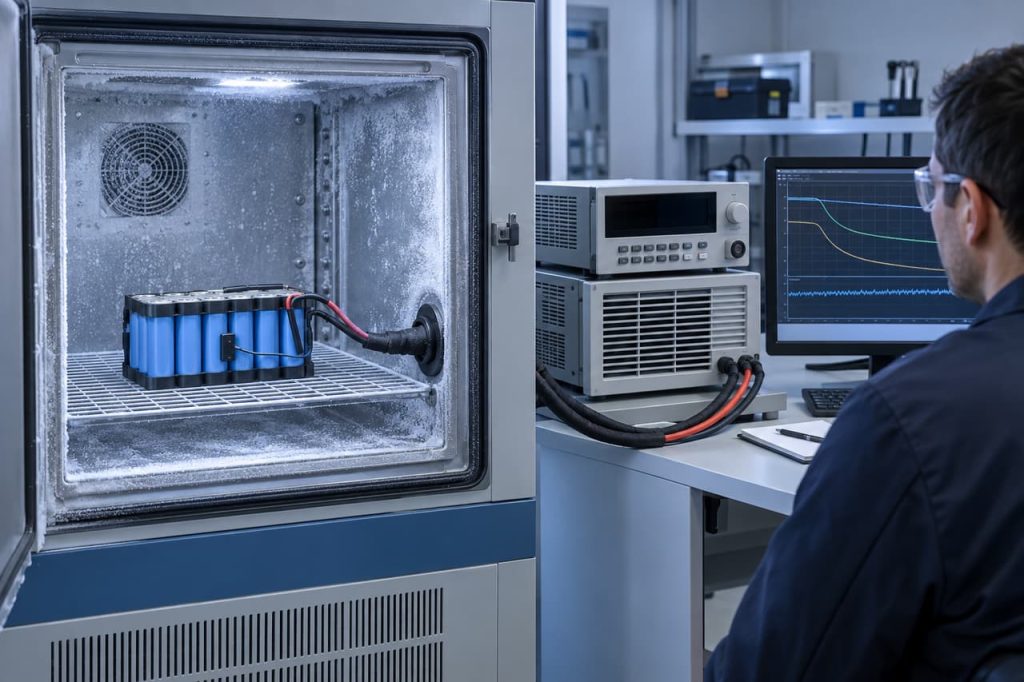
Test production-intent samples with the real equipment, charger, firmware, enclosure, wires, and connectors. Use controlled temperatures that represent the application rather than testing only at room temperature.
Record pack voltage, individual series-group voltage, current, cell temperature, BMS temperature, connector temperature, runtime, cutoff event, and recovery behavior. Repeat high-load events at different states of charge because voltage sag usually becomes more critical near the end of discharge.
Charging tests should verify cold-charge blocking, restart temperature, maximum charge temperature, sensor fault behavior, and charger response after a protection event. Safety and compliance planning should reference the applicable scope and current edition of IEC 62133-2, along with product-specific and transport requirements.
Practical Temperature Checklist
- Confirm cell charging, discharging, and storage temperature limits.
- Measure internal pack temperature, not ambient temperature alone.
- Test startup peaks at the lowest expected operating temperature.
- Verify charging is blocked when cells are too cold or too hot.
- Check temperature rise during the longest duty cycle.
- Validate sensor placement and recovery thresholds.
- Recheck runtime and cutoff behavior after aging.
Frequently Asked Questions
Does cold permanently damage a 21700 battery pack?
Cold operation often temporarily reduces runtime and power. Performance may recover after the pack warms. Charging below the approved temperature is more likely to cause permanent damage and must be prevented.
Why does equipment shut down early in cold weather?
Cold cells have higher internal resistance, which creates more voltage sag under load. The equipment or BMS may reach its cutoff voltage before the pack has used its nominal energy.
Is ambient temperature enough for battery protection?
No. Cell temperature can differ from ambient temperature because of insulation, enclosure design, current heating, nearby components, and thermal delay. Protection decisions should use a validated sensor location inside the finished pack.
Should an industrial battery pack include temperature sensing?
It depends on the cell, current, enclosure, charger, environment, and safety requirements. For equipment exposed to cold charging, high heat, or sustained current, temperature sensing is often an important part of the protection strategy.