

Lithium polymer batteries may remain in a factory warehouse for weeks or months before being installed in finished products. During that period, storage conditions become part of battery quality control. Temperature, state of charge, storage duration, packaging, mechanical handling, and lot traceability can affect whether a battery remains suitable for assembly.
For OEM projects, lithium polymer battery storage should therefore follow a defined process from receiving to production release. This is particularly important for custom lithium polymer battery packs that include protection circuits, wires, connectors, insulation, or other components in addition to the pouch cell.
Set Lithium Polymer Battery Storage Conditions at Receiving
Begin storage control when the shipment reaches the factory.
The receiving team should record:
- battery model;
- production lot;
- manufacturing date;
- receiving date;
- quantity;
- incoming inspection result;
- storage location.
The battery specification should also define the conditions required while the pack remains in inventory.
These may include:
- recommended storage temperature;
- acceptable storage state of charge;
- voltage inspection limits;
- packaging requirements;
- review interval for extended storage.
The factory should not create one universal storage rule for every lithium polymer battery.
A 1S polymer pack and a multi-cell pack with a PCM may have different manufacturer requirements.
For example, one of Zenilove’s 126090 3S1P lithium polymer battery packs specifies a recommended storage temperature of approximately 25°C ± 5°C and approximately 40%–50% charge. Those values belong to that specific pack and should not automatically be copied to every battery model.

Control Temperature During Lithium Polymer Battery Storage
Keep the battery storage area within the range specified for the actual cell or pack.
The recorded warehouse temperature alone may not describe the environment around every battery carton.
Possible local hot spots include:
- sun-facing walls;
- loading areas;
- locations near heaters;
- production equipment;
- metal containers;
- poorly ventilated rooms.
This matters because elevated temperature can accelerate lithium-ion battery aging.
Battery University summarizes lithium-ion aging data showing that elevated temperature and high state of charge together can increase capacity loss during storage. Battery University: How to Prolong Lithium-Based Batteries
For an OEM warehouse, the practical point is simple:
Do not use the device operating-temperature range as the warehouse storage specification.
A battery may tolerate a certain temperature during operation for a limited period while still requiring more controlled conditions during extended storage.
Manage State of Charge During Storage
Lithium polymer batteries should not remain indefinitely at an uncontrolled state of charge.
For lithium-ion systems, long periods at both elevated temperature and high charge level can accelerate calendar aging. General lithium-ion storage guidance therefore favors partial charge and cooler conditions rather than prolonged storage at full charge.
However, an OEM should still follow the requirements of the actual cell or pack rather than applying one percentage to every battery.
The storage document should specify:
- target storage voltage or state of charge;
- acceptable range;
- inspection interval;
- action if voltage moves outside the range.
This becomes especially important when production is delayed.
A battery shipment originally expected to remain in the warehouse for two weeks may still be there several months later because another component is unavailable.
That longer storage period should trigger a defined review rather than an assumption that nothing has changed.
Keep Lithium Polymer Battery Lots Traceable
Battery lots should remain identifiable throughout storage.
Useful records include:
- supplier batch number;
- cell or pack model;
- manufacturing date;
- pack assembly date;
- receiving date;
- storage location;
- quantity remaining;
- inspection status.
Record the manufacturing date and receiving date separately.
Two shipments may arrive at the factory on the same day even though the batteries were manufactured at different times.
If you record only the receiving date, it becomes harder to determine actual battery age.
FIFO can help manage inventory, but FIFO should support traceability rather than replace it.
If a production or field issue later appears, lot records allow the quality team to isolate the affected inventory instead of treating all stored batteries as one group.
Protect Polymer Batteries From Mechanical Storage Damage
Lithium polymer cells use flexible pouch construction, so warehouse handling needs to prevent concentrated mechanical pressure.
Common storage risks include:
- heavy parts stacked on battery cartons;
- connectors pressing into neighboring pouches;
- sharp tray edges contacting the cell;
- trapped or bent wires;
- packs moving freely inside oversized containers;
- batteries being mixed with unrelated metal components.
Original trays and protective packaging should normally remain in place until the batteries are required for assembly.
This helps protect the pouch and keeps production lots separate.
For higher-capacity packs such as Zenilove’s 16000mAh 3.7V polymer battery pack, storage handling must also account for the finished pack structure, PCM, wires, and connector, not just the bare cell.
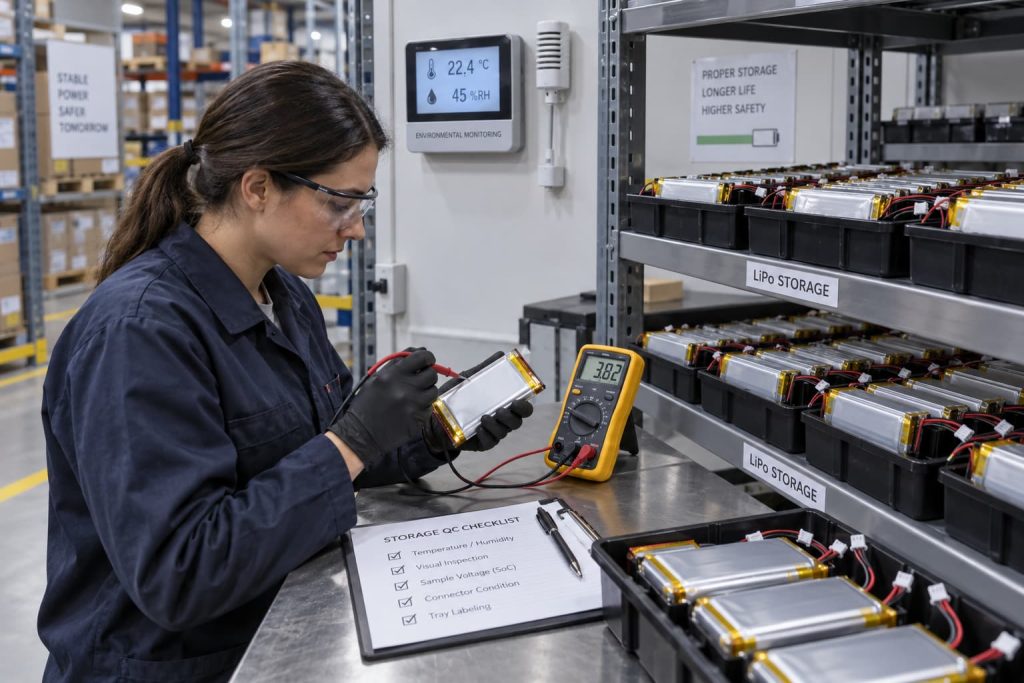
Inspect Batteries During Extended Storage
Inventory that remains unused for an extended period may require another review before production.
This is not the same as repeating battery qualification testing.
The question is narrower:
Has the stored inventory developed an abnormal condition?
Appearance
Check samples for:
- swelling;
- pouch deformation;
- damaged insulation;
- corrosion;
- wire damage;
- connector damage.
Isolate any battery showing abnormal swelling or physical damage from normal production inventory.
Voltage
Compare sample voltage with the battery’s specified acceptance range.
Voltage alone does not fully measure battery health, but an abnormal reading can identify units that need further evaluation.
Packaging
Inspect:
- trays;
- dividers;
- cartons;
- protective covers;
- labels.
Damaged packaging may indicate that the batteries were exposed to pressure or handling conditions that require closer inspection.
Traceability
Ensure the lot identification remains readable and matches the warehouse record.

Prepare Stored Batteries for Production Release
Before a battery lot moves from storage to the assembly line, it should pass a simple release check.
| Release Check | Purpose |
|---|---|
| Lot number | Maintain traceability |
| Storage duration | Identify older inventory |
| Appearance | Detect visible abnormality |
| Sample voltage | Screen unusual units |
| Connector and wire | Detect handling damage |
| Packaging | Confirm storage condition |
| Quantity | Confirm production release |
This process should remain focused on storage.
It is not another battery selection exercise, and it is not a repeat of prototype validation.
Qualification asks:
Is this battery design suitable for the product?
Storage release asks:
Is this specific stored lot still suitable to enter production?
Define Rules for Unexpectedly Long Storage
OEM production schedules often change.
PCB shortages, enclosure changes, certification delays, tooling issues, or customer approvals can extend storage.
The storage procedure should already define what happens when inventory remains unused longer than planned.
Useful controls include:
- review interval;
- sample quantity;
- voltage acceptance range;
- visual inspection criteria;
- maximum interval before another review;
- conditions requiring supplier evaluation.
This prevents warehouse or production staff from making an improvised decision when older inventory is suddenly needed.
Keep Lithium Polymer Battery Storage as a Controlled Process
Lithium polymer battery storage begins when the shipment is received and ends when an approved lot is released to the production line.
A practical process should control:
- storage temperature;
- state of charge;
- inventory age;
- packaging;
- mechanical handling;
- lot traceability;
- release inspection.
General lithium-ion guidance can help explain how temperature and state of charge affect storage aging, but actual limits should always come from the specification for the battery being used.