

A wrong battery size, an inconsistent batch, or a missing shipping document can delay production, increase rework, or create after-sales problems — and none of it shows up in the unit price. For OEM manufacturers, wholesalers, and industrial buyers, bulk purchasing button batteries carries risks that only surface after the order is placed. Here is what buyers should verify before placing a bulk order.
Button Batteries Size Accuracy and Device Compatibility
Button batteries may look nearly identical, but small dimensional differences have real consequences. CR2032, CR2025, and CR2016 share the same 20mm diameter but differ in thickness: 3.2mm, 2.5mm, and 1.6mm respectively. These differences affect fit, terminal contact, and assembly reliability.
Before ordering at volume, confirm:
- Battery model and dimensions — diameter and thickness both matter
- Device compartment size — verify against the spec sheet, not a visual estimate
- Contact structure — spring-loaded and clip-type holders have different tolerances
- Voltage requirement — many lithium coin cells are 3V, but buyers should confirm the device circuit requirements
- Application environment — temperature, humidity, and vibration may affect chemistry selection
Sourcing the wrong size at scale can lead to rework, line stoppages, and delayed shipments.

Stable Voltage and Reliable Button Batteries Performance
Low-grade button battery may pass incoming inspection but underperform in actual use. They can cause unexpected device shutdowns, unstable power output, or shortened product lifespans.
For small electronics such as wearables, remote controls, sensors, and compact medical devices, this kind of performance issue can quickly become a product quality problem. For B2B buyers, it may also lead to warranty claims, returns, and higher after-sales costs.
When evaluating suppliers, ask for documentation on:
- Long service life under typical discharge conditions
- Low self-discharge rate during storage
- Stable discharge performance throughout the battery’s useful life
A reliable button battery should perform consistently not only during initial testing, but also after transportation, warehousing, and final product delivery.
Batch Consistency for Bulk Button Battery Orders
Ordering 50,000 units is not the same as ordering 50. The risk is not just one bad cell. The bigger issue is systematic variation across a production run, which can lead to inconsistent testing results and uneven field performance.
Key consistency factors to confirm with your supplier include:
- Consistent voltage output across the batch at the time of shipment
- Lot-level capacity verification through sampling or full-lot testing
- Batch traceability with lot numbers, production dates, and clear records
- Uniform packaging to prevent discharge and physical damage during transit
- QC process transparency with in-house or third-party inspection records available when needed
For B2B buyers, consistency is often more important than the lowest unit price. A small cost saving means little if field failure rates increase or finished products perform unevenly.

Button Battery Safety, Leakage Resistance, and Export Support
Leakage and short-circuit risks are real concerns, especially in applications such as children’s toys, consumer electronics, and compact medical devices. A leaking cell can damage the device, create safety concerns, and increase after-sales pressure.
Before committing to a supplier, confirm their approach to:
- Leakage resistance
- Sealing materials and cell design
- Short-circuit risk control
- Packaging integrity for long storage or international transit
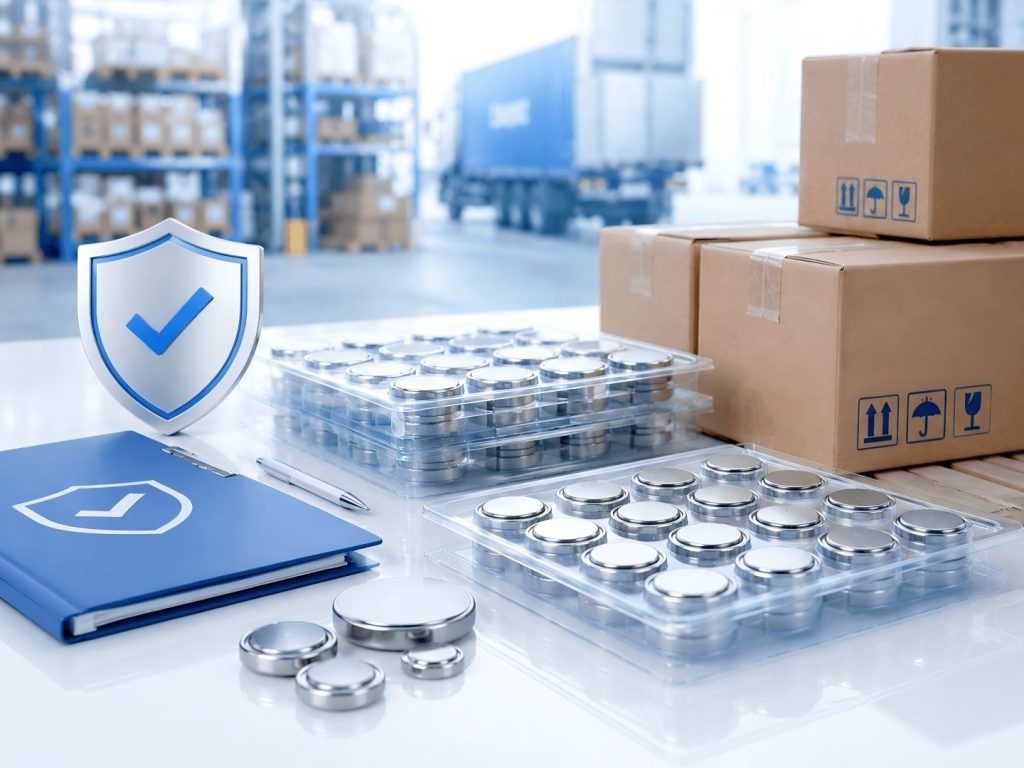
If you are importing button batteries, export documentation also matters. Make sure the supplier can provide MSDS, UN38.3 test reports, and other required shipping documents. Incomplete paperwork can lead to customs delays, rejected shipments, and unexpected logistics costs.
Stable Supply for OEM and Wholesale Buyers
Button batteries are low-cost components, but a supply gap can hold up the entire production schedule. OEM and wholesale buyers need more than a one-time transaction. They need a supplier who can support ongoing volume, consistent lead times, and flexible packaging options across repeat orders.
When evaluating sourcing partners, look for:
- Clear MOQ terms
- Stable production capacity
- Flexible packaging support
- Reliable lead time commitments
- Export experience for your target markets
A stable supplier helps buyers reduce production uncertainty and plan repeat orders with more confidence.
Reliable Button Batteries Start with the Right Supplier
Getting button battery procurement right means looking beyond unit price. Buyers should consider size precision, voltage stability, batch consistency, leakage resistance, export support, and long-term supply reliability.
Zenilove works with OEM manufacturers, wholesalers, and product companies that need a consistent, well-documented button battery supply. In-house quality control, export compliance support, and experience across a range of small-electronics applications help buyers manage button-battery sourcing with greater confidence, from sample evaluation to repeat bulk orders.