
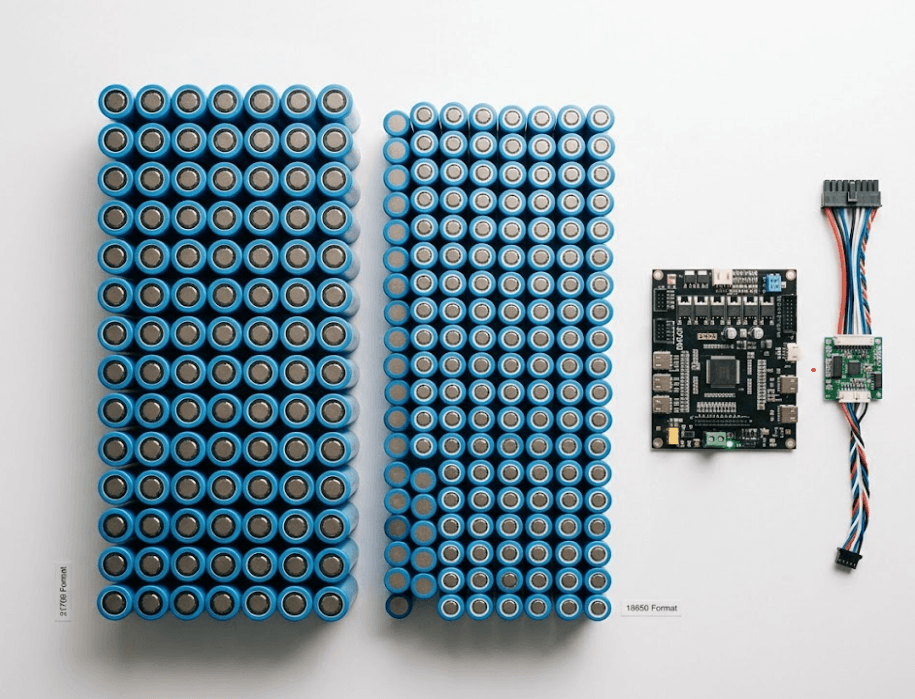
Basically, every UAV, medical device, and industrial IoT product has a power requirement that standard cells were never designed to meet. In fact, off-the-shelf cylindrical cells compromise runtime, thermal performance, and certification compliance. Ultimately, a custom cylindrical battery is not an upgrade — it is the correct engineering decision from the start.

Why Choose a Custom Cylindrical Battery for Your Next Project?
A custom cylindrical battery matches your project’s exact voltage, capacity, form factor, and BMS logic. For UAVs, medical devices, robotics, and industrial IoT, standard cells introduce compromises that custom configurations eliminate. As a result, the outcome is longer runtime, better thermal control, and full certification compliance.
Custom Cylindrical Battery Configurations: Standard vs. Custom
Not all cylindrical battery programs are equal. Here is how they compare:
| Specification | Standard off-the-shelf | Custom cylindrical battery Recommended |
|---|---|---|
| Cell format | Fixed (18650 only) | 18650, 21700, 26650, 32650 |
| BMS configuration | Generic protection only | Application-specific thresholds |
| Voltage / capacity | Fixed by manufacturer | Engineered to device requirements |
| Connector type | Standard terminals | XT30, XT60, IP67, custom |
| Certifications | Generic UN38.3 only | UN38.3, UL 2054, IEC 62133 |
| Casing | Shrink wrap only | ABS, PC enclosure, private label |
| Lead time | Stock availability | 7–14 days prototype, low MOQ Fast |
Voltage and Capacity Match Your Device, Not the Catalog
Standard cells lock you into fixed voltage and capacity combinations. A custom cylindrical battery program, however, starts from your device’s operating requirements. Specifically, series configuration increases system voltage — a 4S pack using 3.6V nominal cells produces 14.4V. That said, this voltage level is standard for UAV flight controllers and industrial motor drivers. In turn, parallel configuration multiplies capacity — a 3P pack triples runtime at the same voltage. Therefore, combined S×P configurations address both constraints in a single assembly. In other words, the engineering conversation starts with your load profile, not the supplier’s catalog.

BMS Logic Protects Your Device, Not a Generic Load
A generic BMS protects a generic load. Your device, however, is not generic. For medical devices, specifically, BMS firmware must support state-of-health reporting via SMBus or I²C. For industrial IoT sensors, meanwhile, ultra-low quiescent current BMS design extends standby life significantly. UAV propulsion, by comparison, overcurrent thresholds must tolerate burst draw without nuisance tripping. Ultimately, a BMS tuned to your application is the difference between a reliable product and a field failure. In short, generic protection is not protection at all.
Certification Compliance Is Built In, Not Added On
Certification is not a final step — it is a design input. Specifically, UN38.3 is non-negotiable for any lithium battery shipped by air. Without it, shipments face customs detention. Moreover, UL 2054 accelerates qualification for North American programs. Additionally, IEC 62133 satisfies CE marking across Europe. Above all, battery safety standards apply at the cell, pack, and system level — meaning compliance must be engineered across the full assembly. Therefore, specifying certifications at the cell selection stage eliminates costly redesigns later. According to IEC, this principle holds across all lithium battery categories.
Custom Cylindrical Battery Series and Parallel Configuration: A Quick Reference
Series increases voltage. Parallel, by contrast, increases capacity. Both, in turn, affect BMS complexity and cell matching requirements. For multi-cell packs, specifically, capacity variance between cells must stay below 2%. Otherwise, string imbalance accelerates over time. Consequently, cell grading before assembly is non-negotiable. Without it, moreover, field performance across a production run becomes unpredictable. In summary, cell matching is as important as cell selection.

Prototype to Production: Lead Times and MOQ
Engineering samples are available within 7–14 working days from confirmed specifications. Notably, pilot runs — typically 50–200 units — use the same cell grade and assembly process as production units. As a result, performance data from pilot testing transfers directly to production qualification. Furthermore, mass production scales to tens of thousands of units per month. In addition, repeat order lead times drop to 5–7 working days with safety stock programs. In short, the process is designed to move as fast as your program demands.
The Right Battery Starts With the Right Specification
A custom cylindrical battery is the correct baseline for any device where runtime, thermal performance, or certification compliance matters. After all, UAV propulsion, medical monitoring, robotic actuation, and industrial IoT sensing all share the same requirement: a power source engineered to the application. Indeed, standard cells approximate that requirement. Custom configurations, by contrast, meet it precisely. Accordingly, Our works with hardware engineers and procurement teams to specify and scale custom cylindrical battery solutions from prototype through mass production.