
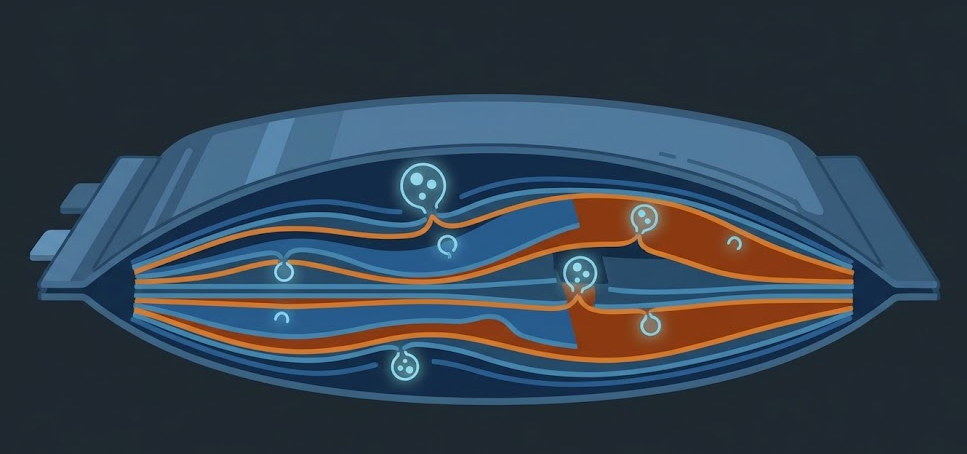
When a LiPo battery starts to swell, the pouch is filling with gas and separating from the inside out. That’s not something that stabilises on its own — it gets worse. Here’s why it happens, what follows if you ignore it, and where to catch it early.
What Causes LiPo Battery Swelling?
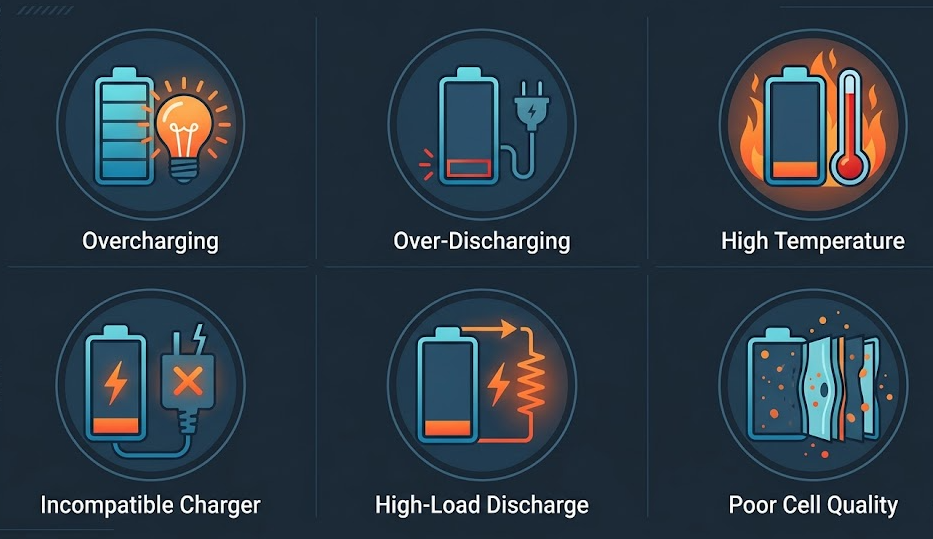
Every swollen LiPo battery has the same root cause — gas building up inside the cell faster than the structure can handle. But what triggers that gas varies. Some batteries swell because of how they were made: inconsistent electrode coating, poor electrolyte quality, or inadequate formation cycling. Others swell because of how they’re being run — pushed past their voltage limits, operated in heat they weren’t designed for, or paired with the wrong charger. In practice, it’s rarely just one factor. A marginal cell under heavy load will swell faster than either problem would cause on its own.
Design and manufacturing factors
- Unstable cell quality: Inconsistent electrode coating, electrolyte impurities, or poor formation cycling in custom lithium polymer cells can trigger gas generation from the very first charge.
- Poor internal heat dissipation: If the cell cannot shed heat fast enough, temperature builds up locally and breaks down the electrolyte — even at normal load.
Usage and Operating Factors
- Overcharge/over-discharge: Exceeding the battery’s voltage limit will cause the electrolyte to decompose and release gases that cannot escape.
- Incompatible charger: A charger that does not match the battery’s charging profile sends the wrong voltage or current — more than the cell was built to handle.
- Prolonged high-temperature use: Heat speeds up every chemical reaction inside the cell, including the ones that produce gas.
- Sustained high-load discharge: Drawing more current than the cell’s rated C-rate raises internal resistance and builds up heat with every cycle.
What Should You Do with a Swollen LiPo Battery?
- Stop using or charging it right away
- Keep it in a cool, ventilated spot away from anything flammable
- Do not puncture, compress, or try to press it flat
- Take it to a certified battery recycling facility — regular waste disposal is not safe
What Are the Risks of a Swollen LiPo Battery?
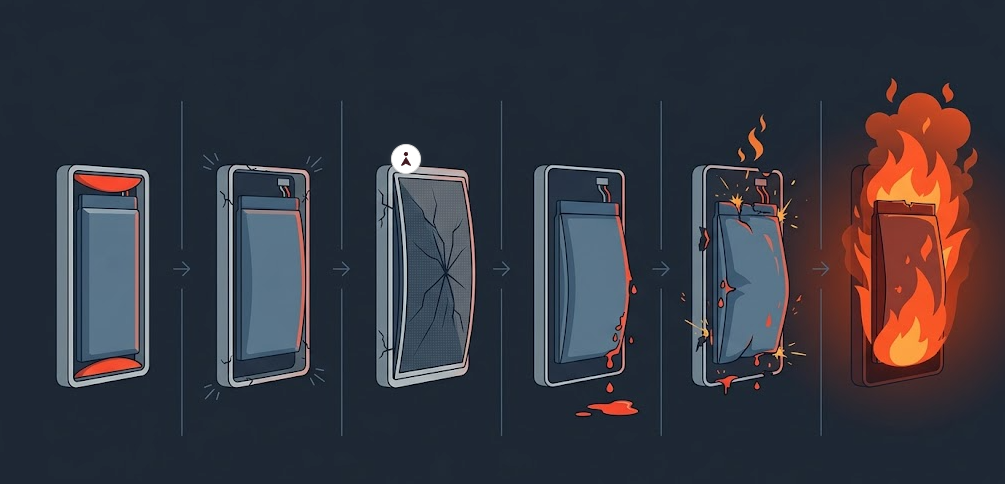
Leaving a swollen battery in place does not slow things down — it makes them worse, step by step.
- The expanding pouch pushes against the device enclosure, cracking the housing or warping the frame
- That pressure then damages screens, PCBs, or structural components
- If the laminate tears, electrolyte leaks out and contacts surrounding materials
- In bad cases, the exposed electrolyte ignites and thermal runaway sets in fast
The further it gets, the harder and more costly it is to deal with.
How to Identify a Swollen LiPo Battery Early?
Catching it early keeps it from reaching the stages above.
- Visual: The battery surface bulges, curves, or no longer sits flat — any deformation counts
- Physical: Pressing the center of the cell feels softer than it should
- Device behavior: Sudden capacity drop, inconsistent charge readings, or the device cutting out earlier than expected
How to Prevent LiPo Battery Swelling?
In most cases, swelling starts with a decision made early on — either the wrong cells were sourced, or the system design pushed the battery harder than it was built to handle. That’s where the fix has to happen. By the time a battery starts swelling, the problem has already gotten through.
At the Design Stage
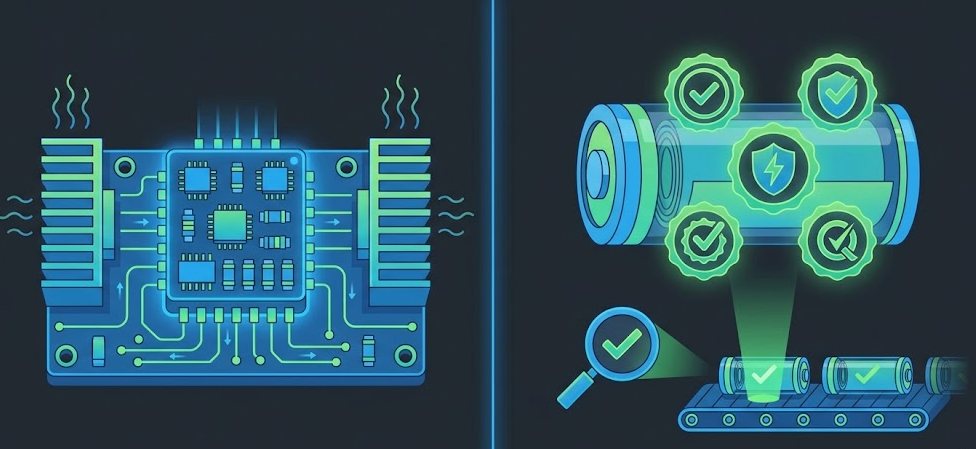
- BMS protection: Set tight overcharge and over-discharge cutoffs — a properly configured BMS stops the most common causes of swelling before they start
- Thermal management: Build enough heat dissipation into the enclosure — cells that stay cool generate far less gas over their lifetime
- Charging protocol: Match the CC/CV profile to the cell’s exact specs; do not assume a charger is compatible without checking
At the Sourcing Stage
- Cell quality verification: Ask for formation data, capacity consistency reports, and cycle life results before locking in a cell supplier — or explore custom battery solutions built to your exact spec
- Certification standards: Work with manufacturers that hold UN38.3 certification standards, MSDS, and transport certifications — these show process control, not just paperwork
Swelling Doesn’t Fix Itself — But It Can Be Prevented
When lithium polymer batteries swell, it usually indicates a problem with the battery itself, the system design, or its operation. The solution is not to resort to post-incident remediation, but to reduce the likelihood of swelling in the first place. This includes ensuring battery quality, correctly configuring the battery management system (BMS), and establishing thermal management mechanisms early on. Swelling is predictable and, in most cases, preventable.