
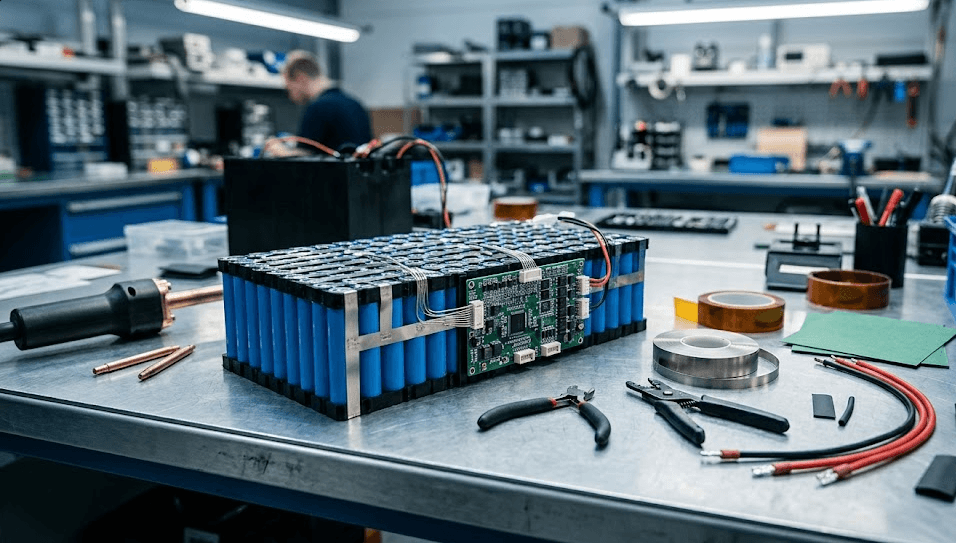
Custom battery pack assembly combines selected cells, a BMS, wiring, connectors, insulation, and mechanical structures into a battery pack designed for a device’s voltage, capacity, size, discharge current, and safety requirements. Unlike off-the-shelf battery packs, a custom lithium battery pack is built for a specific application, so each design decision affects performance, safety, and reliability in real use.Unlike off-the-shelf battery packs, a custom lithium battery pack is built for a specific application.
Defining Battery Pack Requirements
Every lithium battery assembly project starts with a clear specification. Before any cell is selected or wiring is planned, the following parameters need to be defined:
- Nominal voltage – determined by how many cells are connected in series
- Capacity (Wh or Ah) – how much energy the pack must store
- Maximum continuous discharge current – based on the peak load of the device
- Charging method – CC/CV charging, wireless charging, or regenerative input
- Physical dimensions – length, width, height, and weight limits
- Operating temperature range – storage, discharge, and charging temperature windows
- Certifications required – such as UL, CE, UN38.3, IEC 62133, or RoHS
Missing or vague specifications at this stage often lead to redesigns and delays later in the battery pack manufacturing process.
Selecting the Right Cells for Your Battery Pack Assembly
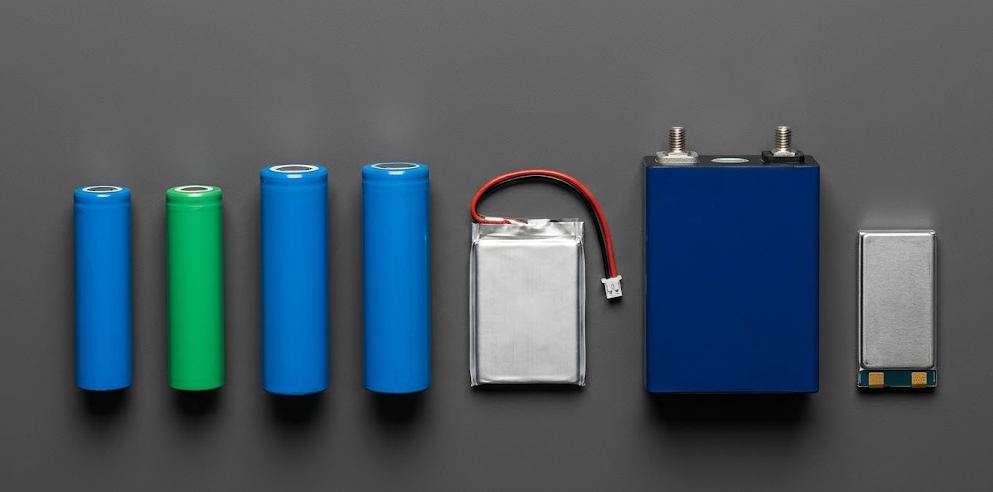
Cell selection is one of the most important decisions in custom battery pack assembly. The cell type affects energy density, cycle life, discharge rate, thermal behavior, and overall cost.
Lithium battery cell types — comparison
| Cell type | Form factor | Key strength | Typical use |
|---|---|---|---|
| 18650 | Cylindrical | Mature supply chain, stable chemistry, widely available | Laptops, power tools, EVs |
| 21700 | Cylindrical | Higher capacity than 18650, better energy-to-weight ratio | High-drain devices, EVs |
| LiPo | Pouch / flat | Thin and lightweight, flexible shape for tight enclosures | Drones, wearables, IoT |
| LiFePO4 | Various | Long cycle life, thermally stable, safer chemistry | Energy storage, medical, industrial |
| Prismatic | Rectangular | High capacity per cell, space-efficient in flat pack designs | Stationary storage, EVs |
Cell selection should also account for cell-to-cell consistency (matched internal resistance and capacity) to ensure stable performance across the full pack. For cylindrical battery designs, 18650 and 21700 cells are common choices because of their mature supply chain and stable performance.
Designing the Pack Structure and Layout
Once the cells are chosen, the pack structure must be designed around the device’s physical constraints. This involves:
- Series-parallel configuration – series connections raise voltage; parallel connections raise capacity
- Cell arrangement – linear rows, stacked layers, or custom layouts to fit the enclosure
- Housing material – plastic shells, aluminum enclosures, or soft shrink wrapping depending on the application
- Wire gauge and connector type – matched to the expected current load and mating connector on the device
- Insulation and thermal padding – to prevent short circuits and manage heat distribution
An OEM battery pack design must balance electrical performance with mechanical durability and ease of assembly.
Adding BMS Protection and Safety Features
A Battery Management System (BMS) is required in virtually all custom lithium battery packs. The BMS monitors and controls the pack to prevent damage and ensure safe operation. Core protection functions include:
- Overcharge protection – cuts off charging if cell voltage exceeds the safe limit
- Over-discharge protection – prevents cells from discharging below the minimum voltage
- Overcurrent and short-circuit protection – disconnects the output if current exceeds safe thresholds
- Over-temperature protection – shuts down the pack if temperature sensors detect unsafe heat levels
- Cell balancing – equalizes charge across cells in series to extend cycle life and prevent imbalance
The BMS specification must align with the pack’s voltage, current, and operating environment. An undersized or poorly matched BMS is one of the most common causes of field failures in custom battery packs.
Welding and Insulation in the Battery Pack Assembly Process
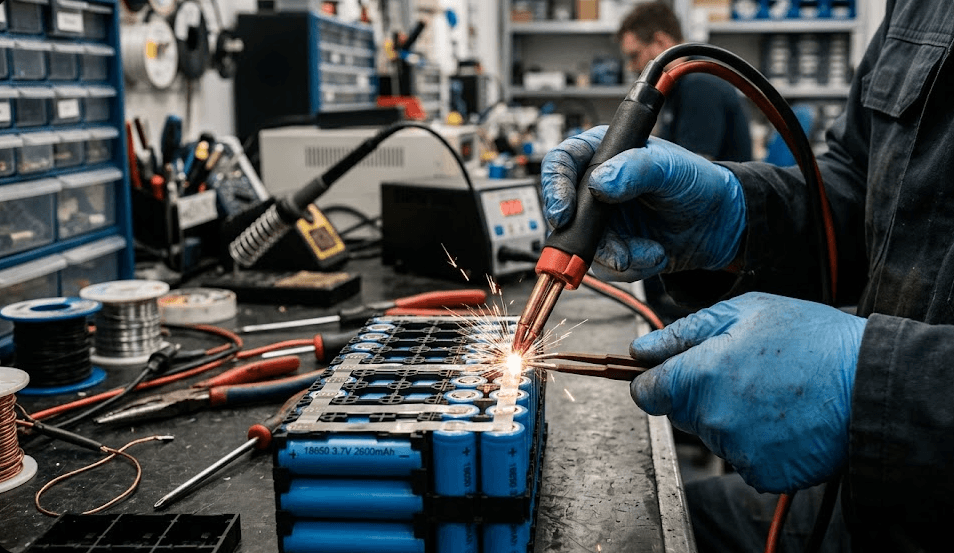
With the design finalized, physical assembly begins. Technicians use spot welding to connect nickel strips or nickel-plated steel strips to the cell terminals, forming the required series and parallel connections. Most manufacturers avoid direct soldering on cells at this stage because excessive heat can damage the cell or affect long-term performance.
After welding, the team secures the cells with holders or brackets to keep the pack stable and reduce mechanical stress on the weld points. Insulation materials such as fish paper, Nomex, Kapton tape, or PVC heat shrink help prevent internal short circuits. Lead wires are then crimped or soldered to connectors, while wire routing is arranged to avoid sharp bends, pressure points, or contact with enclosure edges.
Finally, the assembled cell group and BMS are placed into the housing, secured, and closed. Workmanship quality at this stage directly affects long-term reliability, so clean welding, proper insulation, and stable mechanical assembly are essential.
Testing Every Custom Battery Pack Before Delivery
Before delivery, every custom battery pack assembly should complete a defined testing process. Engineers usually check the open-circuit voltage to confirm the initial voltage level, run capacity tests to verify the rated Ah output, and measure internal resistance to identify weak cells or high-resistance connections. Charge-discharge cycling also helps confirm charging behavior and BMS protection functions, while aging tests may be added for applications that require additional stability checks before shipment.
Visual inspection is also part of the process. Engineers review weld quality, insulation integrity, connector seating, labeling, and the overall pack structure. For regulated industries, third-party certification testing, such as UN38.3 for transport or IEC 62133 for portable batteries, may also be required.

Applications That Need Custom Battery Pack Assembly
Many industries rely on custom lithium battery packs because standard products cannot meet their specific requirements:
- Medical devices – strict safety, certification, and reliability standards
- Robotics and automation – high discharge rates, compact form factors, and long cycle life
- IoT and smart devices – small size, low self-discharge, and compatibility with custom PCBs
- Industrial tools – rugged housings, high current output, and wide temperature tolerance
- Portable electronics – thin LiPo designs matched to product enclosures
- Energy storage systems – high-capacity LiFePO4 packs with active BMS management
- Defense and field equipment – extended temperature range and shock resistance
Each of these use cases requires a different combination of cell chemistry, pack configuration, BMS specification, and structural design.