
Cart Total Items (0)

Cart

CR2025 Battery 3V Lithium Coin Cell Battery

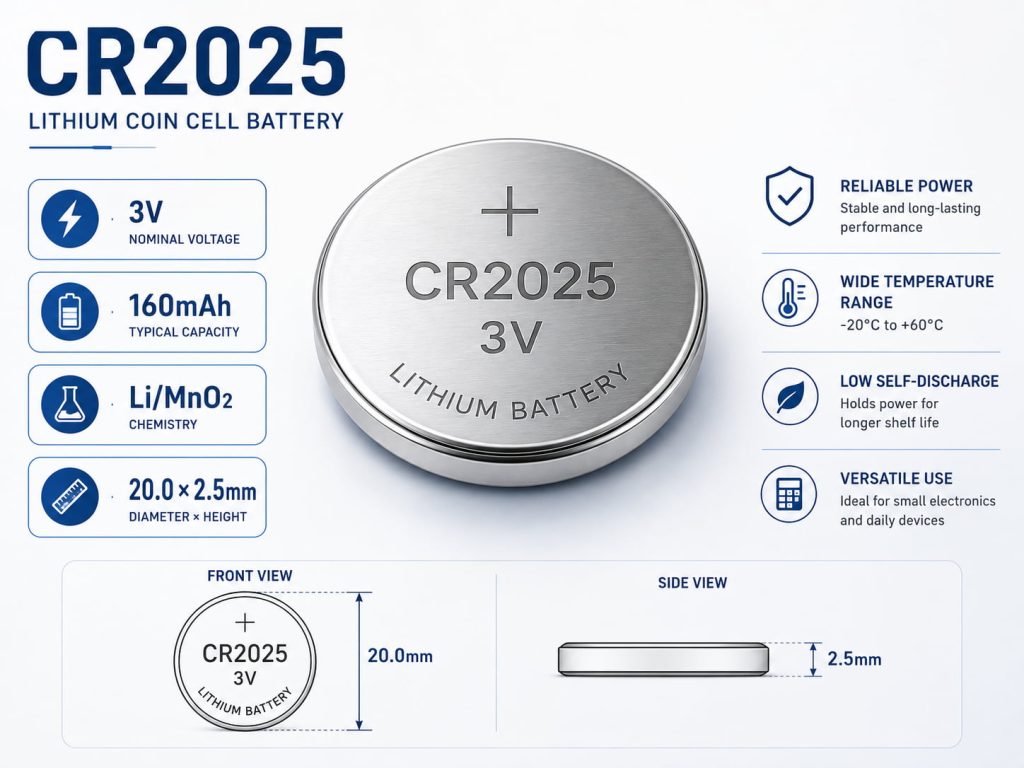
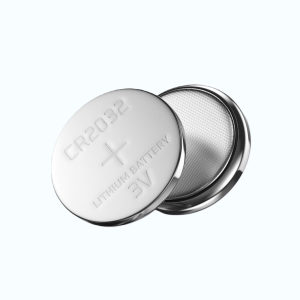
The CR2025 Battery 3V is a non-rechargeable lithium manganese dioxide coin cell with a 3.0V nominal voltage and 160mAh nominal capacity. Its compact 20.0 × 2.5mm structure suits key fobs, remote controls, memory backup circuits, sensors, calculators, and other low-drain electronics. Buyers requiring a thicker coin cell can compare the CR2032 battery. Product design, marking, packaging, and use should follow applicable IEC 60086-4 safety requirements.

Item Unit Value Condition
Nominal Voltage V 3.0
Nominal Capacity mAh 160 Continuous discharge through a 15kΩ load to a 2.0V cut-off voltage at 20–25°C
Instantaneous Short-Circuit Test Current* mA ≥250 Test duration ≤0.5s; quality-inspection value only
Open-Circuit Voltage V ≥3.20 Measured under no-load conditions
Operating Temperature Range °C −20 to +60 Capacity and discharge performance vary with temperature
Standard Weight g Approx. 2.5 Per cell
Initial Standard Discharge Duration h 840 Continuous discharge through a 15kΩ load to 2.0V at 20–25°C
Standard Discharge Duration After 12-Month Storage h 790 After 12 months under specified storage conditions; then continuously discharged through a 15kΩ load to 2.0V at 20–25°C

CR2025 Battery 3V for Compact Electronic Devices

The CR2025 Battery 3V is a primary lithium coin cell designed for compact electronic products that require a small battery compartment, a 3.0V nominal voltage, and low-current operation. It uses lithium manganese dioxide chemistry, commonly written as Li/MnO₂, and must not be recharged.

This CR2025 battery has a nominal capacity of 160mAh. The capacity is evaluated using a 15kΩ load, continuous discharge, and a 2.0V cut-off voltage under the specified test temperature. Its calculated nominal energy is approximately 0.48Wh.

The battery measures 20.0mm in diameter and 2.5mm in height. Its thin coin-cell structure supports installation in key fobs, compact remote controls, memory backup modules, calculators, electronic labels, small sensors, and other space-limited products.
CR2025 Battery 3V

Electrical Performance of the CR2025 Battery

The CR2025 3V battery provides a nominal voltage of 3.0V. This does not mean the battery delivers a regulated or constant 3V output. Actual terminal voltage changes according to load current, remaining capacity, operating temperature, contact resistance, and device cut-off voltage.

Under the current Zenilove test conditions, the initial standard discharge duration is 840 hours using a 15kΩ load at 20°C to 25°C until the battery reaches 2.0V. This is a laboratory discharge result and should not be presented as the guaranteed operating time of a finished device.

The listed instantaneous short-circuit test current of at least 250mA, measured for no more than 0.5 seconds, is a factory inspection value. It is not a rated continuous current or recommended pulse current for equipment operation.

Before using the CR2025 lithium battery in a device, confirm:

  • Average operating current
  • Standby current
  • Pulse-current duration
  • Recovery interval between pulses
  • Minimum equipment voltage
  • Contact resistance
  • Expected service life
  • Operating temperature
  • Discharge cut-off voltage

Device-level testing should be completed before mass production.

CR2025 Coin Cell Battery Size and Device Integration

The CR2025 coin cell battery has a standard diameter of 20.0mm and a height of 2.5mm. It is thinner than a CR2032 cell, which has the same nominal diameter but a greater height.

Projects with more installation depth and higher energy requirements may also evaluate a CR2032 battery. A CR2032 should not replace a CR2025 automatically because the battery compartment, contact pressure, holder depth, and product enclosure may not support the thicker cell.

Before choosing between CR2025 and CR2032, check:

  • Battery-holder dimensions
  • Available installation height
  • Required operating time
  • Average and pulse load
  • Terminal contact pressure
  • Enclosure clearance
  • Product weight limits

The positive terminal is the marked upper surface, while the lower surface acts as the negative terminal. The cell must be installed according to the polarity marking on the equipment.
CR2025 Battery 3V2

CR2025 Lithium Battery Safety and Storage

The CR2025 lithium battery is a non-rechargeable primary cell. Do not recharge, short-circuit, crush, puncture, disassemble, heat, burn, or install it with reversed polarity.

A standard bare coin cell should not be soldered directly using uncontrolled heat. Products requiring PCB installation should use an approved battery holder, solder-tab version, terminal assembly, or preassembled wire-lead configuration.

Store the battery in a dry and ventilated environment away from direct sunlight, high humidity, heat sources, and conductive metal objects. The current page lists a self-discharge rate of no more than 5% after 12 months under normal temperature and humidity conditions.

Product design, battery marking, testing, child-resistant packaging, and misuse prevention should be reviewed against the applicable IEC 60086-4 safety requirements. Coin cells must be kept away from children because swallowing can cause severe internal injury.

Applications for the CR2025 3V Battery

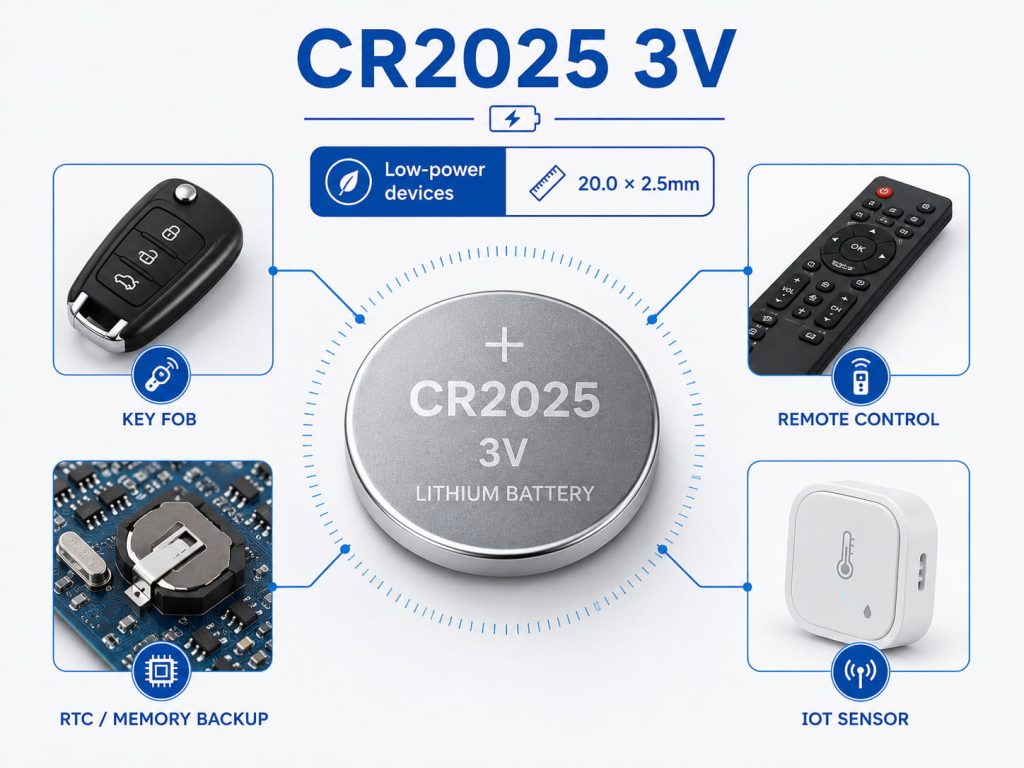
The CR2025 3V battery is mainly intended for devices with low average power consumption and controlled pulse requirements.

Typical applications include:

  • Vehicle key fobs
  • Remote controls
  • RTC and CMOS memory backup
  • Calculators
  • Electronic labels
  • Digital thermometers
  • Small measuring instruments
  • Security sensors
  • IoT sensor nodes
  • Compact monitoring devices
  • Fitness and wearable electronics
  • Electronic modules

Application suitability depends on the complete electrical load profile. Products with frequent wireless transmission, bright displays, alarms, motors, or extended high-current pulses may require additional testing or a different battery model.
CR2025 Battery 3V1

Custom Supply from a CR2025 Battery Manufacturer

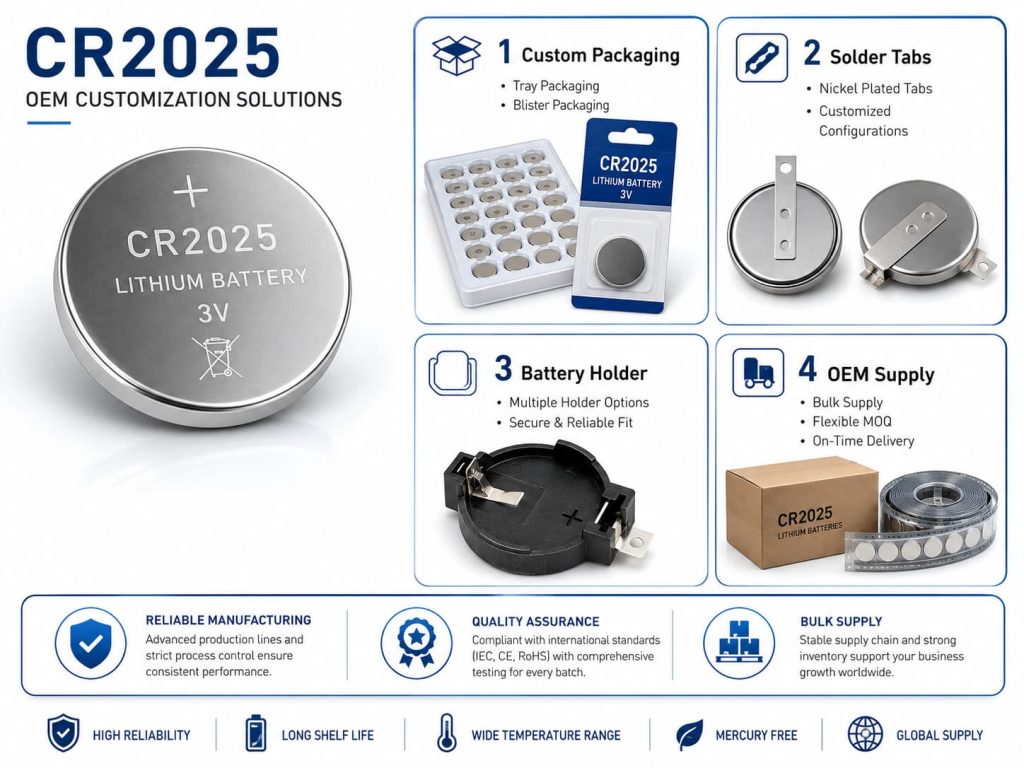
As a CR2025 battery manufacturer and supplier, Zenilove can evaluate different terminal, assembly, labeling, and packaging requirements for OEM projects.

Available customization options may include:

  • Standard bare CR2025 cells
  • Horizontal solder tabs
  • Vertical solder tabs
  • Axial or radial terminals
  • Wire leads
  • Custom connectors
  • Coin-cell holders
  • Insulation sleeves
  • Custom polarity markings
  • Private-label printing
  • Tray packaging
  • Blister packaging
  • Individual packaging
  • Lot and date coding
  • Project-specific inspection requirements

Before sample development, provide the device operating current, pulse profile, battery-holder drawing, available space, terminal direction, expected service life, operating temperature, packaging requirements, annual quantity, and target-market documentation.
Specification

Basic Specifications

Parameter Correct Specification
Product Name CR2025 Battery 3V Lithium Coin Cell
Model CR2025
Battery Type Primary Lithium Coin Cell Battery
Rechargeability Non-rechargeable
Chemistry Lithium Manganese Dioxide, Li/MnO₂
Nominal Voltage 3.0V
Nominal Capacity 160mAh
Nominal Energy Approximately 0.48Wh
Diameter 20.0mm
Height 2.5mm
Approximate Weight 2.5g
Operating Temperature Range −20°C to +60°C
Polarity Positive upper surface; negative lower surface
Casing Stainless Steel
Charging Do not recharge

Electrical and Test Data

Item Specification Test Condition or Note
Nominal Capacity 160mAh Continuous discharge through a 15kΩ load to 2.0V
Standard Load 15kΩ Used for the listed capacity and discharge-duration test
Approximate Initial Discharge Current 0.2mA Approximate value at 3.0V through a 15kΩ load
Discharge Cut-off Voltage 2.0V Standard test cut-off
Open-Circuit Voltage ≥3.20V Measured with no load
Initial Standard Discharge Duration 840 hours 15kΩ load at 20°C–25°C to 2.0V
Discharge Duration After 12-Month Storage 790 hours 15kΩ load at 20°C–25°C to 2.0V
High-Temperature Storage Test 790 hours After storage at 60°C ± 3°C for 20 days, then tested through 15kΩ to 2.0V
Annual Self-Discharge Rate ≤5% After 12 months under normal temperature and humidity
Instantaneous Short-Circuit Test Current ≥250mA Test duration no longer than 0.5 seconds; quality-inspection value only
Maximum Continuous Operating Current Confirm with approved datasheet Do not derive from the short-circuit test
Maximum Pulse Current Confirm with approved datasheet Pulse duration and recovery interval must be defined

Customization Process

Step 1: Confirm the Device Requirements

Provide the equipment type, operating voltage, average current, standby current, pulse current, expected service life, minimum operating voltage, and temperature range.

Step 2: Select the CR2025 Configuration

Confirm whether the project requires a standard bare cell, solder tabs, axial terminals, radial terminals, wire leads, a connector, or a coin-cell holder.

Step 3: Review Mechanical Integration

Submit the battery-compartment dimensions, PCB layout, terminal direction, available height, contact method, polarity requirement, and enclosure clearance.

Step 4: Confirm Labels and Packaging

Choose standard or private-label printing, lot coding, date coding, tray packaging, blister packaging, individual packaging, carton quantity, and shipment markings.

Step 5: Produce and Test Samples

Sample inspection may cover dimensions, open-circuit voltage, polarity, terminal strength, connector fit, load performance, holder compatibility, packaging, and device operation.

Step 6: Approve Mass Production

After sample approval, confirm the final specification, drawing, inspection criteria, packaging method, compliance-document requirements, production quantity, and delivery schedule.

FAQ

1. Is the CR2025 battery rechargeable?

No. The CR2025 battery is a primary, non-rechargeable lithium manganese dioxide coin cell. Attempting to recharge it may cause leakage, overheating, rupture, or equipment damage.

2. What is the capacity of this CR2025 Battery 3V?

This product page should use a nominal capacity of 160mAh. The value is measured under the specified 15kΩ load and 2.0V cut-off conditions.

3. What is the difference between CR2025 and CR2032?

Both models have a nominal voltage of 3V and a diameter of approximately 20mm. The CR2025 is 2.5mm high, while the CR2032 is 3.2mm high. The thicker cell generally provides more capacity, but it may not fit a CR2025 battery compartment.

4. Can the 250mA short-circuit value be used as the operating current?

No. The ≥250mA value is an instantaneous short-circuit inspection result measured for no more than 0.5 seconds. It is not a rated pulse current or continuous discharge current.

5. Can this CR2025 coin cell battery be supplied with solder tabs?

Yes. Project options may include horizontal or vertical solder tabs, terminal assemblies, wire leads, connectors, holders, insulation, and custom packaging. Direct soldering onto a standard bare cell is not recommended.

6. What information should be provided to a CR2025 battery manufacturer?

Provide the device load, standby current, pulse current, required service life, battery-compartment drawing, terminal direction, operating temperature, packaging method, target market, and estimated order quantity.

Reviews

There are no reviews yet.

Be the first to review “CR2025 Battery 3V Lithium Coin Cell Battery”

Your email address will not be published. Required fields are marked *

Related Products