

You put a portable device away with some charge remaining. Months later, it will not switch on. Does that mean the battery has failed, or should you have recharged it while it sat unused? A lithium polymer battery may need a maintenance recharge during extended storage. The timing depends on the battery specification, its starting charge, storage temperature, and any power the connected device continues to consume. No single charging interval suits every product.
For equipment manufacturers, lithium polymer battery storage is also a customer-experience issue. Users need clear instructions that help them put equipment away and return it to service without unnecessary guesswork.
Why a Stored Lithium Polymer Battery Can Lose Charge
A rechargeable battery can lose stored charge even when it is not powering a task. If it remains installed in equipment, connected electronics may keep drawing power. A dark display does not confirm that the battery is electrically disconnected. Depending on the design, a clock, controller, sensor, or communication function may remain active.
These losses accumulate over Time. A small drain that has little effect during daily use can become relevant over months in storage. Manufacturers selecting polymer battery products should therefore consider both the battery’s storage requirements and the equipment’s actual shutdown behavior.

A Storage Charge Is Different from a Full Charge for Work
Charging before a long workday serves a different purpose than preparing equipment for months without use. For long-term storage, follow the finished-device instructions and the approved battery specification. Do not deliberately run the battery empty before storing the product.
Apple’s long-term device storage guidance recommends storing devices at about half charge and recharging them periodically during extended storage. That is a manufacturer-specific procedure; it does not establish the correct interval or charge target for every custom battery pack. An equipment manufacturer should define its own procedure using the selected battery, measured storage consumption, and intended environment. The instructions should tell users what to do without requiring them to interpret a cell datasheet.
How Often Should a Lithium Polymer Battery Be Checked?
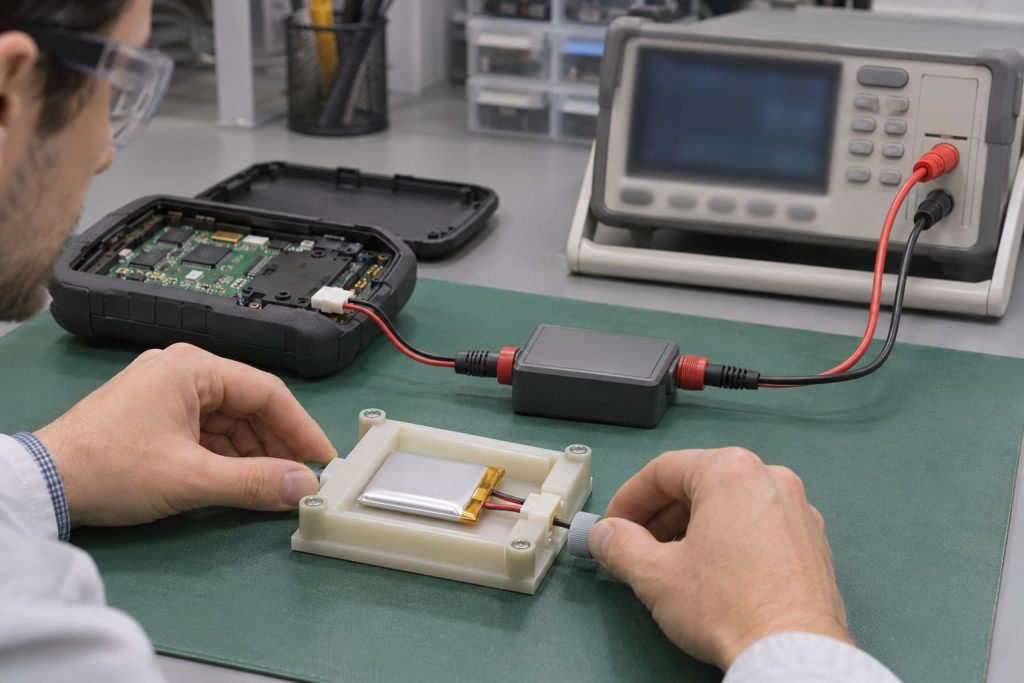
Start with the supplier’s storage limits and the finished-device maintenance instructions. If those instructions are missing, obtain them before setting a recharge schedule. For product development, measuring residual Current provides a useful first estimate of the charge consumed by connected electronics.
For a constant current:
Charge consumed in mAh = Current in mA × Time in hours
For example, a continuous 0.1mA load consumes approximately 72mAh over 30 days:
0.1mA × 24 hours × 30 days = 72mAh
This calculation covers only the assumed electrical load. It excludes cell self-discharge, current variation, temperature effects, and changes in battery condition. It cannot determine a safe storage period on its own.
| Item to establish | Why it affects the check interval |
|---|---|
| Starting charge condition | Determines the initial reserve available during storage |
| Current in the intended storage mode | Shows how much charge connected electronics consume |
| Cell and pack storage requirements | Define applicable limits and maintenance guidance |
| Expected temperature range | Helps establish representative storage-test conditions |
| Battery condition and age | Affect the reserve available after Time in service |
| Required readiness after storage | Determines what the product must do when retrieved |
Set the inspection interval early enough to verify that the product remains within its approved conditions. Confirm the interval through storage testing rather than extending it based on capacity calculations alone.
A Larger Battery Pack Does Not Remove Storage Requirements
A higher-capacity pack can provide more reserve against a given electrical drain, but capacity alone does not establish how long equipment can remain unattended. Consider the 16000mAh 3.7V Polymer Battery Pack. Its capacity identifies the product, but a storage plan still needs the approved starting condition, environmental limits, protection-circuit consumption, and connected-device load.
Two devices using the same pack may need different maintenance procedures. One may isolate most electronics during shutdown, while the other continues monitoring an input or maintaining a standby function. The useful question is how the complete product behaves throughout the proposed storage period.
Device Design Can Reduce Storage Maintenance
Manufacturers can make storage easier by reducing unnecessary power consumption when equipment is inactive. Some power-management components provide ship or shutdown modes with different current consumption and wake-up methods. Their usefulness depends on how the finished circuit implements them.
A storage mode also needs a predictable way back to normal operation. Confirm that the user can wake the product using the intended button or approved external power source. When specifying a Custom Battery Pack, describe the expected idle period and customer routine. “The instrument may remain unused between seasonal inspections” gives the development team a storage requirement to evaluate alongside runtime and dimensions.
Check the Battery Before Recharging a Stored Device
Before connecting power, inspect the accessible equipment and battery areas according to the product instructions. Stop using a pack that shows swelling, leakage, physical damage, or unusual heating. Follow the manufacturer’s service procedure rather than repeatedly attempting to charge it.
If the device appears intact, use approved charging accessories and check its normal status indication. Some products need a defined period connected to power before they can start after extended storage. Follow that product’s procedure. If a device remains unresponsive, it needs investigation. Possible causes include the battery, charging input, protection state, connector, or equipment electronics. Do not bypass battery protection to force a recovery.

FAQ
These questions address common concerns about keeping rechargeable equipment unused for extended periods.
Should I Fully Charge a Lithium Polymer Battery Before Storing It?
Follow the battery and device manufacturer’s storage instructions. A full charge for immediate use differs from preparation for long-term storage. Avoid storing the battery completely discharged, and use the specified storage charge condition.
Does Turning the Device Off Stop All Battery Drain?
It may not. Some circuits remain connected after software shutdown. Manufacturers should measure Current in the intended storage state and confirm what functions remain active.
Can I Leave the Device Plugged In Throughout Storage?
Only use continuous connected storage if the manufacturer supports it. Leaving equipment on a charger is a different operating condition from disconnected storage and needs its own validation of charging behavior, temperature, and long-term operation.
A Lithium Polymer Battery May Need Recharging During Extended Storage
Periodic inspection and an appropriate maintenance recharge can help keep a stored product within its approved battery conditions. The correct schedule comes from the battery specification and the finished device’s measured behavior. For equipment manufacturers, the practical deliverable is a clear storage procedure: how to prepare the device, where to keep it, when to check it, and how to return it to use. That guidance helps customers maintain equipment without turning battery care into a guessing exercise.