

Battery pack design requirements for small devices should be based on measured load, usable volume, temperature, charging, protection, and service conditions. A buyer should issue controlled host drawings and load files, then require the supplier to prove cell choice, BMS settings, mechanical fit, prototype behavior and documentation on the same configuration before approval.
A compact enclosure leaves little room for assumption. A connector can consume clearance reserved for a cell, a short peak load can trip protection, and heat from the host device can change the safe operating window. A clear set of requirements prevents a small pack from becoming a late mechanical or safety redesign.

What Battery Pack Design Requirements Should Buyers Define for Small Devices?
Describe the device function, expected runtime, use pattern, charging source, user environment, storage periods, service model, and replacement policy. State the host voltage window and system limits the battery must meet. Separate measured facts from targets so the supplier can identify what still needs verification. Document these battery pack design requirements for small devices before the supplier freezes the cell, BMS, enclosure, and wiring configuration.
How Measured Loads Shape Battery Pack Design
Record startup current, steady current, peak duration, duty cycle, sleep periods, recharge timing, and expected aging margin. Measure the device in representative modes rather than estimating from a nominal power label. The supplier can then relate cell selection and protection settings to the real load. Ask for the raw measurement method, instrument range, sample interval, voltage point, state-of-charge condition, temperature, and test script. If firmware or a motor, radio, heater, or display changes later, mark that change for a new load review.
Which Battery Pack Design Details Protect Compact Device Fit?
Review cell geometry, pack orientation, compression space, insulation, holder or adhesive method, connector height, wire bend radius, service access, and tolerance stack. The pack must fit across production variation, not only in a nominal CAD assembly.
| Review item | Buyer provides | Supplier returns |
| Envelope | 3D model, keep-outs, tolerances | Pack model and stack-up |
| Interfaces | Connector, polarity, cable path | Pinout and harness drawing |
| Retention | Fasteners, adhesive or bracket limits | Retention concept and test |
| Service | Removal path and replacement time | Service procedure and access need |
How Battery Pack Design Handles Temperature and Charging
Map the pack location against heat sources, ambient conditions, charging states, and airflow. Define allowed operating and storage ranges through the responsible engineering and quality teams. Do not assume a cell or BMS rating applies to the complete pack in the host enclosure.
How Should Buyers Review a Battery Pack BMS?
The BMS review should connect sensing, control logic, protection behavior, communication, configuration control, and recovery actions to the device requirements. Request proposed settings, tolerances, test method, and reset behavior for the selected configuration.
How Prototype Evidence Supports Battery Pack Design
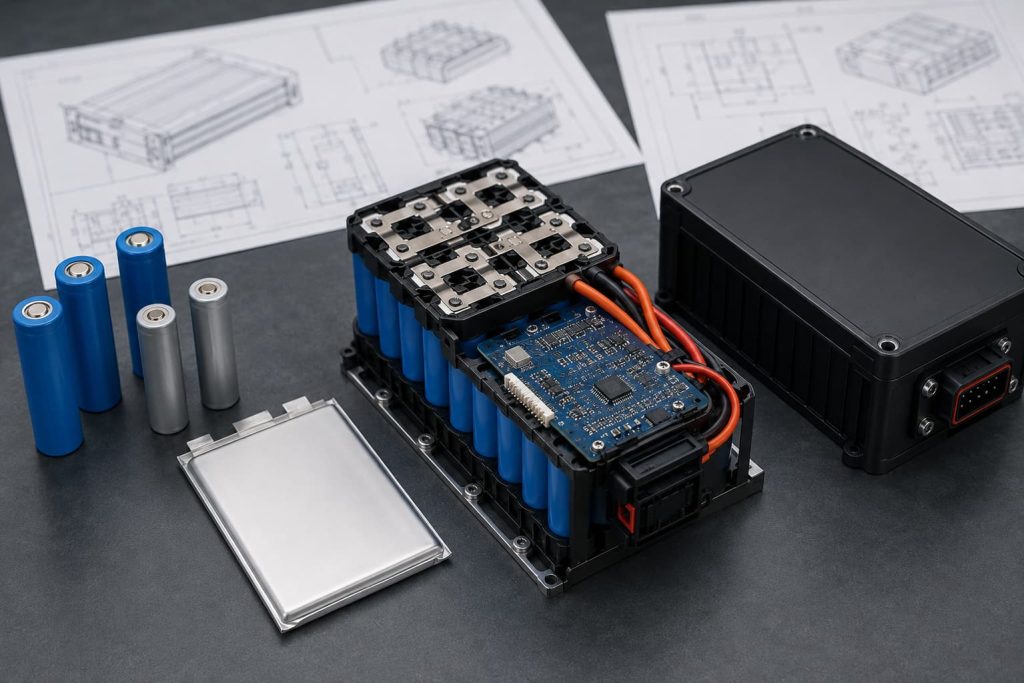
Build a prototype that represents planned cells, enclosure, wiring, connector, BMS, and configuration. Test fit, retention, load response, charging, temperature, runtime, protection events, and recovery under approved conditions. Record sample identity, equipment, method, results, and deviations.
What Evidence Should a Battery Engineering Supplier Provide?
Request a requirement matrix, dimensioned pack drawing, cell and BMS documents, electrical schematic, wiring and connector data, thermal assumptions, charging description, prototype report, and open-item list. Each document should identify the part, revision, sample, and test condition it covers.
• Measured load profile with peak and duty-cycle records.
• 3D fit model, tolerance stack, retention and service drawing.
• Cell, BMS, protection-setting and charging documentation.
• Prototype test records for fit, load, temperature, runtime and fault recovery.
• Change-control and traceability information where required.
What Should a Small Device Battery RFQ Ask?
Give every bidder the same load files, mechanical references, operating profile, charging context, service expectation, and evidence schedule. Ask them to identify exclusions, third-party items, required samples, and assumptions in the quotation.
• Confirm measured load, peak current, duty cycle, runtime target and recharge window.
• Provide controlled drawings, connector details, keep-outs and tolerances.
• Request the exact cell, BMS, enclosure, wiring and protection configuration.
• Define prototype tests, sample identity, conditions, pass criteria and approval owners.
• Require as-built drawings, settings backups, traceability and service documents.
When Is a Compact Pack Ready for Release?
Approve the pack when load behavior, volume, interfaces, thermal boundary, charging, protection, service path, prototype evidence, and document revisions point to the same configuration. Send the host drawings, measured profile, operating conditions, and approval needs to Zenilove through its Custom Battery Solutions discussion path.
Review the mapped Battery Pack Design, Custom Battery Solutions, Lithium Battery Solutions, and Battery Engineering pages when scoping the project.
For a safety reference, review battery safety guidance alongside the project requirements.