

An industrial device can pass its first bench test and still fail in daily operation if you select its industrial lithium battery based on capacity alone. A motor may draw more startup current than the battery can supply, a radio may create short power peaks, a connector may loosen under vibration, or the pack may overheat inside a sealed enclosure. A reliable selection process must account for how the battery behaves under all of these conditions.
Selecting an industrial lithium battery starts with the equipment load, installation space, operating environment, charging method, and production plan. Buyers need a complete set of requirements before a manufacturer can recommend cells, pack configuration, protection, wiring, and mechanical structure. Clear inputs reduce sample changes and make quotations easier to compare.
What Must an Industrial Lithium Battery Match First?
The device defines the battery. Before discussing cell brands or pack prices, the project team should describe how the equipment starts, runs, charges, and shuts down. This information gives the battery engineer a realistic load profile instead of a single capacity target.
Continuous and Peak Current
Continuous current covers the normal working load. Peak current appears when a motor starts, a pump activates, a radio transmits, or several functions run together. A pack with enough energy can still trigger protection or suffer a voltage drop when its cells, BMS, connectors, or wires cannot carry the peak load.
Record the normal current, maximum current, peak duration, and peak frequency. If the device has several operating modes, measure each one. Bench measurements from a working prototype give the supplier better information than estimates from component data sheets alone.
Runtime and Charging Schedule for an Industrial Lithium Battery
Runtime depends on usable energy, load variation, conversion losses, temperature, and the discharge limits set by the equipment and BMS. Buyers should define the required working hours, permitted charging time, expected standby period, and minimum acceptable runtime near the end of the product’s service life.
A device that charges overnight has different pack requirements from equipment that must return to service during a short break. The charging schedule affects capacity, charge current, connector selection, thermal behavior, and charger design.
Space, Weight, and Installation Direction
Please provide a three-dimensional installation envelope rather than a single maximum dimension. The supplier needs to know where wires exit, how the pack is fixed, which surfaces contact the enclosure, and how much tolerance remains around nearby components.
Weight also affects portable instruments, handheld terminals, wearable industrial controls, and mobile service equipment. A larger pack may increase runtime while making the finished device harder to carry or balance.
How Should Buyers Compare Cell and Pack Options?
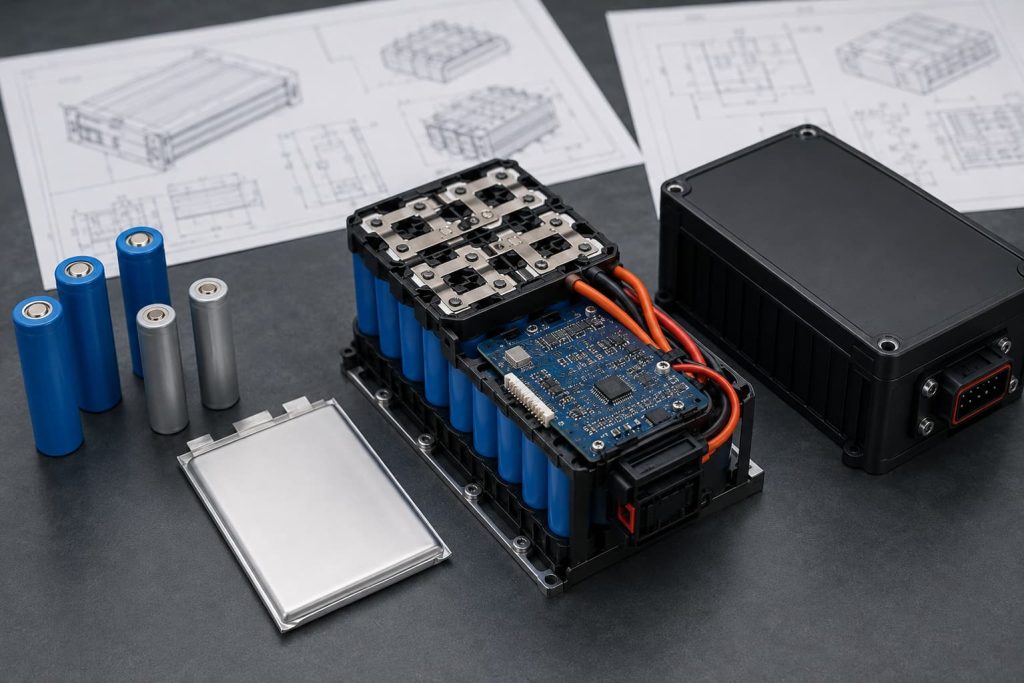
Cell format influences the pack shape, discharge capability, assembly method, and mechanical support. The right option depends on the equipment, not a general claim that one cell type performs better in every project.
Cylindrical Cells for Structured Pack Layouts
A cylindrical battery can suit devices that need a structured pack, stable cell geometry, and several series or parallel configuration options. The enclosure must still provide cell spacing, insulation, mechanical retention, wire routing, and room for the protection board.
Buyers comparing cylindrical cells should look beyond capacity. Cell size, discharge current, internal resistance, temperature range, consistency, and supply continuity can affect the final pack. The supplier should also explain how it matches cells before assembly.
Polymer Cells for Restricted Internal Space
Polymer cells can support thinner or shape-sensitive devices when the internal layout cannot accept a cylindrical pack. Their flat form helps designers use limited space, but the enclosure must protect the cell from bending, compression, sharp edges, and swelling clearance problems.
The project team should confirm thickness tolerance, tab and wire direction, connector position, and mechanical protection during design. A drawing that shows only length and width leaves important risks unresolved.
Series and Parallel Configuration
Series connections raise pack voltage. Parallel connections increase capacity and available current. The configuration must match the device input range, charger, load profile, and protection strategy.
Changing from one configuration to another affects more than energy. It may change the BMS, pack dimensions, cell balancing requirements, wiring, charger specification, and certification scope. Buyers should freeze the electrical architecture before approving tooling or final housing drawings.
Which Parameters Belong in an OEM Battery Brief?
A useful OEM brief lets suppliers quote the same technical scope. It also gives engineering, purchasing, quality, and production teams a shared reference during sampling and change control.
| Requirement | Information to Provide | Risk if Missing |
|---|---|---|
| Nominal voltage | Device input range and cutoff voltage | Poor compatibility or early shutdown |
| Continuous current | Normal operating current by mode | Excess heat or weak runtime |
| Peak current | Value, duration, and frequency | Protection trips or voltage drop |
| Runtime | Working hours and duty cycle | Incorrect capacity selection |
| Pack envelope | 3D space, tolerances, and mounting points | Mechanical interference |
| Connector | Part number, polarity, wire length, and exit direction | Assembly error or field failure |
| Charging | Charger output, charge time, and charging environment | Slow charging or compatibility problems |
| Environment | Temperature, vibration, dust, moisture, and cleaning exposure | Shortened life or mechanical damage |
| Compliance | Destination markets and transport route | Late document or test changes |
| Production plan | Prototype quantity, forecast, and target launch | Component and capacity planning delays |
The brief should include drawings, photos, load measurements, and charger information when available. A Custom Battery Pack project usually moves faster when the supplier can review the battery and device as one system.
How Do Industrial Conditions Change Industrial Lithium Battery Design?
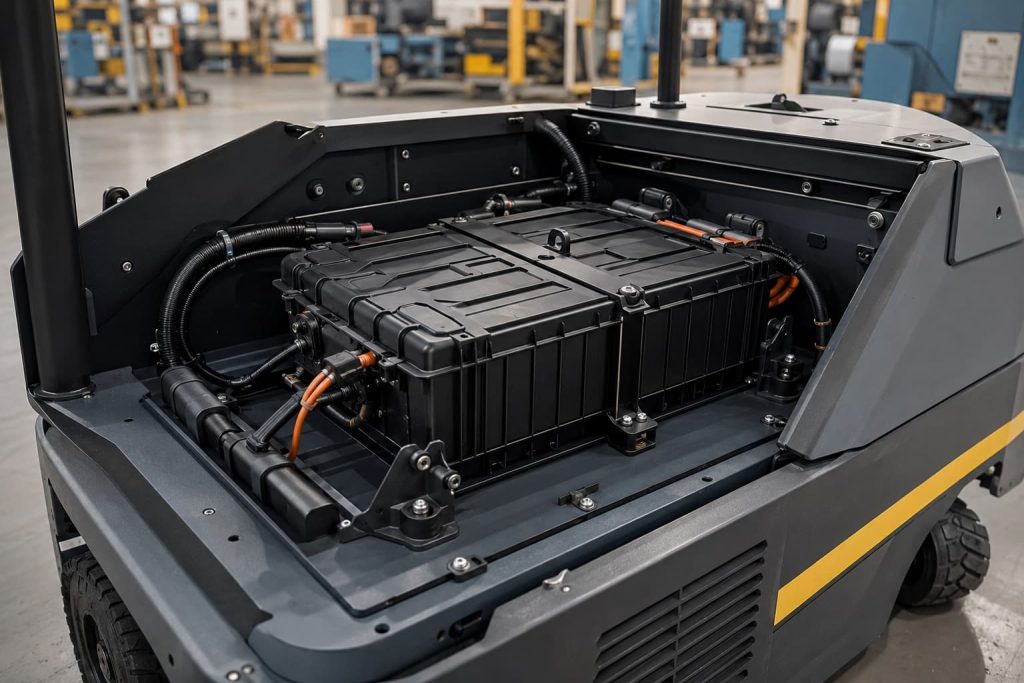
Industrial equipment often works in environments that place mechanical and thermal stress on the battery. The project team should define real operating conditions, including temporary extremes, instead of relying only on a broad indoor or outdoor label.
Industrial Lithium Battery Temperature and Enclosure Heat
Ambient temperature does not equal cell temperature. Electronics, motors, charging circuits, sealed housings, and direct sunlight can raise the temperature around the pack. Cold conditions can reduce available power and affect charging behavior.
Measure the temperature near the battery during the highest-load operating mode and during charging. If the device works in a vehicle, warehouse, outdoor cabinet, or cold room, include storage conditions as well as operating conditions.
Vibration, Shock, and Connector Retention
Mobile tools, inspection devices, robotics, and machine-mounted controls can expose the pack to repeated vibration and occasional shock. Cell holders, insulation, welds, wires, connectors, and mounting features all contribute to mechanical reliability.
The device team should define the mounting method and likely movement direction. A loose battery can pull on wires, damage insulation, or disconnect the equipment even when the cells remain electrically healthy.
Dust, Moisture, and Service Access
The device enclosure usually provides the main environmental barrier. Pack design still needs to account for possible condensation, cleaning procedures, service handling, and connector exposure. Maintenance staff also need a clear replacement method when the battery is removable.
Review relevant industrial battery applications before deciding on pack construction. Portable instruments, logistics terminals, robotics controls, and fixed monitoring devices can require different mechanical and service strategies.
What Testing Does an Industrial Lithium Battery Need Before Mass Production?
Testing should reproduce the way the finished equipment uses and charges the battery. A cell data sheet cannot replace a pack-level test inside the actual device.
Electrical and Runtime Validation for an Industrial Lithium Battery
Run the device through startup, maximum load, normal duty cycle, standby, low-battery shutdown, and charging. Record pack voltage, current, runtime, and temperature. Repeat the test across multiple samples to identify variation.
Confirm that the BMS responds correctly to abnormal current, overcharge, over-discharge, and temperature conditions defined for the project. The equipment and battery protection settings should work together, not cause unexpected shutdowns.
Mechanical Fit and Assembly Checks
Install the battery using the intended production process. Check clearances, mounting pressure, wire routing, connector access, polarity controls, and enclosure closure. A pack that fits when placed by an engineer may still create problems on an assembly line with fixed tools and takt time.
Inspect the pack again after vibration, drop, or transport simulation relevant to the device. Look for wire movement, abrasion, loose fasteners, damaged insulation, connector release, or changes in electrical performance.
Transport and Market Requirements
Tell the supplier where the battery will ship, how it will be packed, and if it will travel alone, with equipment, or installed in equipment. These details affect transport classification and documentation. The official PHMSA lithium battery transportation guidance explains why lithium batteries receive specific handling and shipping controls.
Market requirements should enter the project plan before design approval. Late changes to cell type, pack structure, labels, documentation, or testing can delay production and delivery.

Which Supplier Questions Prevent Project Delays?
The quotation stage gives buyers a chance to test how a supplier manages engineering detail. A low unit price has limited value when the scope excludes tooling, samples, testing, documentation, or change control.
Ask the supplier to explain the proposed cell, configuration, BMS functions, connector, wire specification, pack structure, and validation plan. Request a clear list of assumptions and excluded items. This makes later quotation changes easier to understand.
Buyers should also confirm cell sourcing, incoming inspection, cell matching, traceability, sample approval records, production testing, component change notification, and support for repeat orders. If the project needs several sample rounds, define what each round must prove.
Zenilove supports battery selection, structural design, BMS development, prototypes, and production for small and application-specific devices. A productive supplier discussion should still start with measured load data, installation drawings, target markets, and the operating conditions of the finished equipment.
A Suitable Industrial Lithium Battery Starts With the Load
The right industrial lithium battery matches the full device system: voltage range, continuous and peak current, runtime, charger, installation space, connector, temperature, vibration, service method, and production requirements. Buyers who document these inputs can compare suppliers on the same basis and identify technical gaps before tooling or certification work begins.
Start with a measured load profile and a controlled mechanical envelope. Then confirm cell format, pack configuration, BMS functions, charging, validation, and transport requirements. This sequence gives the project team a defensible path from the first quotation to a production-ready battery pack.