
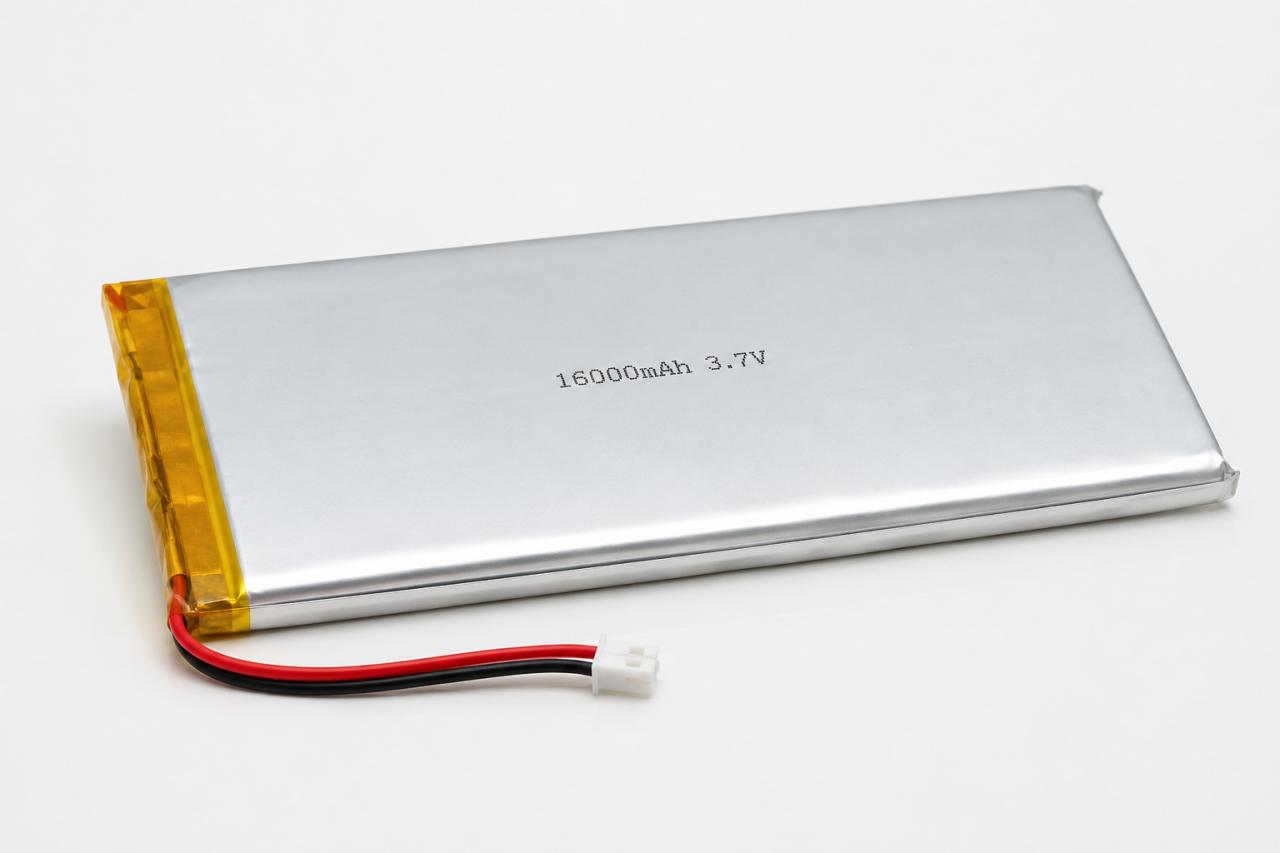
A 16000mAh 3.7V Polymer Battery Pack is designed for devices that need a 3.7V power supply and longer working time. It provides 59.2Wh of energy and uses a flat polymer structure, making it suitable for equipment with wide or rectangular battery compartments. This battery uses a 1S2P structure. It maintains a nominal voltage of 3.7V while increasing the total capacity to 16000mAh. It can support portable equipment, monitoring devices, handheld terminals, medical devices, IoT products, and other low-voltage applications.
Before selecting the battery, confirm the device voltage, operating current, installation space, connector, charging circuit, and protection requirements.
What Is a 16000mAh 3.7V Polymer Battery Pack?
A 16000mAh 3.7V Polymer Battery Pack is a rechargeable battery assembly designed for low-voltage devices that need longer runtime.
Its main specifications include:
- Nominal voltage: 3.7V
- Typical capacity: 16000mAh
- Rated energy: 59.2Wh
- Battery structure: 1S2P
- Full-charge voltage: 4.2V
- Approximate dimensions: 60.5 × 25 × 96mm
- Approximate weight: 255g
The nominal voltage is 3.7V, but the battery voltage reaches 4.2V when fully charged. The device charger must support the correct charging voltage for a single-cell lithium battery.
This 3.7 V Li ion polymer battery also includes a protection circuit module. The PCM helps control overcharge, over-discharge, overcurrent, and short-circuit conditions.
The protection current must match the device load. Equipment with motors, pumps, wireless transmitters, or heating elements may draw a high current during startup. If the PCM limit is too low, the battery may disconnect even when the device is operating normally.
Why a 16000mAh 3.7V Polymer Battery Pack Provides Longer Runtime?
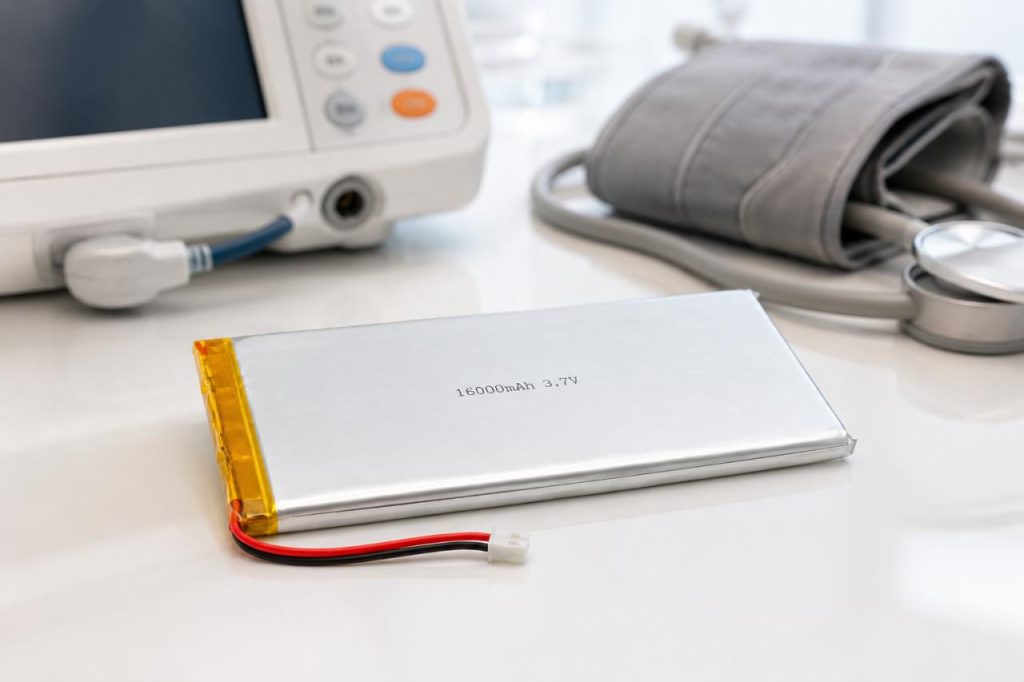
The 16000mAh capacity allows the battery to store more energy than a smaller polymer battery. At 3.7V, the pack provides 59.2Wh of rated energy.
The theoretical runtime can be estimated with this formula:
Runtime = Battery Energy ÷ Device Power
For example, if a device consumes 10W:
59.2Wh ÷ 10W = 5.92 hours
This is only a theoretical result. Actual runtime is usually shorter because of voltage conversion losses, standby power, peak current, temperature, battery age, and the device’s discharge cut-off voltage. Runtime calculations should use the device’s measured power consumption. The rated power shown on a product label may not reflect startup current or changes between different operating modes.
A high-capacity rechargeable lithium polymer battery can reduce charging frequency, but capacity is not the only factor. The battery must also support the device’s continuous current and short-term peak current.
How Does the 1S2P Battery Structure Work?
The battery uses a 1S2P structure.
“1S” means there is one cell group in series. This keeps the nominal voltage at 3.7V.
“2P” means two cells are connected in parallel. This increases the total capacity while keeping the voltage unchanged.
The structure is suitable for devices that already use a 3.7V power system but need more runtime. It allows the battery capacity to increase without changing the device to a higher-voltage circuit. The two cells must have similar voltage, capacity, internal resistance, and production characteristics. Poorly matched cells may discharge unevenly and reduce battery performance.
Battery assembly should include controlled:
- Cell matching
- Tab welding
- Insulation
- Wire connection
- PCM installation
- Connector polarity
- Capacity testing
- Charge and discharge testing
A larger battery should not replace a smaller one based only on voltage. The device must also have enough space, suitable charging current, correct connector polarity, and sufficient support for the additional weight.
Where Can a 16000mAh 3.7V Polymer Battery Pack Be Used?
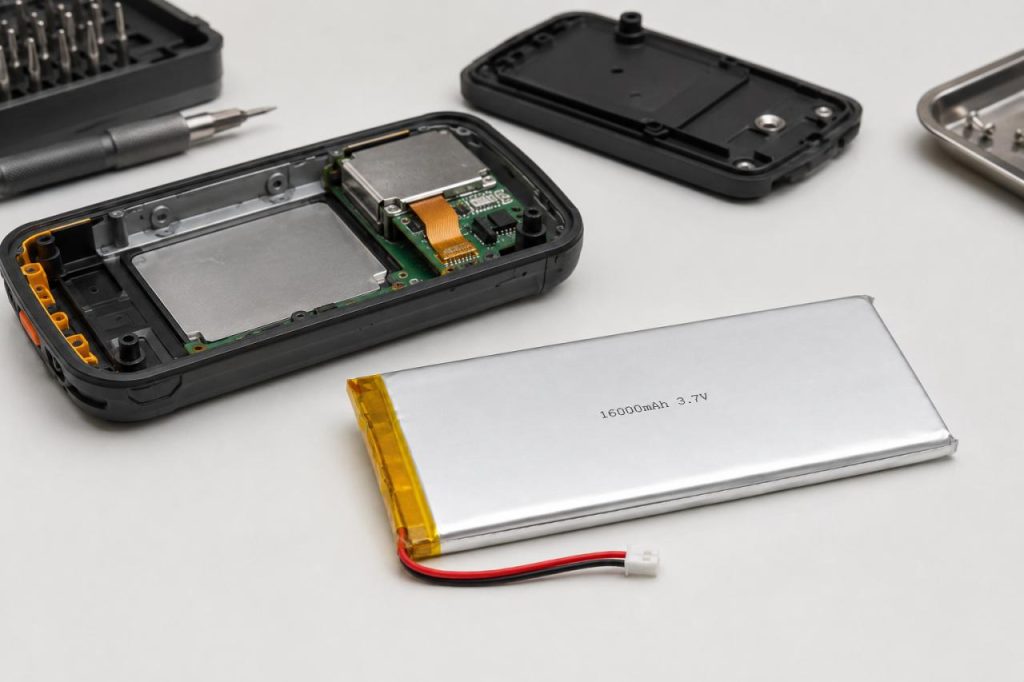
A 16000mAh 3.7V Polymer Battery Pack can be used in equipment that needs a low-voltage battery and longer operating time.
Common applications may include:
- Portable monitoring equipment
- Handheld terminals
- Data collection devices
- Remote sensors
- Communication equipment
- Medical and rehabilitation devices
- IoT equipment
- Portable testing instruments
- Low-voltage backup modules
- Selected robotics products
The battery measures approximately 60.5 × 25 × 96mm. Its rectangular shape can fit products with a wide or flat battery compartment. The product housing should leave enough space for the battery, wires, connector, insulation, and installation tolerance. The battery should not be pressed tightly between rigid parts. The pack weighs approximately 255g. It is more suitable for equipment where runtime is more important than minimum product weight. Small wearable products may need a thinner or lower-capacity Li polymer battery.
Before using the battery, confirm:
- Normal operating current
- Startup and peak current
- Required runtime
- Battery compartment dimensions
- Product weight limit
- Charging frequency
- Operating temperature
- Expected battery life
How to Customize a 16000mAh 3.7V Polymer Battery Pack?
Battery customization should begin with the device requirements. First, confirm that the device uses a nominal 3.7V battery and supports a full-charge voltage of 4.2V. This battery cannot directly replace a 7.4V, 11.1V, or other multi-series battery pack.
The device manufacturer should provide:
- Normal operating current
- Maximum continuous current
- Startup current
- Peak current
- Charging current
- Required working time
These values help determine whether the battery cells, PCM, wires, and connector can support the device.
The battery compartment drawing should also show:
- Maximum available length, width, and thickness
- Wire exit direction
- Connector position
- Battery mounting method
- Required insulation
- Available clearance
The battery dimensions should not be exactly the same as the internal compartment dimensions. Extra space may be needed for manufacturing tolerance, wiring, insulation, and normal pouch-cell expansion.
The connector can be customized according to the device design. Custom options may include:
- Connector model
- Wire length
- Wire gauge
- Terminal direction
- Positive and negative polarity
- NTC temperature sensor
- Identification resistor
- Battery label
- Packaging method
The PCM settings should also match the actual load. A current limit that is too low may cause the battery to shut down during startup. A limit that is too high may not provide suitable protection for the cells and wiring. The battery and charging system must remain within suitable lithium-ion battery safety limits. The finished device should prevent charging or discharging outside the approved voltage, current, and temperature ranges.
A 16000mAh 3.7V Polymer Battery Pack Fits Long-Runtime Devices
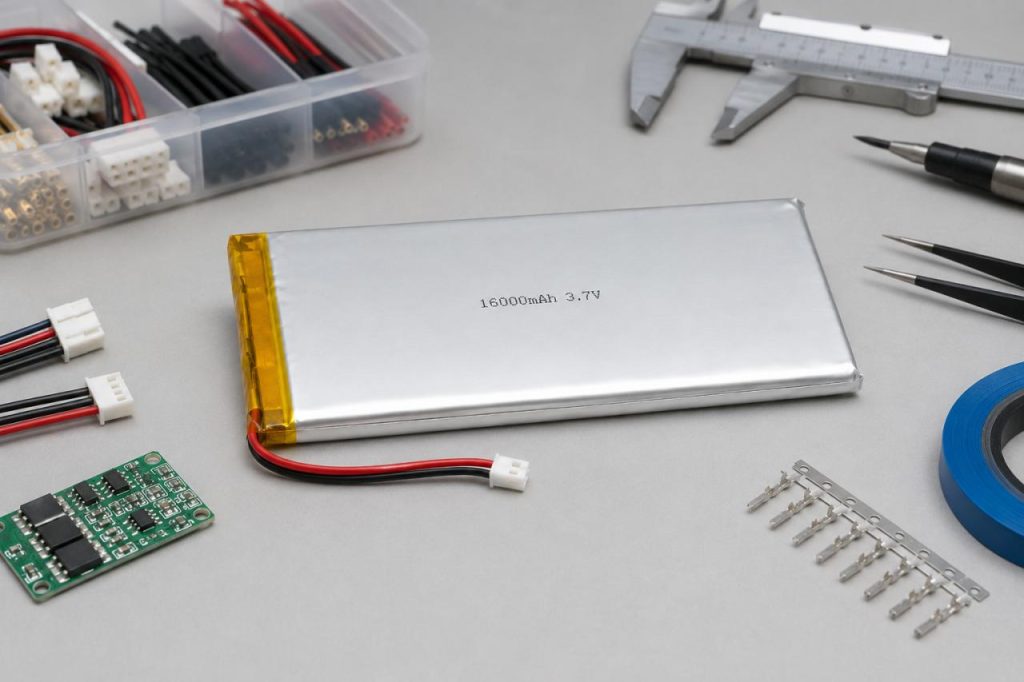
A 16000mAh 3.7V Polymer Battery Pack provides 59.2Wh of energy while maintaining a nominal output of 3.7V. Its 1S2P structure is suitable for devices that need longer runtime without changing to a higher-voltage battery system. The battery should be selected according to the device voltage, operating current, peak current, dimensions, weight, charging method, connector, and working environment. When these details are confirmed before production, the battery can be customized with suitable wires, connectors, PCM settings, insulation, labels, and packaging for the final device.