
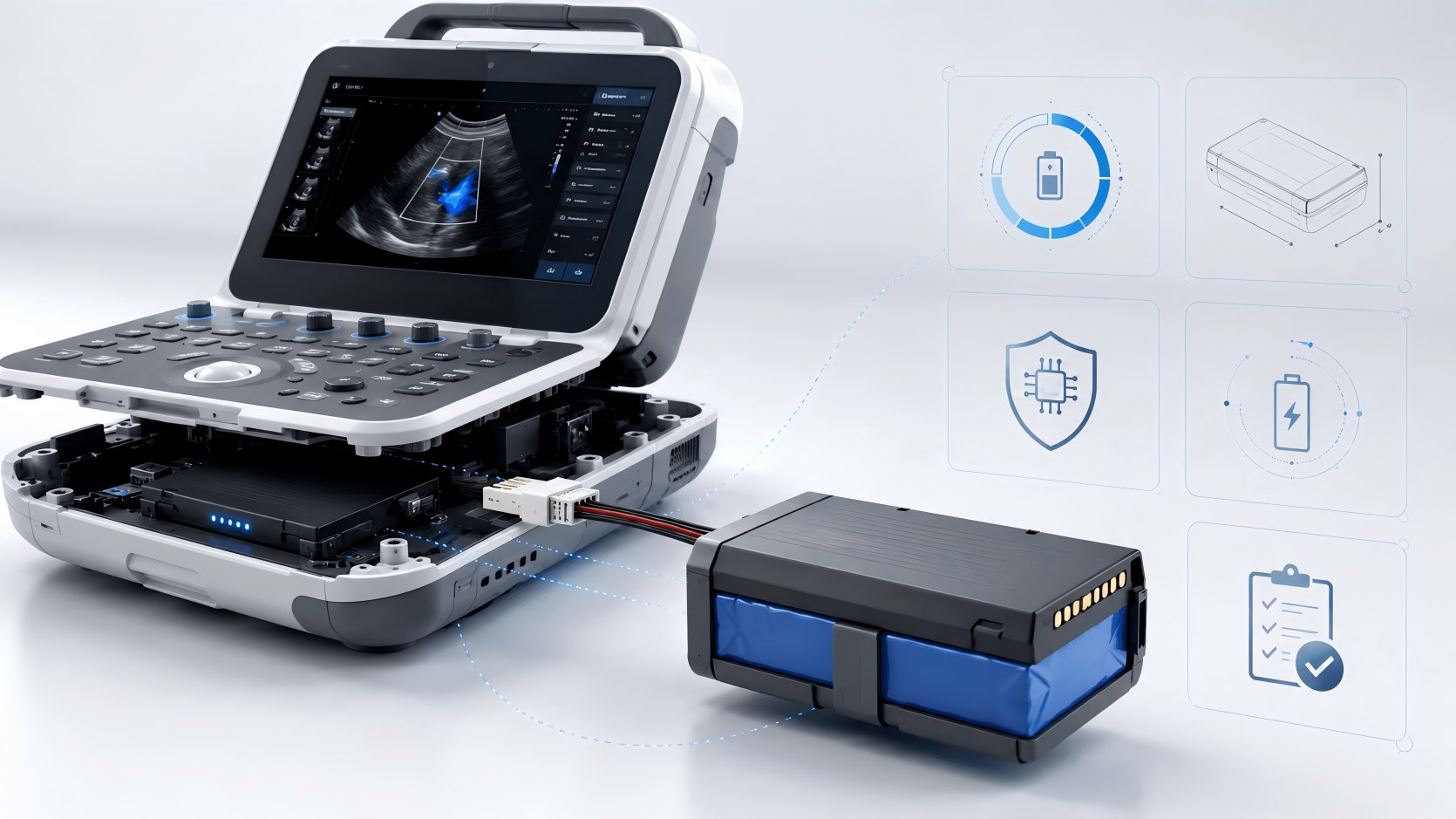
A portable diagnostic equipment battery pack must deliver stable runtime, consistent voltage output, compact form factor, safe charging and discharging under a robust BMS, and reliable long-term supply for OEM production. Voltage and capacity targets are only part of the specification. Devices used in hospitals, clinics, field testing, laboratories, and home healthcare demand more — thermal stability, protection circuit reliability, and a form factor that fits inside a defined enclosure without compromising device weight.
What a Portable Diagnostic Equipment Battery Must Deliver
The performance requirements for a portable diagnostic equipment battery pack go beyond basic energy storage:
- Stable runtime throughout full testing cycles, not just at the start of discharge
- Consistent voltage output across the discharge curve to avoid measurement drift
- Compact and lightweight structure to support ergonomic device design
- Safe charging and discharging with protection against thermal and electrical faults
- Reliable performance across hundreds to thousands of charge-discharge cycles
- Supply chain stability for OEM production, including consistent cell sourcing and BMS production
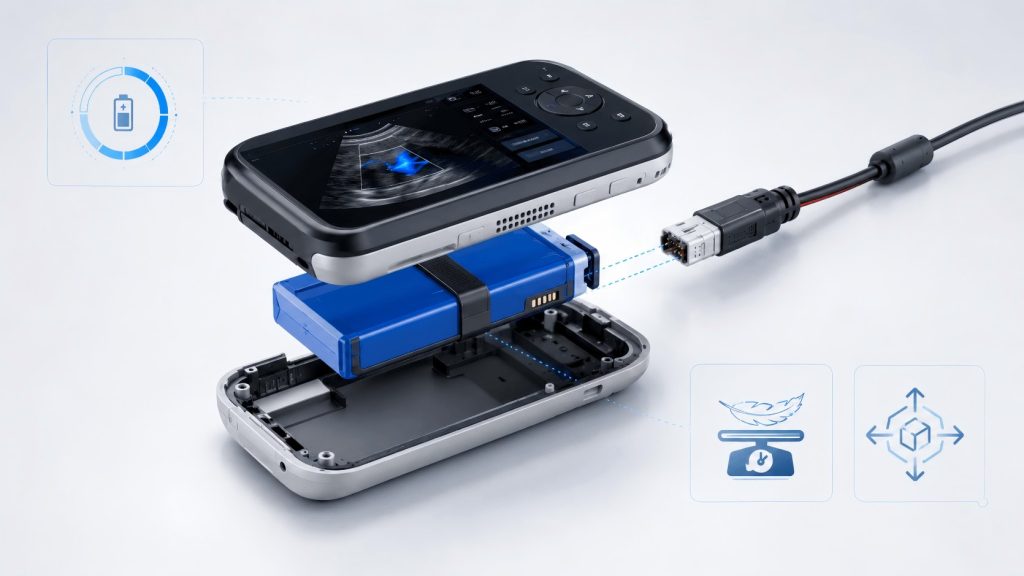
Key Design Factors for Custom Battery Packs
Each project starts with a set of electrical and mechanical parameters. Engineers and sourcing teams should define voltage and capacity configuration, continuous and peak discharge current, battery compartment dimensions, weight limits, charging method, operating temperature range, standby power consumption, and connector and cable requirements.
These factors together determine whether a standard cell format is viable or whether a custom cell layout is required.
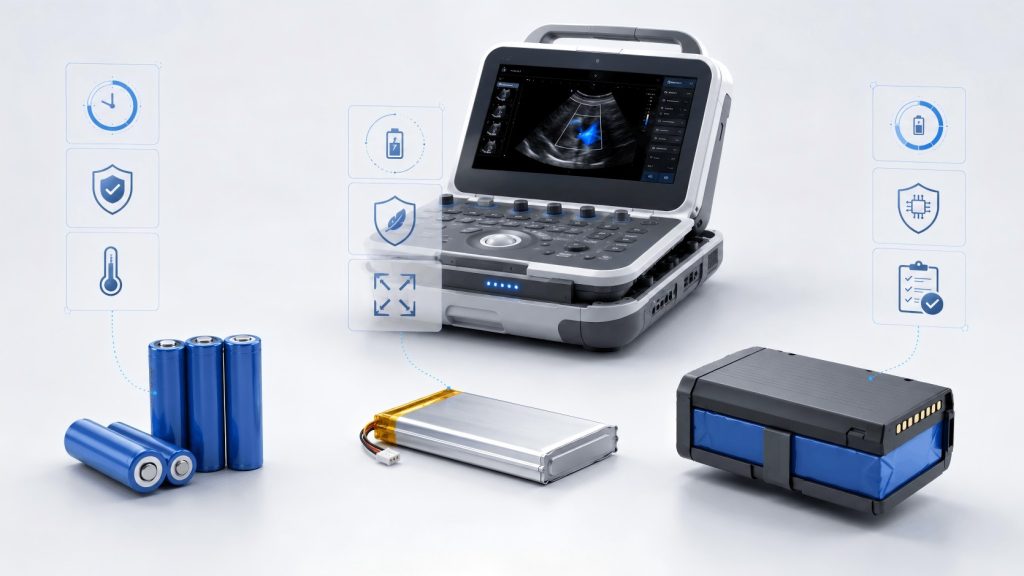
Lithium Cell Options for Portable Diagnostic Devices
| Cell type | Strengths | Typical use cases |
|---|---|---|
| Li-ion 18650 / 21700 |
High capacity Mature supply chain |
Standard enclosures, higher-capacity packs |
| Li-polymer (LiPo) |
Slim profile Flexible shape |
Slim or irregular housings |
| LiFePO4 |
Long cycle life High thermal stability |
Safety-critical or high-cycle applications |
No single cell type suits every application. The right choice for a lithium battery for portable diagnostic devices depends on enclosure size, runtime target, discharge load profile, safety classification, and production volume.
BMS and Safety Protection for Portable Diagnostic Equipment Battery Packs
The BMS is a core component of any rechargeable lithium battery pack for medical devices. It protects both the user and the device by managing electrical and thermal boundaries throughout charge and discharge.
A well-designed BMS for portable diagnostic applications should cover overcharge, over-discharge, overcurrent, and short-circuit protection. NTC temperature monitoring detects abnormal heat at the cell or board level. Cell balancing maintains equal voltage across cells in multi-series configurations. Where required, a fuel gauge function provides accurate state-of-charge reporting, and a communication interface — SMBus, I2C, or UART — enables data exchange with the host MCU.
BMS specifications must match the actual load profile of the device. A mismatch between protection parameters and real-world operating conditions is a common cause of field failures.
Certification and Testing Considerations
Applicable requirements vary by target market, distribution channel, and device classification. For a custom medical device battery pack, documentation and testing may include:
- UN38.3 for lithium battery transportation
- MSDS / SDS for shipping documentation
- IEC 62133 where applicable
- RoHS / REACH depending on customer or market requirements
Production testing typically covers cell incoming inspection, charge-discharge cycle testing, aging tests, protection board functional verification, and sample validation before mass production approval. Certification scope should be confirmed based on the device’s intended use and target market.
Information OEM Buyers Should Prepare
Having the following ready accelerates quotation and sample development:
- Nominal voltage and cutoff voltages
- Capacity (mAh) or runtime target at a defined load
- Maximum continuous current and peak current
- Battery compartment dimensions
- Operating and storage temperature range
- Charging method, voltage, and current
- Connector type and cable length
- Certification or documentation requirements
- Sample quantity, annual volume, and target schedule
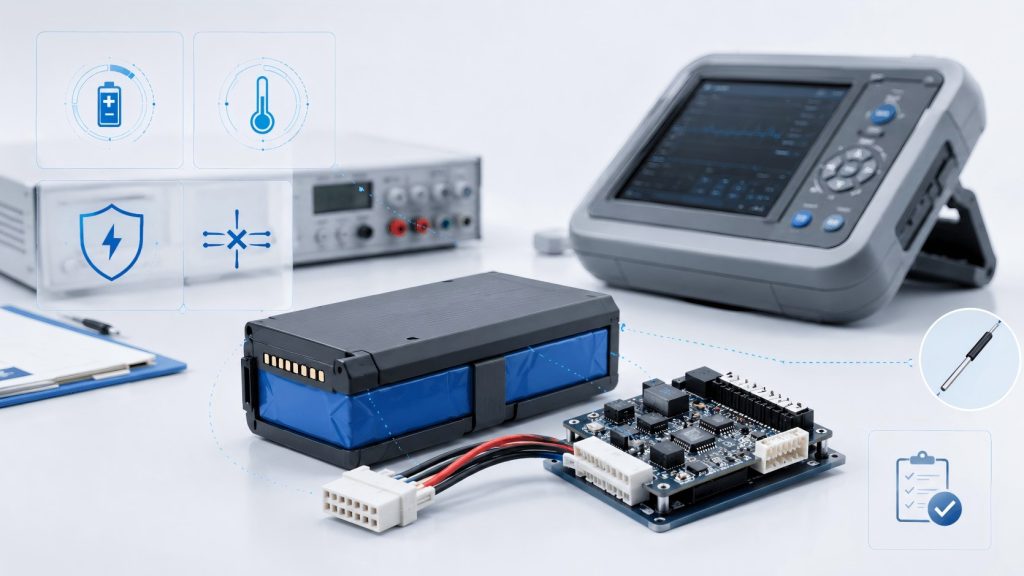
Custom Portable Diagnostic Equipment Battery Manufacturing
Zenilove supports the full development and production cycle for portable diagnostic equipment battery projects — from cell selection and BMS design to structural layout, sample development, testing, and mass production.
Contact Zenilove to discuss your portable diagnostic equipment battery requirements, including voltage, capacity, size, BMS protection, connector design, and certification needs.