
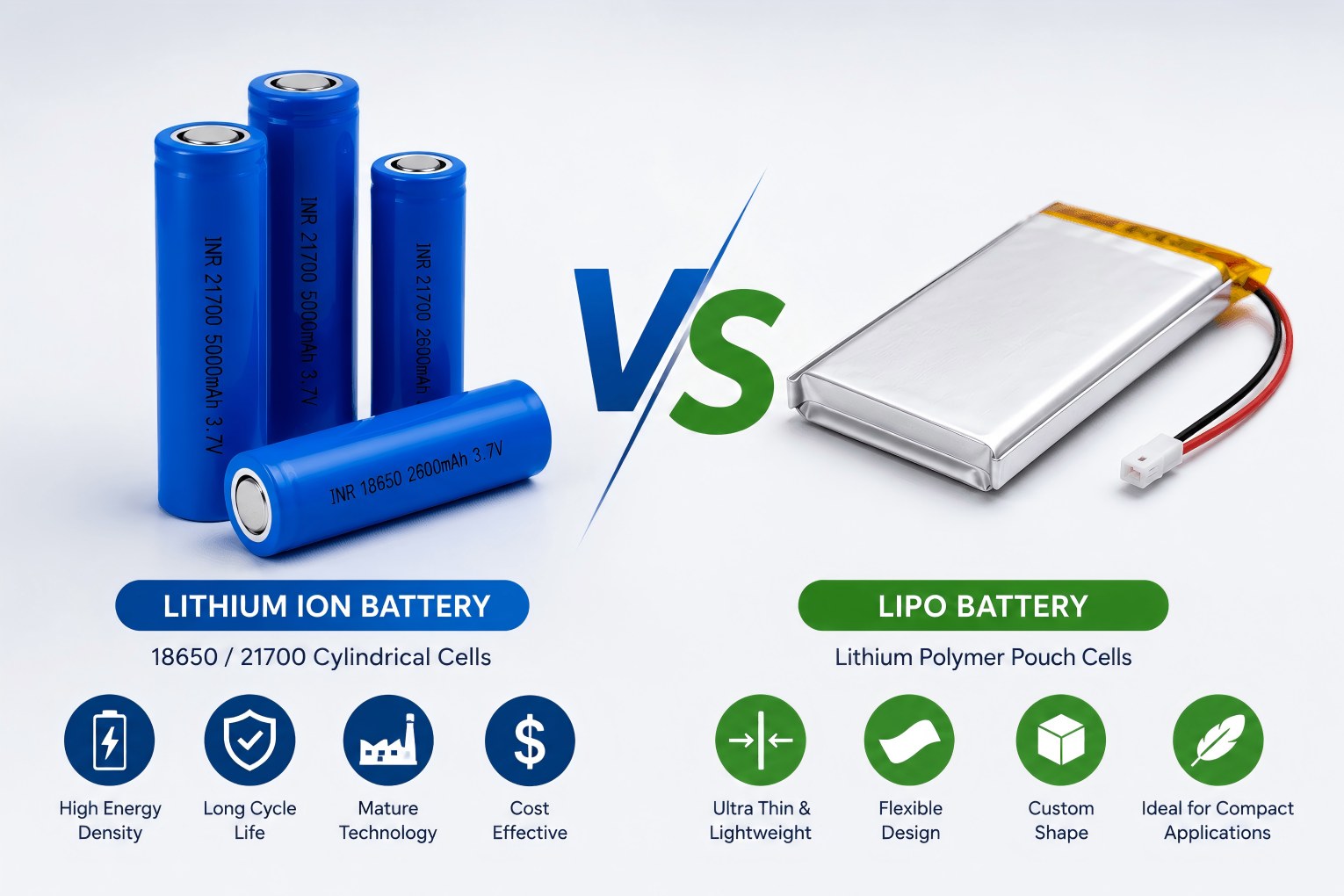
Choosing between lithium ion vs LiPo battery is not only about capacity or voltage. For engineers, product designers, and bulk buyers, the right choice depends on battery shape, cost, cycle life, safety, and supply stability.
Lithium ion batteries are commonly used in cylindrical formats such as 18650 and 21700 cells, while LiPo batteries are usually designed as thin pouch cells for compact or custom-shaped devices. This guide compares lithium ion vs LiPo battery options so you can choose the right power solution for your product.
What Are We Actually Comparing?
Lithium-ion and lithium polymer batteries both use rechargeable lithium-based chemistry. The core electrochemical process is similar lithium ions move between electrodes during charge and discharge. The difference comes down to the electrolyte and the form factor.
Lithium ion batteries use a liquid electrolyte sealed inside a rigid metal casing. The 18650 cell that cylindrical format you’ve seen in laptops, power tools, and EV battery packs is the most common example. The form factor is standardized, the manufacturing process is mature, and the global supply chain is deep. Browse our 18650 lithium ion battery catalog to see available specs and certifications.
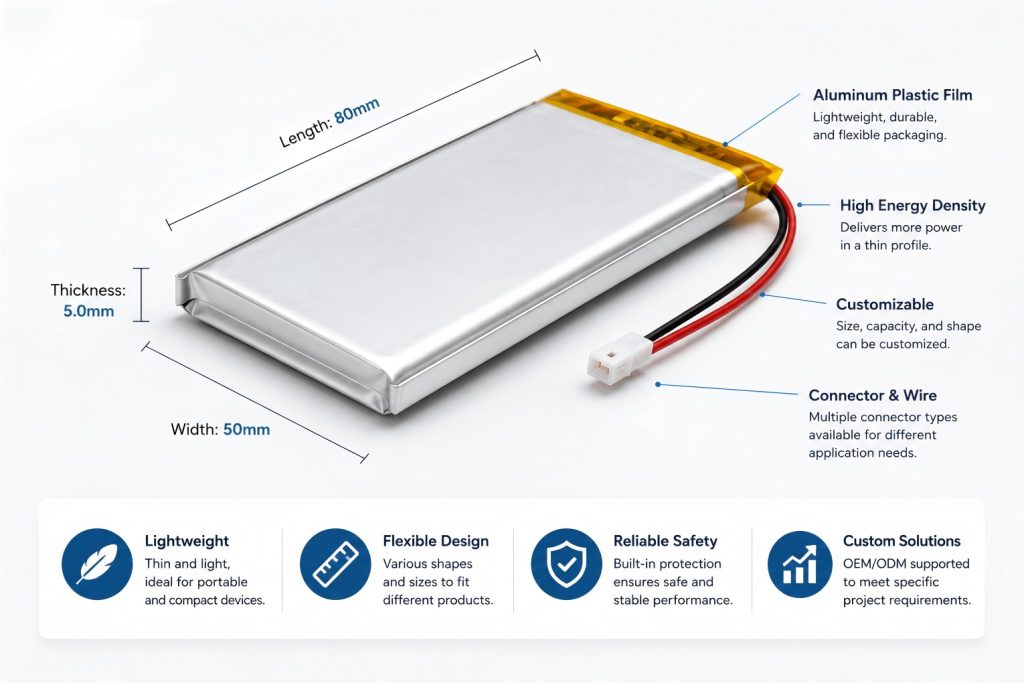
Lithium polymer batteries replace the liquid electrolyte with a gel or solid polymer. Manufacturers can produce it as a soft pouch, making it thinner, lighter, and available in almost any shape.You’ll find LiPo cells in smartphones, drones, and wearables anywhere weight and form factor are critical constraints.
Li ion vs LiPo Battery Comparison Table
The table below compares lithium ion vs LiPo battery options from a product development and procurement perspective.
| Criteria | Li-Ion Battery | LiPo Battery |
|---|---|---|
| Energy Density | Higher, typically 200–265 Wh/kg | Moderate, typically 100–200 Wh/kg |
| Form Factor | Fixed cylindrical formats such as 18650 or 21700 | Flexible pouch format for custom shapes |
| Unit Cost | Lower for standardized production | Higher when custom tooling is required |
| Cycle Life | Usually 500–1000+ cycles | Usually 300–500 cycles, depending on design |
| Safety | More stable structure with hard casing and mature BMS design | Needs careful swelling control and protection design |
| Supply Chain | Global, mature, and easier to scale | More customized, with longer lead times |
| Bulk Procurement | Easy to standardize, source, and scale | Custom specifications can make scaling more complex |
| Weight | Heavier because of the metal casing | Lighter for the same capacity target |
| Thickness | Limited by fixed cell diameter | Can be very thin, often below 5 mm |
When Lithium Ion Battery Is the Better Choice
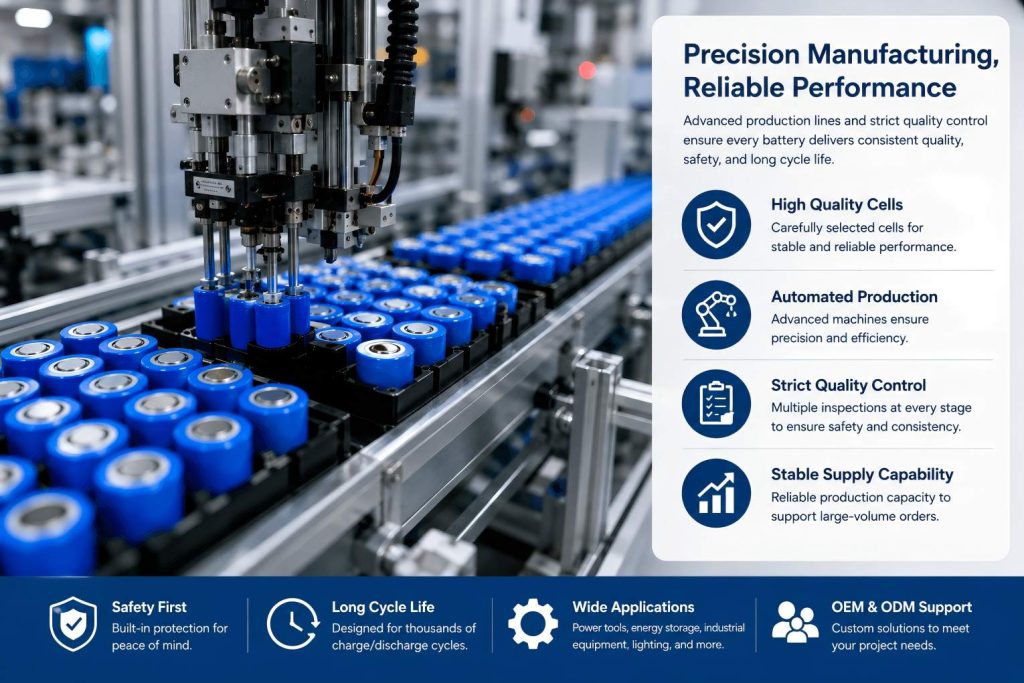
Lithium ion batteries are the more practical option for many industrial and commercial applications. Standard cylindrical formats such as the 18650 lithium ion battery and the 21700 lithium battery are produced at scale by established manufacturers worldwide. As a result, buyers usually get more predictable lead times, lower unit costs, and a more stable supply chain.
For products where form factor is not a major constraint, lithium ion cells offer consistent performance, well-understood thermal behavior, and broad compatibility with off-the-shelf battery management systems. These advantages make them a reliable fit for power tools, energy storage systems, industrial equipment, commercial lighting, and portable electronics.
However, lithium ion is not always the right answer. If your design requires a thin profile, a custom shape, or a very specific footprint, standard cylindrical or prismatic cells may not fit. But when the application allows a conventional form factor and production volume is a priority, lithium ion batteries are usually the lower-risk and lower-cost choice.
When LiPo Wins Over Lithium Ion
In certain real-world scenarios, lithium-polymer batteries are indeed the superior choice; however, turning a blind eye to alternative solutions will ultimately place you at a disadvantage.
If your product faces extremely stringent space constraints—such as in smart cards, ultra-thin wearable devices, or compact medical instruments—then the ability of lithium-polymer batteries to be custom-shaped to fit the contours of the circuit board becomes a highly valuable asset. This logic applies equally to the consumer drone sector, where even a single-gram increase or decrease in battery weight can directly impact flight endurance and handling performance.
If your product involves extremely low production volumes, and “performance per unit of weight” takes precedence over purely cost-driven considerations, then selecting lithium-polymer batteries constitutes a completely rational decision. High-end remote-controlled models and niche aerospace applications often fall into this category.
The Biggest Mistake When Choosing Lithium Ion vs LiPo
The most common error we see is choosing LiPo because it looks more “advanced” or because a competitor’s consumer product uses it. That logic rarely holds up in a B2B context.
LiPo’s advantages — thin profile, light weight, shape flexibility — are genuine. But if your product doesn’t specifically require those properties, you’re paying a premium for features you don’t need, while taking on supply chain complexity and a shorter cycle life.
The second mistake is underestimating LiPo’s lead times. Custom cell dimensions require tooling, and tooling takes time. If you’re under schedule pressure, this can push your product launch by weeks or months. 18650 cells, by contrast, are typically available off the shelf.According to IEEE Electrification Magazine, advances in lithium-ion technology continue to improve energy density and cycle life, reinforcing its position as the go-to chemistry for demanding applications.
3 Key Questions for Making a Decision
Before finalizing your choice of battery chemistry, consider the following three questions:
Does your product’s form factor require a non-standard shape or a thickness of less than 5 mm? If so, you may be required to use a lithium polymer battery; otherwise, the 18650 battery is the recommended first choice.
What is your annual production volume? If your annual output is fewer than 1,000 units, the cost of custom molds for lithium polymer batteries remains manageable; however, if the volume exceeds this figure, selecting standardized lithium-ion batteries offers greater economic advantages.
How many charge-discharge cycles is the battery expected to undergo within its actual operating environment? If your device requires daily charging, the differences in cycle life between various battery types will become quite apparent over the product’s typical 2-to-3-year lifespan.
Most industrial and commercial applications — energy storage, power tools, medical devices, robotics, fleet equipment,answer these questions in the same direction: Li-Ion, 18650 format. If you’re ready to move forward, get in touch with our team for a no-obligation spec consultation.
Final Recommendation for Lithium Ion vs LiPo Battery
When comparing lithium ion vs LiPo for your product, start with three factors: form factor, cost, and production volume. For industrial equipment, commercial devices, and high-volume products, lithium ion batteries are often more practical. They offer better cost control, broader supplier availability, and a mature manufacturing ecosystem.
LiPo batteries are better when the product has strict size or weight limits. They also work well when a device needs a custom battery shape or a slim enclosure. In these cases, standard cylindrical cells may not fit. LiPo’s form factor flexibility is its main advantage. It can justify the added cost and sourcing complexity in the right applications.
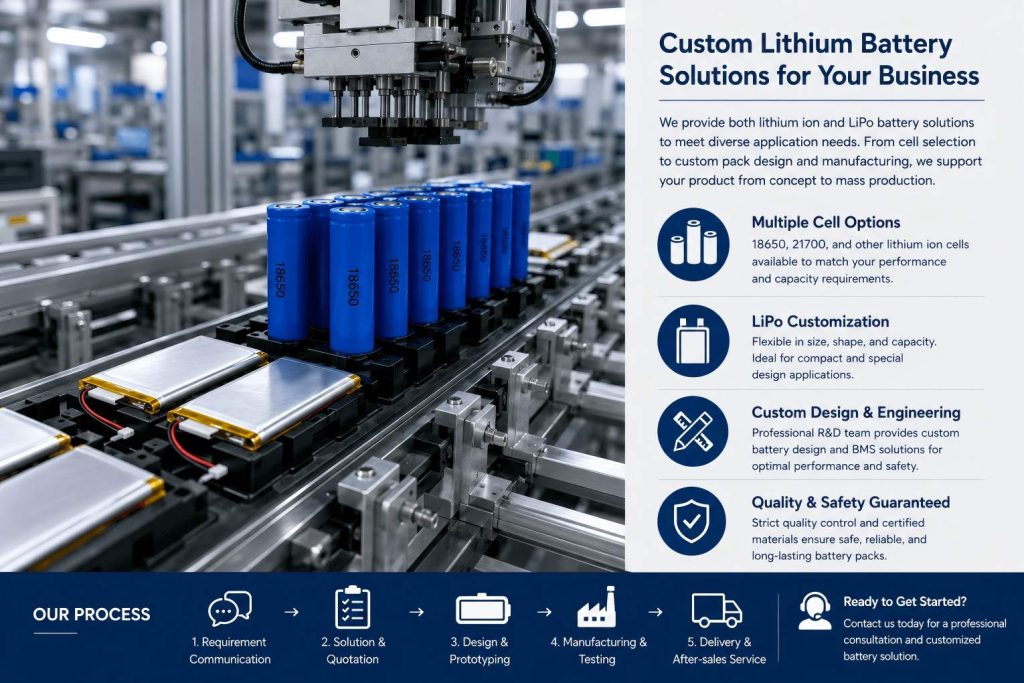
Before placing an order, compare all key requirements. These include physical dimensions, voltage, capacity, cycle life, safety certifications, production volume, and long-term supply continuity. If you need guidance on which battery type fits your product, contact a lithium battery manufacturer with experience in both formats. This helps you confirm the right solution before committing to a design.