
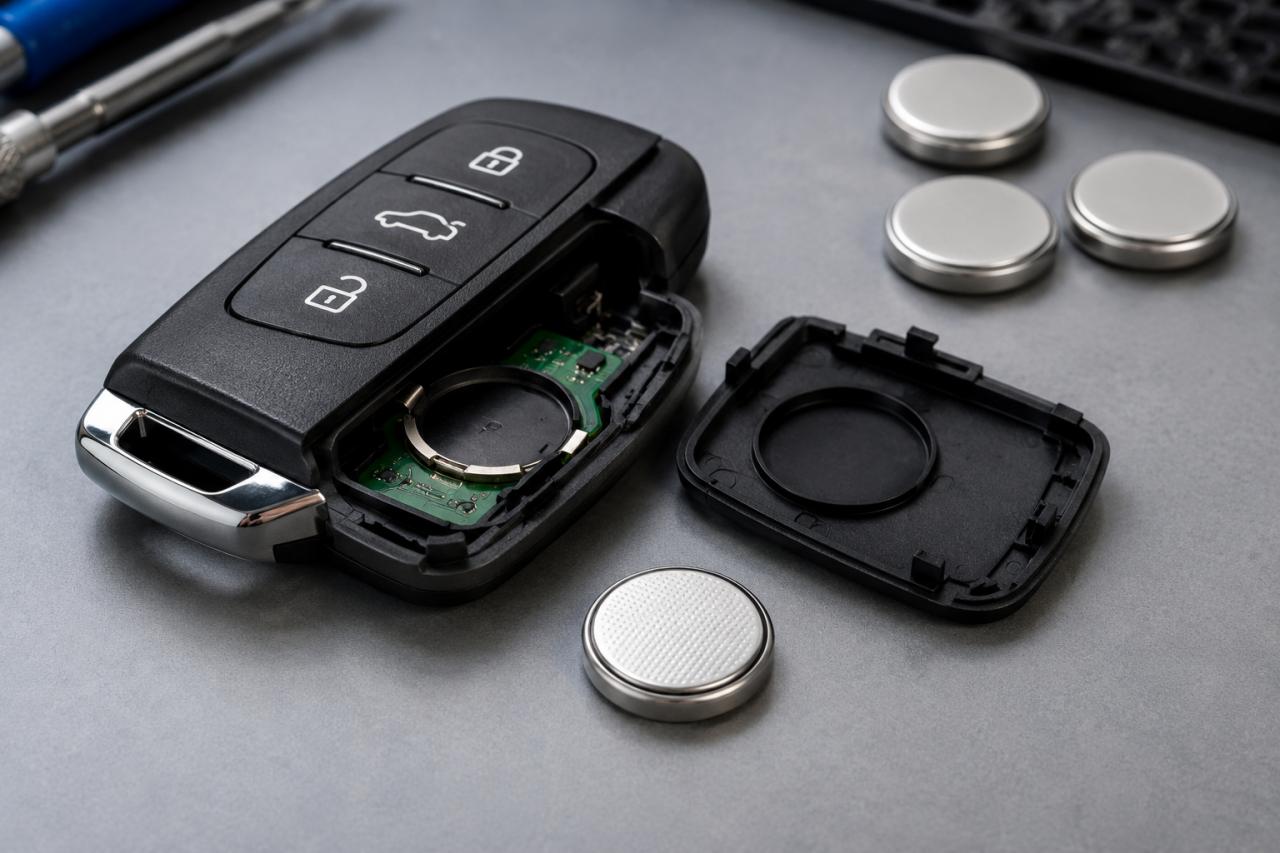
A single CR2032 failure shuts down a key fob completely. For automotive OEMs, aftermarket distributors, and procurement teams sourcing at volume, that’s not a product complaint — it’s a supply chain problem. Getting the spec right and the supplier right from the start is what prevents it. Here’s everything buyers need to know about the CR2032 battery for car key fob applications before placing a bulk order.
CR2032 Battery for Car Key Fob: Full Specifications
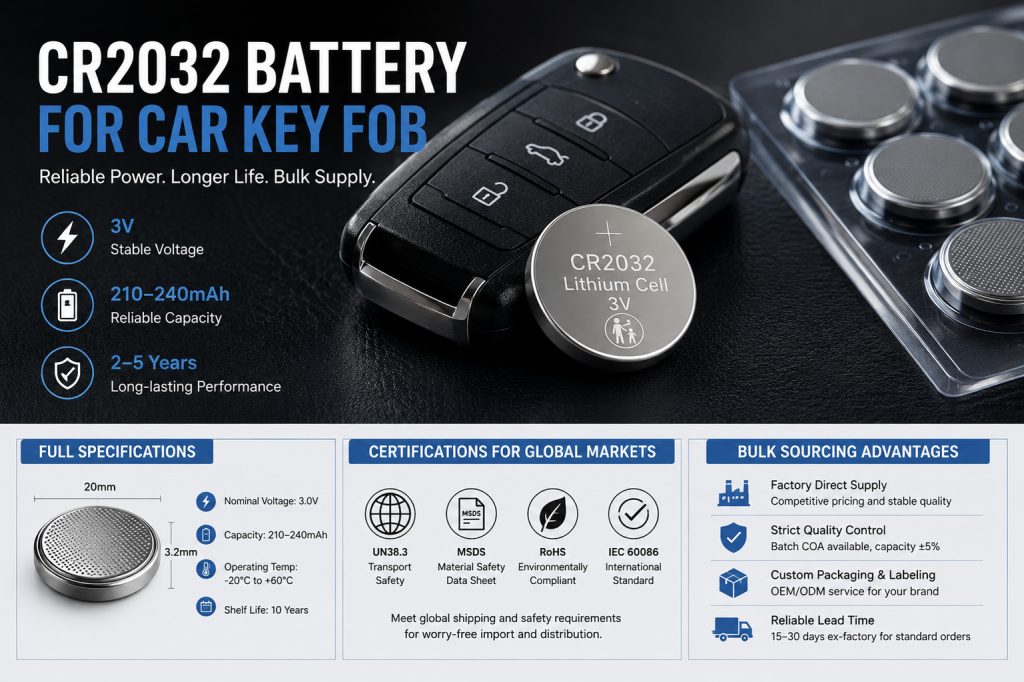
The CR2032 is a 3V lithium manganese dioxide coin cell — 20mm in diameter, 3.2mm thick, and weighing approximately 3 grams. That combination of compact size and stable voltage output is exactly why automotive engineers default to it for key fob design.
Voltage, Capacity, and Dimensions
Nominal voltage is 3.0V, with a cutoff voltage typically 2.0V for most key fob circuits. Rated capacity ranges from 210–240 mAh, depending on the manufacturer and cell grade. The IEC designation is CR2032, where “CR” indicates lithium manganese dioxide chemistry, “20” is the diameter in millimeters, and “32” refers to the thickness in tenths of a millimeter.
For procurement teams comparing alternatives: the CR2025 shares the same 20mm diameter but measures only 2.5mm thick and carries around 160–165mAh. It fits some CR2032 housings physically, but the lower capacity reduces the operational life by roughly 25–30%. That substitution creates field complaints. Avoid it in spec documents unless the device is explicitly rated for CR2025.
Operating Temperature and Shelf Life
Standard CR2032 cells operate between -20°C and +60°C, which covers the thermal range of automotive cabin and exterior environments in most markets. Shelf life for quality-grade cells is 10 years from the date of manufacture — that figure assumes storage at 20°C and 45–75% relative humidity. In practice, cells stored in uncontrolled warehouse environments should be tested before deployment if they have been held for more than 5 years.
Discharge Characteristics for Key Fob Applications
Key fobs draw current in short bursts — typically 1–15mA per press — with near-zero standby drain between uses. That pulse-discharge profile suits the CR2032’s chemistry well. Under normal usage patterns of 4–6 presses per day, a quality CR2032 delivers 2–5 years of in-use life in a standard key fob. Lower-grade cells with inflated capacity specs often fail within 12–18 months under the same conditions.

CR2032 Battery for Car Key Fob: Certifications for Global Markets
Bulk shipments of CR2032 batteries are classified as dangerous goods under international transport regulations. That means certification isn’t optional — it determines whether your shipment clears customs or gets held at port.
UN38.3 is the baseline requirement for air and sea freight of lithium batteries. It covers altitude simulation, thermal testing, vibration, shock, and short circuit tests. Any supplier offering bulk CR2032 without a current UN38.3 certificate is a compliance risk.
Most freight forwarders and destination customs authorities require MSDS (Material Safety Data Sheet). Buyers sourcing for markets in North America and the EU should also confirm RoHS compliance, which restricts the use of hazardous substances in electrical components. For automotive OEM applications specifically, some tier-1 suppliers also require IEC 60086 compliance — the international standard for primary batteries that covers performance and safety requirements.
Different destination markets carry different requirements. The EU demands RoHS and may require REACH documentation. North American markets typically require UN38.3 and MSDS as a minimum. Always confirm the full certification stack with your supplier before finalizing a purchase order.
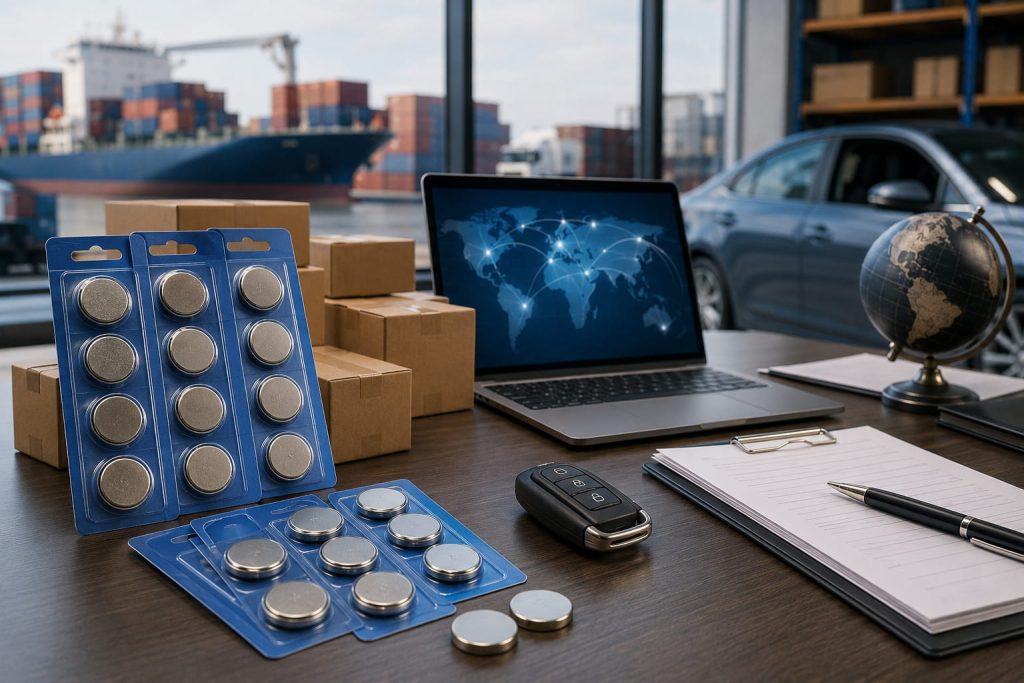
CR2032 Battery for Car Key Fob: Bulk Sourcing Guide
Bulk sourcing should start with supplier qualification, not unit price. Check production date, batch COA, packaging method, and export documents before ordering. Test samples first, then scale only when voltage, capacity, and labeling match the spec.
MOQ, Lead Time, and Consistency Control
Most factory-direct suppliers set MOQ at 3,000 pieces for standard CR2032 bulk orders, though this may vary by packaging type. Lead time for standard-grade cells typically runs 15 days ex-factory; custom-labeled or OEM-packaged orders may require additional time for printing setup and packaging confirmation.
Consistency is where bulk orders get complicated. Capacity variance across a single production batch should not exceed ±5%. Request a Certificate of Analysis (COA) for each batch — it should document the actual measured capacity, internal resistance, and open-circuit voltage. Suppliers who cannot provide batch-level COAs are a red flag for quality control.
Packaging and OEM Labeling Options
Standard bulk packaging comes in a bulk tray, a blister card, or a retail-ready option. For automotive aftermarket supply, individual blister packaging with brand labeling is common. OEM orders typically require custom-printed packaging with part numbers, lot codes, and expiry dates aligned to the vehicle manufacturer’s documentation standards.
Confirm minimum order quantities for custom packaging separately — they often differ from the cell MOQ and can significantly affect unit economics on smaller runs.
Spotting Capacity Misrepresentation
Capacity inflation is a real issue in the coin cell supply chain. Some suppliers list 240mAh on packaging while shipping cells that test at 180–190mAh under standard load. The test to request: IEC 60086 discharge test at 15 kΩ load, to 2.0V cutoff, at 20°C. That result is the number that matters for real-world key fob performance — not the figure on a product sheet.
Choosing a CR2032 Battery for Car Key Fob Supply: What Manufacturers Must Prove
Factory-direct sourcing eliminates the middleman margin and gives procurement teams direct access to production data. That said, not every factory producing CR2032 cells has the process controls required for automotive-grade supply.
When evaluating a manufacturer, request the following before committing to a trial order: UN38.3 certification dated within the past 3 years, batch COA samples from recent production runs, and a sample order of at least 500 pieces for in-house testing. Run those samples against the IEC discharge test and check actual capacity against the stated spec.
Lead time reliability matters as much as cell quality. Ask for on-time delivery records from existing customers — a factory with strong QC but poor scheduling creates a different kind of supply chain risk.
For automotive OEM and aftermarket buyers sourcing CR2032 batteries for car key fob applications at volume, the right manufacturer combines certified products, transparent quality documentation, and flexible packaging capabilities. Those three criteria, applied consistently at the shortlisting stage, filter out most of the risk before a single order is placed.