

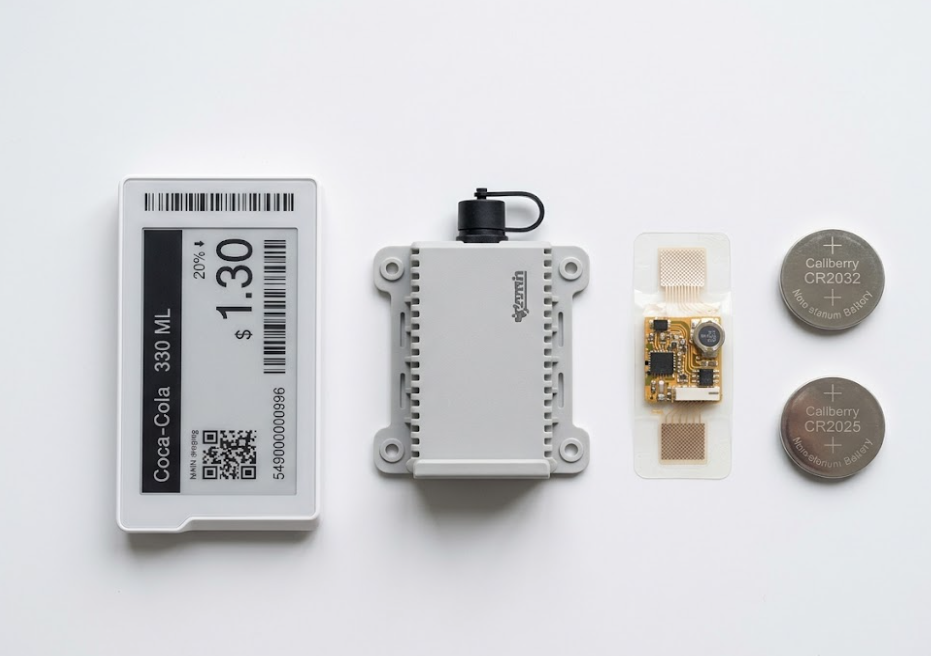
The CR2025 and CR2032 share the same 20mm diameter and 3V lithium manganese dioxide chemistry — but the 0.7mm thickness difference (2.5mm vs. 3.2mm) and capacity gap (~165mAh vs. ~225mAh) determine everything. For ultra-thin wearables and disposable medical patches, CR2025 wins on form factor. For BLE-connected ESLs and active RFID, CR2032 wins on energy budget.

CR2025 vs CR2032: Electrochemistry, Energy Density, and Pulse Discharge
Both cells use lithium manganese dioxide (Li-MnO₂) chemistry, delivering a stable 3V nominal voltage, a flat discharge curve, and a 10-year shelf life. In practice, however, the physical volume difference drives every performance distinction that matters to a hardware engineer.
| Specification | CR2025 | CR2032 |
|---|---|---|
| Diameter | 20.0 mm | 20.0 mm |
| Thickness | 2.5 mm (Ultra-slim) | 3.2 mm (Standard) |
| Typical Capacity | ~160-170 mAh | ~220-235 mAh |
| Ideal B2B Applications | Ultra-thin remotes, compact medical patches | Electronic Shelf Labels (ESL), Smart Tracking Tags |
How the 0.7mm Thickness Difference Drives Energy Density
Coin cell capacity scales directly with the volume of active electrode material. Specifically, the CR2032’s additional 0.7mm translates to approximately 36% more active cathode and anode material by volume. As a result, the capacity advantage — roughly 225 mAh versus 165 mAh — is a direct consequence of geometry, not chemistry.
For a device drawing 10µA continuously, that difference extends operational life from approximately 1.9 years on a CR2025 to 2.6 years on a CR2032. In other words, the 0.7mm delta is worth roughly nine months of additional field life at low drain rates. Furthermore, the CR2032’s larger electrode stack produces lower internal resistance — typically 15–25Ω versus 20–35Ω for the CR2025. Consequently, the CR2032 maintains higher terminal voltage under load, which is critical for RF transmission events.
Pulse Discharge Characteristics: BLE, LoRa, and NFC Transmission Events
Wireless transmission is the most demanding load condition a coin cell encounters. A BLE advertisement event draws 10–15mA for 1–3 milliseconds. Under a 15mA pulse load, the CR2032 maintains terminal voltage above 2.7V — the typical minimum for BLE SoCs such as the Nordic nRF52 series. By contrast, the CR2025 under the same condition drops to approximately 2.5–2.6V, which is within 100–200mV of the brownout threshold for many low-power microcontrollers.
Therefore, any design using peak currents above 10mA in a temperature-variable environment should default to CR2032 unless PCB thickness constraints make it impossible. Additionally, pulse performance degrades as the cell discharges — at 50% state of charge, internal resistance increases by 30–50% in both types. In turn, the CR2032’s larger electrode area partially compensates, sustaining pulse performance later into the discharge cycle.
CR2025 vs CR2032: Application Selection Based on PCB Design Constraints
Choosing between CR2025 and CR2032 is a systems engineering decision. In addition to energy budget, PCB stack height, holder geometry, and operating environment all constrain the selection.
When to use CR2025
The CR2025 is the correct choice when total device thickness is the primary constraint and peak current remains below 5mA.
Ultra-thin wearables — continuous glucose monitors, NFC-enabled patient wristbands, and skin-contact biosensors — typically target total device thickness below 6mm. In these designs, the 2.5mm CR2025 profile allows the remaining 3.5mm for PCB, encapsulation, and cover layer. Moreover, for disposable medical patches worn for 72–96 hours, 165mAh is more than sufficient at microamp-level drain. At those volumes, the CR2025’s lower per-unit cost in bulk procurement also becomes a meaningful factor in device economics.
When to use CR2032
The CR2032 is the correct choice for any device where peak current exceeds 5mA, operating temperature drops below 0°C, or service life must exceed two years without replacement.
Electronic Shelf Labels are the clearest example. A typical ESL updates its e-ink display via sub-GHz radio every few minutes, drawing 8–12mA per update event. Over a five-year deployment, both the energy budget and pulse performance requirement point unambiguously to CR2032. Similarly, smart tracking tags using BLE at 10 advertisements per second generate recurring 15mA peaks — a load profile that depletes a CR2025 in under 12 months. By contrast, a CR2032 sustains the same load for 18–24 months. Active RFID nodes and smart home sensors share the same profile: infrequent but high-peak transmission events over multi-year deployments, making CR2032 the only appropriate specification.
FAQ:Are CR2025 and CR2032 physically interchangeable in the same battery holder?
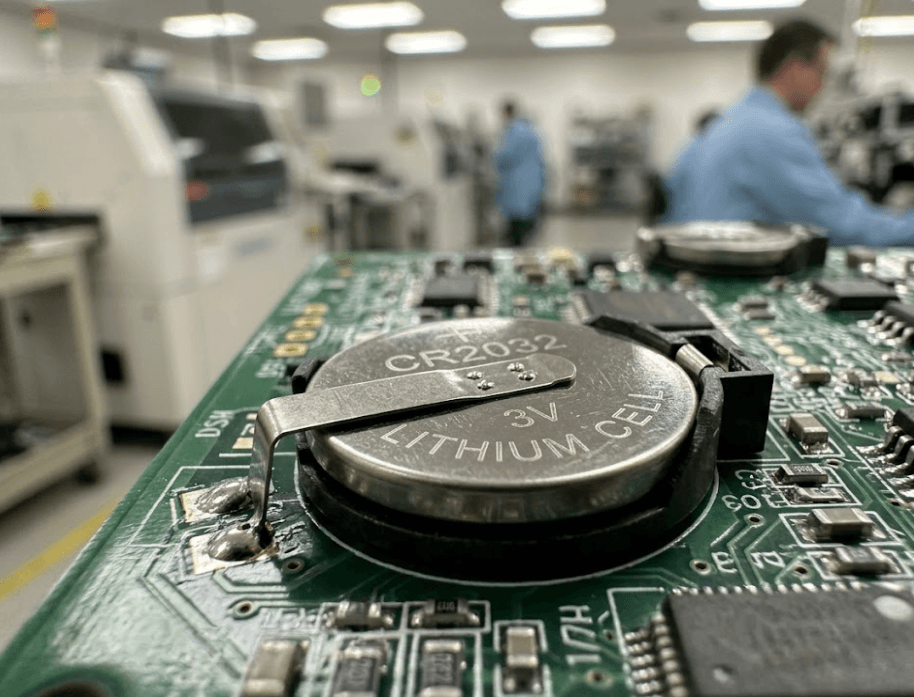
No. The 0.7mm thickness difference means a CR2025 sits loose in a CR2032 holder, producing intermittent contact under vibration. Conversely, a CR2032 will not seat in a CR2025-spec holder without mechanical interference. Therefore, the holder specification must match the cell exactly.
How does temperature affect CR2025 vs CR2032 performance differently?
Both cells use the same Li-MnO₂ chemistry, so temperature response curves are similar in shape. However, the CR2032’s lower internal resistance means a smaller absolute voltage drop under pulse load at low temperature. At −20°C, a CR2032 retains approximately 80% of rated capacity versus 75–78% for the CR2025 — a meaningful difference for cold-chain or outdoor deployments.