
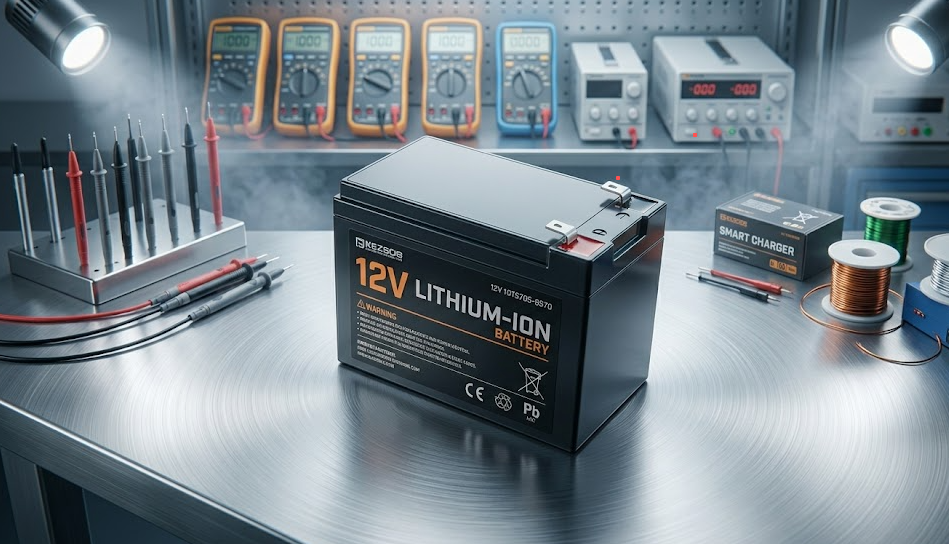
12V rechargeable battery technology is currently being widely adopted across a diverse range of industries; yet, when undertaking large-scale selection and specification planning, which factors are truly paramount?
Today, within most industrial facilities, you will find 12V lithium batteries quietly shouldering a multitude of routine yet indispensable responsibilities. They sustain the continuous operation of AGVs (Automated Guided Vehicles) during shift changes; store solar energy that might otherwise go to waste; or sit ready within UPS (Uninterruptible Power Supply) cabinets. It is often not until the moment of a sudden power outage that their existence and their true value is fully realized.
The reason this specific battery configuration has become so ubiquitous is, in fact, quite simple and intuitive: its voltage parameters align perfectly with the lead-acid battery systems that the industrial sector has relied upon for decades. They feature identical terminals and the same nominal voltage, yet represent a qualitative leap forward in terms of performance and all other key metrics. We invite you to browse our 12V lithium battery product catalog to review detailed product specifications and relevant certification information.

Why 12V Rechargeable Battery Technology Replaced Lead-Acid in Most Applications
Lead-acid batteries have a few things going for them: they’re cheap upfront, widely available, and well understood. But run the numbers over a three-year operating cycle and the economics flip fast. A lithium 12V battery typically delivers two to three times the cycle life, charges in roughly half the time, and weighs 60–70% less. For equipment running multiple shifts, that weight difference alone changes the conversation about operator fatigue and vehicle payload.
The deeper advantage is voltage stability. Lead-acid voltage drops off steadily as the battery discharges. Lithium holds a flat curve until it’s nearly empty. For sensitive equipment — medical devices, precision industrial tools, network gear — that stability matters more than headline capacity numbers.
Beyond performance, lithium packs scale in ways lead-acid can’t. Cells connect in series or parallel inside a managed pack, and a well-designed BMS (battery management system) handles cell balancing, thermal protection, and charge cutoff automatically. That predictability is what industrial buyers are actually paying for.

12V Rechargeable Battery in Action: Five Industries, Five Different Requirements
The 12V format is the same across applications. The specifications inside it are not. Here’s where the requirements actually diverge.
Solar Energy Storage
Off-grid and hybrid solar installations put more cumulative stress on a battery than almost any other application. A system charging and discharging daily will hit 300+ cycles per year. Run that math on a 500-cycle cell and you’re replacing it in 18 months. LFP (lithium iron phosphate) chemistry is the standard choice here — according to NREL’s 2024 Annual Technology Baseline, LFP has become the primary chemistry for stationary storage, offering 2,000 to 4,000 cycles with stable thermal performance.
Electric Vehicles and AGVs
Fleet operators care about two numbers: time to full charge and cycles before replacement. A warehouse AGV running two shifts needs to recharge fast during the changeover window. Cells with high C-rate ratings handle that load without degrading prematurely. BMS integration is non-negotiable here — a pack failure mid-shift is an operational problem, not just a maintenance issue.
Industrial Equipment
Power tools, floor scrubbers, portable test equipment — the 12V lithium advantage here is mostly about weight and runtime. Shaving two kilograms off a handheld tool matters over an eight-hour shift. What’s less obvious is the temperature requirement: factory floors near kilns, compressors, or outdoor loading docks can push cells outside their rated range. Spec for the environment, not the catalog.
Medical Devices
This is where the certification conversation becomes the whole conversation. Infusion pumps, portable monitors, and imaging systems require UL, IEC 62133, and often additional market-specific certifications before they can ship. The battery supplier’s documentation package needs to be complete before the product design is locked — retrofitting certifications after the fact is expensive and slow.
Telecom and Backup Power
Base stations and UPS systems sit idle most of the time and need to perform reliably when called on — sometimes after months of standby. Low self-discharge and wide operating temperature range (many outdoor installations see -20°C to 55°C) are the critical specs. Cycle life matters less here than in solar; calendar life and storage performance matter more.

How to Specify the Right 12V Rechargeable Battery for Your Operation
Before requesting quotes, consider these three factors:
Cycle frequency determines chemistry. Daily cycling applications need LFP chemistry with 2,000+ cycle ratings. Lower-frequency applications can use standard lithium-ion cells at a lower cost, with no need to over-specify.
Peak discharge requirements define the C-rate. High-power applications such as AGVs and power tools require high-C-rate cells and robust BMS integration. Standby and backup applications prioritize energy density and low self-discharge over raw discharge speed.
End-market certifications narrow your supplier list. Medical, telecom, and certain industrial applications have mandatory certification requirements, such as UL, CE, UN38.3, and others. Clarifying this upfront determines which suppliers are qualified to bid and saves time on both sides.
一开始就制定正确的规格无需任何成本。而规格错误则会导致现场故障、保修索赔和过早更换。如果您希望根据您的具体应用和产量获得建议,我们的团队将竭诚为您服务。